

Key takeaways
- Recall quizzes confirm fundamentals but reveal little about operational judgment.
- A profitability model makes assumptions, trade-offs and gaps in reasoning visible.
- Microlearning prepares learners for a larger scenario-based performance task.
- The finished artifact supports feedback, certification and targeted follow-up learning.
- The pattern transfers to custody, treasury and Lightning operations.
Today, September 24, 2026, the Bitcoin Mining Academy — Helsinki Edition uses a stronger output than a final quiz. In its full-day, 30-seat workshop, participants build and defend a mining profitability model. The published program moves from proof-of-work, difficulty and pool payouts through site viability, Nordic power markets, treasury and financing. That sequence offers a useful pattern for Bitcoin product education. This is an event-design example, not a controlled effectiveness study. Its value lies in the assessment design.
Quizzes Stop at Recognition
A quiz can establish whether someone recognizes a definition or recalls that difficulty affects expected mining revenue. That is useful groundwork. It does not show whether they can select hardware, model power consumption, choose a payout assumption, identify missing data or explain why a marginal site should not proceed.
Operational competence appears when learners must combine variables under constraints. Authentic assessment is designed for this kind of work: learners construct a response to an ambiguous scenario rather than select from pre-written options. The assessment captures their reasoning, not only the answer they chose.
Mining Economics Creates Productive Friction
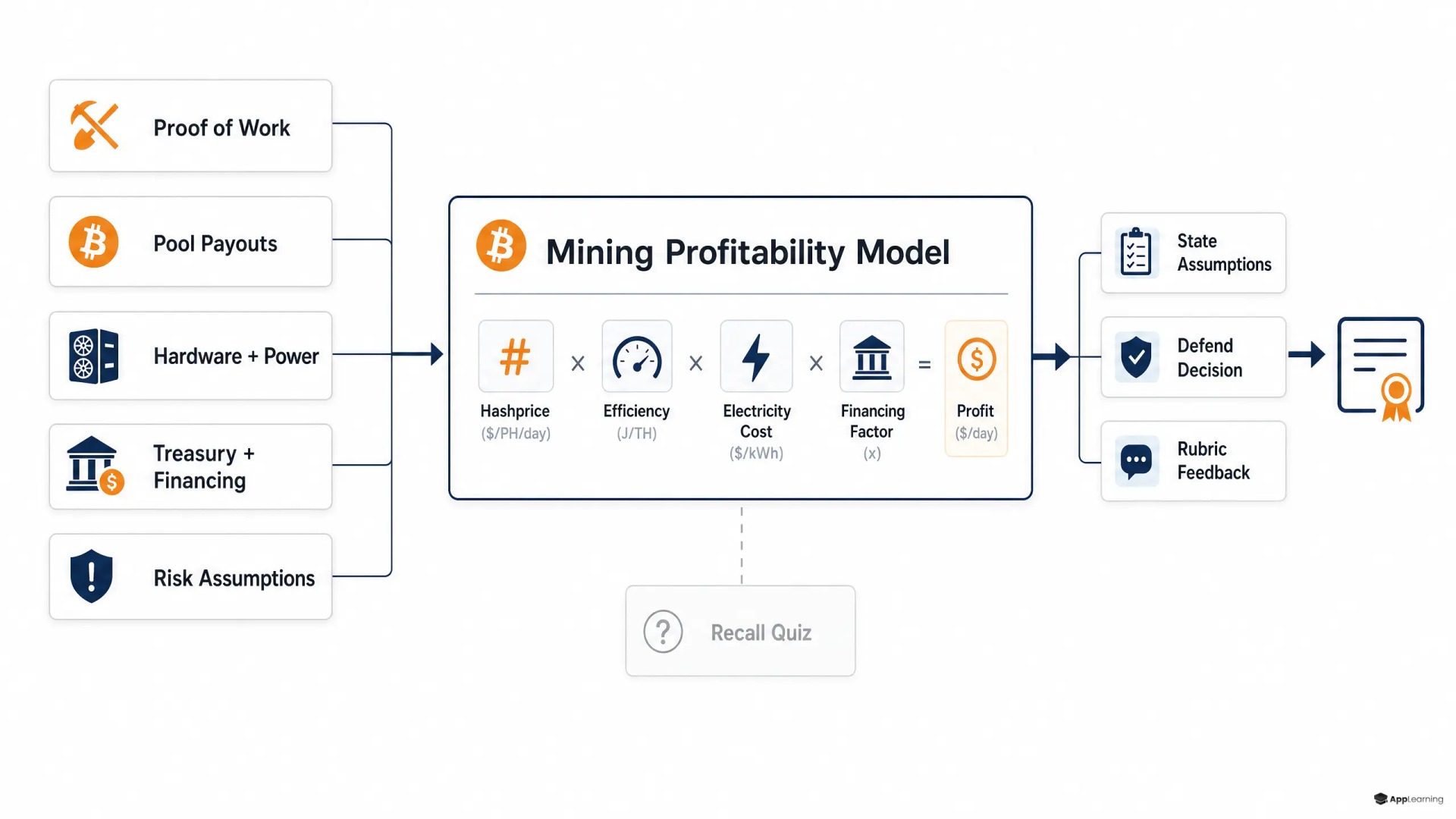
Mining profitability training is a strong case because no single input decides the result. Hashrate, network difficulty, machine efficiency, power cost, uptime, pool fees, payout structure, capital cost and treasury policy interact. Change one assumption and the economics can move quickly. A credible model therefore requires both calculation and judgment.
Pool design adds another operational layer. In pooled mining, shares provide evidence of contributed work and pools distribute proceeds according to their payout systems. A learner who can explain the difference between expected revenue and the timing or variance of payouts is showing a more useful level of applied Bitcoin learning than one who merely recognizes an acronym.
Microlearning Builds the Input Layer
The answer is not to replace short learning units with one large spreadsheet exercise. Microlearning remains the input layer. It should prepare learners to make the final decision without overwhelming them on a mobile screen.
- Short concept cards introduce hashrate, difficulty, hashprice, joules per terahash, uptime and pool payouts.
- Estimation exercises ask learners to predict which variable will have the greatest effect before calculating it.
- A scenario supplies real hardware, power and operating inputs while leaving important assumptions open.
- Branching feedback explains the consequence of an unrealistic assumption instead of only marking it wrong.
Assumptions Must Be Visible
A model is valuable because it exposes the choices hidden behind a headline profitability number. Learners should enter their own electricity price, uptime target, difficulty-growth case, hardware purchase cost, financing terms and treasury policy. They should then explain which assumptions are most sensitive and what evidence would change their decision.
This is where scenario-based crypto education becomes useful for a product lead. The system can distinguish a learner who copied a favorable return figure from one who understands downside risk, cash requirements and the limits of the available data. It also gives the learner a safer way to practise judgment before they act on a real product decision.
Good to know
Should quizzes disappear from a Bitcoin academy?
No. Use quizzes to check foundational knowledge and direct learners to gaps. Do not treat them as the only proof of applied competence.
Does the final task need a full spreadsheet?
No. A structured mobile scenario can collect assumptions, guide calculations and capture a written rationale without recreating a desktop financial model.
How can a product team assess submissions at scale?
Use a clear rubric, automated checks for required inputs and targeted feedback paths. Reserve human review for high-stakes certificates or complex submissions.
The Model Becomes the Assessment
The final submission should include the model, key assumptions, recommendation and rationale. A simple rubric can assess calculation integrity, completeness of assumptions, sensitivity analysis and decision quality. Feedback should point to the missing concept or weak assumption, then route the learner to a targeted refresher rather than forcing a full course restart.
For a digital Bitcoin academy, App-Learning can turn this workshop pattern into a mobile-first learning flow: compact cards and practice tasks feed a final model-and-rationale submission. The resulting artifact supports human review where needed, rubric-based certificates, learning analytics and follow-up modules that address the precise gap.
Build assessment evidence into your Bitcoin learning experience.
DiscussThe Pattern Extends Beyond Mining
The same structure applies across Bitcoin operations. A treasury learner can recommend an allocation policy under drawdown and liquidity constraints. A custody learner can design an approval flow for a specific threat model. A Lightning learner can decide how to rebalance channels for a stated payment pattern. Each task should require inputs, assumptions, trade-offs and a defensible recommendation.
That is the practical shift for Bitcoin mining education and beyond. Teach the concepts in small, accessible units, but ask learners to produce something that resembles the decision the job or product journey demands. A quiz records recognition. A model records judgment, and judgment is the evidence that enables better feedback, more credible certification and more confident action.