

Key takeaways
- Product documentation and curriculum serve different operational jobs.
- Accurate source material still needs audience filtering and instructional structure.
- Separate general financial concepts from company-specific product behavior.
- Subject-matter review catches missing concepts and temporary language.
- Keep the detail learners need for decisions, not every implementation detail.
Two systems with different jobs
A product specification helps teams build, launch, maintain, and troubleshoot a product. It needs edge cases, dependencies, system states, release constraints, and implementation detail. A curriculum helps a specific person make sound decisions in a specific context. It needs a clear sequence, relevant terminology, worked situations, practice, and evidence that the learner understands the task.
That difference matters in fintech product training. A learner who needs to explain a pending transfer, choose the right onboarding step, or understand a Bitcoin-related feature does not need the full history of every API decision. They need enough detail to recognise the situation, apply the right rule, and know where the boundary lies. The move from product documentation to training is therefore a design task, not a copy-and-paste task.
A PRD to course conversion fails when it treats completeness as the goal. It produces long lessons that mirror internal navigation, expose details with no decision value, and leave core concepts unexplained. The result may be technically correct but operationally weak.
Truth needs an owner before it needs a lesson
Start with the authoritative source. For a live product, this is rarely one document. It may include the current specification, approved product screens, policy rules, support guidance, release notes, and a product owner who can resolve conflicts. Name the owner for each source and record the version used. Otherwise, the learning layer becomes a second, ungoverned version of the product.
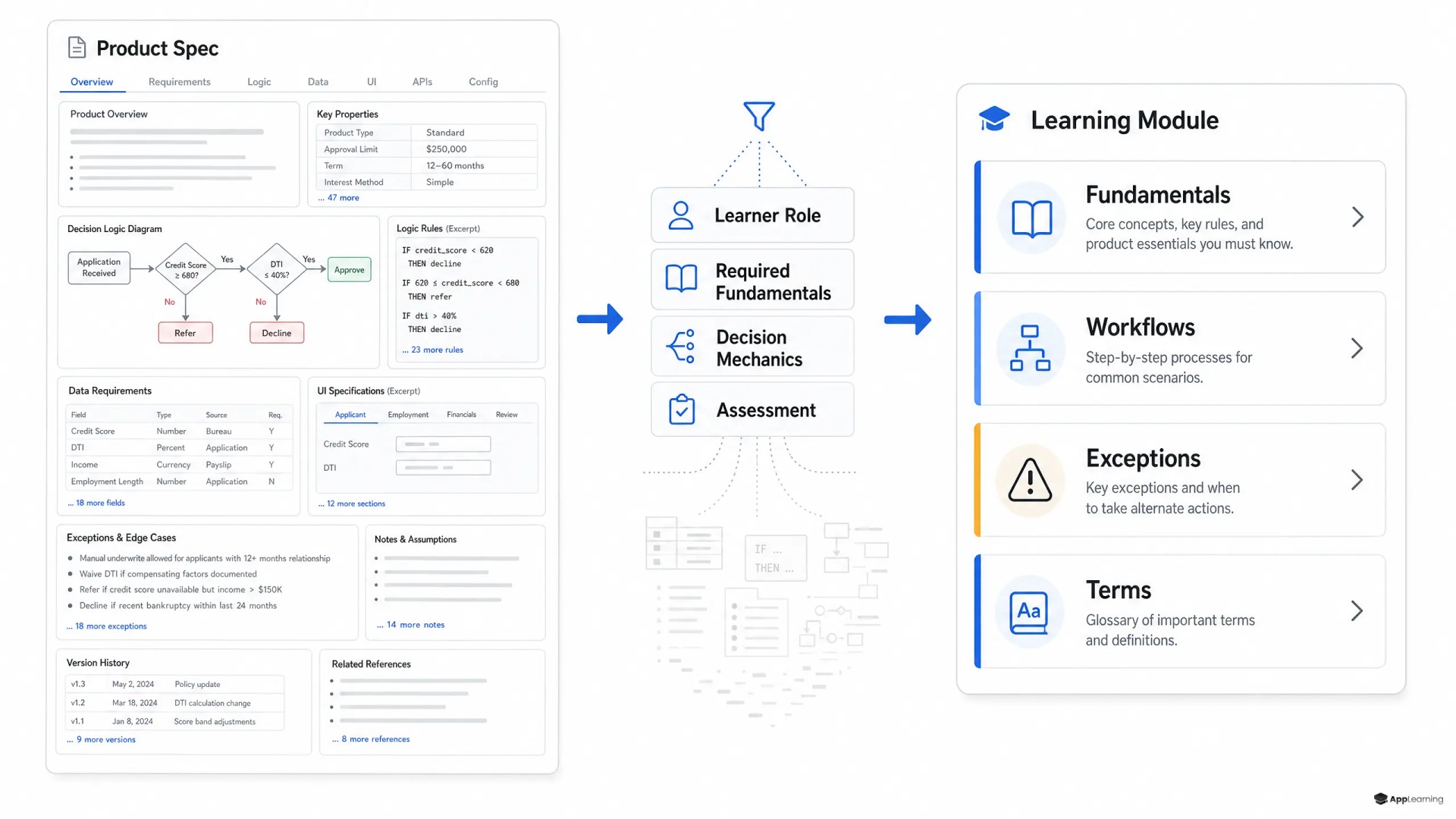
Screenshots help, but they are evidence rather than curriculum. They show what a learner will encounter. They do not explain what to notice, which action matters, or what changes in an exception. Product education design begins by extracting those decisions from the source material.
Relevance is the filter that protects attention
The target role determines what survives the filter. Instructional design should account for prior knowledge: research on the expertise reversal effect shows that support useful to novices can become redundant for more experienced learners. A single product document cannot make that choice. A curriculum must.
For every source element, ask four practical questions before adding it to a module:
- Does this change a decision the target learner must make?
- Will the learner encounter this workflow, term, or exception in practice?
- Is this needed to understand a later concept or scenario?
- Would omitting it create a customer, compliance, support, or operational risk?
If the answer is no, keep the detail in documentation, not in the lesson. This is not simplification for its own sake. It is a deliberate reduction of noise so learners can focus on the mechanics that affect action.
Fundamentals cannot remain implicit
Product teams often write for colleagues who already understand the domain. That makes basic concepts invisible in the source. A feature description may assume that the reader knows settlement timing, network fees, identity checks, market orders, or the difference between a balance and available funds. New employees and customers may not.
The curriculum must add these prerequisites before the product-specific workflow. This does not mean building a generic finance course. It means teaching the smallest set of concepts that lets a learner interpret the product correctly. Learning research supports combining explanations with visuals, concrete examples, and retrieval through quizzes rather than relying on reading alone, as the Institute of Education Sciences guidance makes clear.
Domain knowledge and product behavior need separate labels
A durable internal product academy distinguishes between what is generally true and what is true because of the company’s present design. General concepts include how a financial mechanism works, what a risk means, or why a transaction may be irreversible. Product behavior includes which controls exist in the app, what status labels mean, which limits apply, and how the product handles a specific case.
This separation improves maintenance. When a flow changes, the team updates the product-behavior module rather than rewriting a whole foundation course. It also prevents learners from mistaking a current interface choice for a universal financial rule.
Good to know
Why can’t a product specification simply become a course?
A specification is organised around building and operating the product. A course must be organised around what a defined learner needs to understand, decide, and do. Those structures overlap, but they are not the same.
How do teams decide which product details to exclude?
Exclude details that do not affect the learner’s decisions, explain a prerequisite, or reduce a meaningful operational, customer, or compliance risk. Keep the full detail in its governed product source.
How should fintech teams manage course updates after product releases?
Separate stable domain fundamentals from changeable product behavior, assign source owners, and review affected modules as part of release readiness. This limits each update to the learning assets that genuinely changed.
Review finds the omissions that source documents hide
Subject-matter review is not a final approval gate. It is a structured check for missing prerequisites, misleading sequences, outdated terminology, and exceptions that require a different learner response. Reviewers should validate the decision path, not merely confirm that each sentence is factually possible.
In a recent financial-product education project, detailed internal documentation and product visuals contained far more operational detail than the employee audience needed. The learning sequence retained the functional mechanics and decision-relevant concepts, while removing implementation detail with no behavioural value. During review, an assumed basic concept was added before production, and launch-specific language was replaced with terms that would remain useful as the product evolved.
Turn complex product knowledge into learner-ready journeys with App-Learning.
TalkThe learning layer becomes a product capability
App-Learning acts as the translation layer between product knowledge and learner readiness. Product sources, screenshots, and expert review feed structured mobile-first modules. The academy then scopes content for the audience, introduces prerequisites, builds realistic scenarios, and uses assessments to reveal where understanding breaks down.
For a fintech product lead, that creates a repeatable system for customer education, employee enablement, and feature adoption without turning the core product team into a permanent content studio. It also creates a cleaner path for multilingual rollout, in-app guidance, and learning analytics because the curriculum is built from reusable concepts and product-specific components rather than a static document dump.
The strongest learning layer does not dilute product truth. It gives that truth a usable form: the right concept, at the right moment, for the right learner, with enough practice to turn information into correct action.