

Key takeaways
- Course completion is an activity metric, not a financial capability outcome.
- Place short learning moments beside decisions users already need to make.
- Measure activation, protection, and adoption without claiming unsupported causality.
- Institutional partnerships are a distribution requirement, not a late-stage sales task.
- Auditable content and event design keep education useful in regulated journeys.
A policy priority becomes a product benchmark
At the August 31 and September 1, 2026 G20 finance meetings in Asheville, the G20 Chair’s Statement named financial literacy among the Finance Track priorities and called for evidence-based efforts to improve financial decisions. The U.S.-backed Sprint, reported by Associated Press, is explicitly seeking technology- and data-enabled solutions. That moves financial literacy innovation beyond publishing more content. It frames education as a product capability that must work in a real financial context.
Capability is built at the moment of choice
The distinction matters. A user can finish a budgeting module and still abandon a savings setup, misread a credit offer, or approve a scam transfer. CGAP’s Sprint focuses on practical solutions embedded in financial services and digital ecosystems, where guidance can reach a user in context and in real time. This is the operating logic behind financial capability technology: knowledge becomes useful when it changes the next decision.
Traditional approaches have often struggled to translate knowledge into action.
The criteria expose a tougher operating model
The CGAP application questions ask teams to show how their solution is delivered through financial institutions or digital platforms, report results such as engagement, behavior change, or financial outcomes, and explain their pathway to scale. These are selection criteria, not proof that every embedded format causes better outcomes. But they set a clear benchmark for fintech education outcomes.
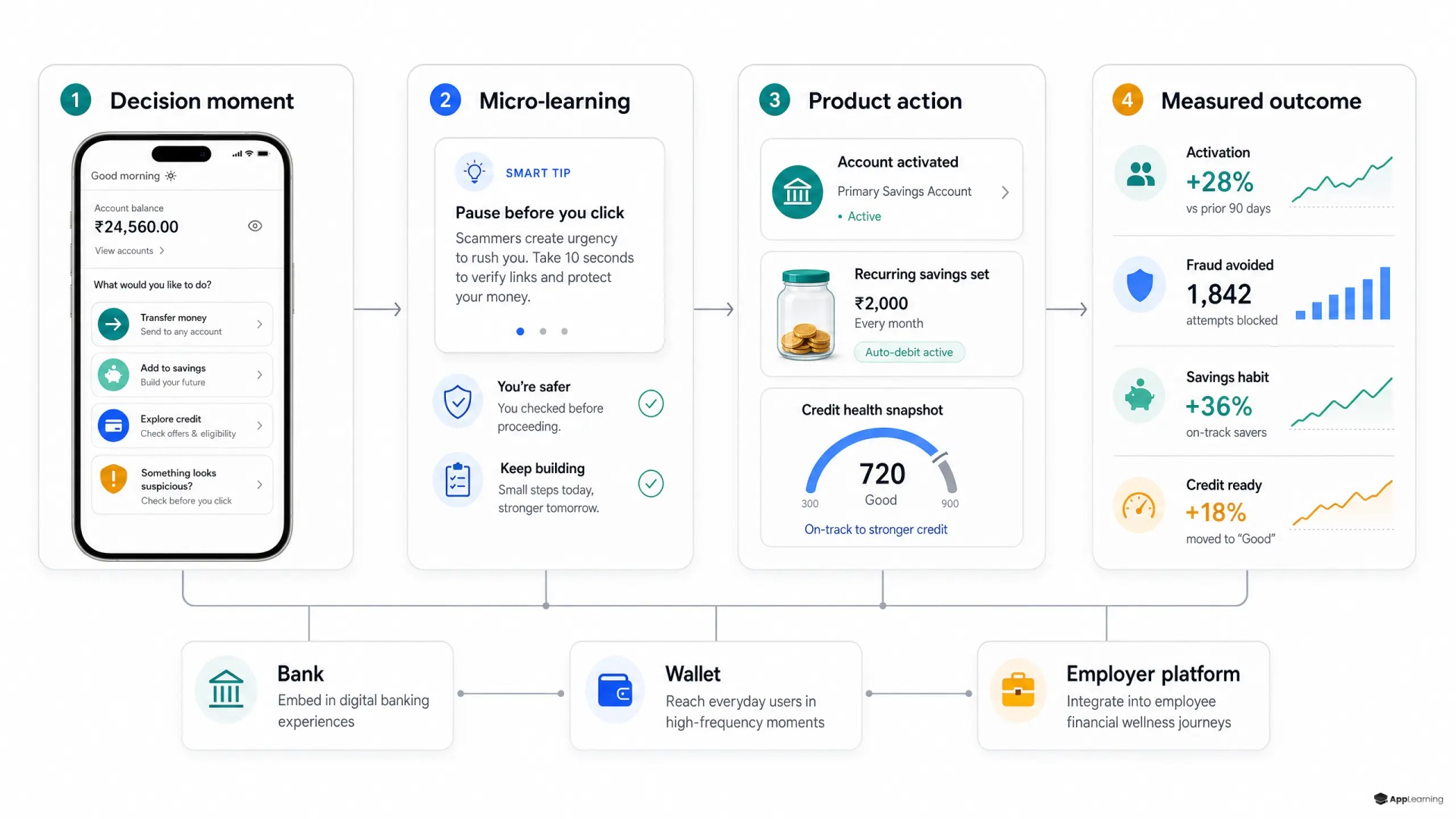
- Trigger learning from a concrete user state or decision.
- Resolve one misconception or skill gap at a time.
- Give the user a clear, appropriate next action.
- Instrument the learning event and the subsequent product event.
Embedded education belongs in the customer journey
A standalone financial literacy platform can build awareness, but it often sits outside the moments that determine activation and trust. Embedded financial education should begin with product friction: an incomplete onboarding step, an unfamiliar security prompt, a dormant savings feature, or a credit-readiness gap. Map the user job, the likely misunderstanding, the consequence of getting it wrong, and the smallest learning intervention that helps. A 90-second scenario, decision aid, or practice flow can outperform a broad lesson when it appears at the right time.
This is where App-Learning fits the operating model. Short, modular learning flows can sit inside onboarding, lifecycle messaging, support, or in-app surfaces while product, growth, compliance, and CX teams retain a shared view of the content, trigger, version, and intended behavior.
Good to know
Does the Sprint prove that embedded education improves financial outcomes?
No. The Sprint signals a preferred model for practical, scalable solutions, but causal impact still requires a clear measurement design, suitable comparison groups, and careful interpretation of results.
Where should a fintech start with embedded financial education?
Start with one high-friction customer moment that affects activation, trust, or safe product use. Build the smallest useful intervention, define the expected next action, and measure it before expanding the program.
Which teams should own fintech education?
Product should own the journey and measurement model, while Growth, Content, Compliance, CX, and Data share responsibility for triggers, quality, governance, and iteration.
Product metrics need disciplined interpretation
Learning analytics should connect to product data, but the connection must be honest. Track the chain from exposure to comprehension, action, and downstream signal. For a fintech, that may mean activation after an onboarding explainer, fraud avoidance after a scam simulation, feature adoption after a guided walkthrough, savings behavior after a goal-setting module, or credit readiness after financial-health guidance.
- Define the learning event and product event before launch.
- Set a time window for the expected user action.
- Compare exposed cohorts with meaningful baselines or controls where feasible.
- Segment results by user need, eligibility, and journey stage.
- Treat correlation as a product signal, not automatic causal proof.
Balances, eligibility rules, prior intent, channel mix, and market conditions all shape financial behavior. A clean measurement model therefore helps teams learn which interventions merit iteration, rather than overstating impact from a completion-rate uplift.
Build education into the customer moments that determine trust and activation.
DiscussDistribution and governance carry the scale burden
The Sprint’s model emphasizes solution refinement, technical assistance, and routes to scale through partners rather than direct grant funding, as CGAP explains. That reflects a practical constraint: education reaches meaningful volume through banks, fintechs, platforms, employers, public programs, and trusted local channels. Partnerships are part of the product model, not a late commercial add-on.
For the product team, this makes governance a design requirement. Content needs clear ownership, approval paths, version history, localization rules, accessible formats, and limits on claims. Event data needs purpose boundaries and an auditable definition of what was shown, to whom, and why. Those foundations let a learning layer scale without becoming an unmanaged collection of campaigns.
The G20 Financial Literacy Solutions Sprint does not prove a single winning format. It does show the direction of travel. Fintech education is becoming a measurable product layer: embedded where decisions happen, distributed through institutions, and judged by its contribution to safer and more capable customer behavior. The teams that build that layer well will improve activation and trust without confusing education with promotion.