

Key takeaways
- Course terminology needs entity identity, not only matching text.
- Internal glossaries should outrank generic public knowledge sources.
- Low-confidence enrichment should fail closed and add nothing.
- Every automated definition and link needs retained source provenance.
Keyword detection is the easy layer
Most LMS glossary automation starts with a simple pattern: find a term in course text, then add a tooltip, definition or external link. Detection is useful, but it is not the hard decision. The hard decision is whether the detected string refers to the same thing as a candidate definition.
That is an entity-resolution problem. Entity-resolution research describes the task as identifying different descriptions that refer to the same real-world entity. In learning content, the descriptions include the course sentence, the product, the audience, the market, the lesson objective and the organization’s own terminology. A text match captures almost none of that context.
A product education glossary cannot treat every capitalized term or acronym as public vocabulary. In fintech, a three-letter label may identify an internal feature, a payment method, a regulatory concept, a partner integration or an unrelated public entity. The string can be identical while the learning meaning is not.
Ambiguous acronyms create polished errors
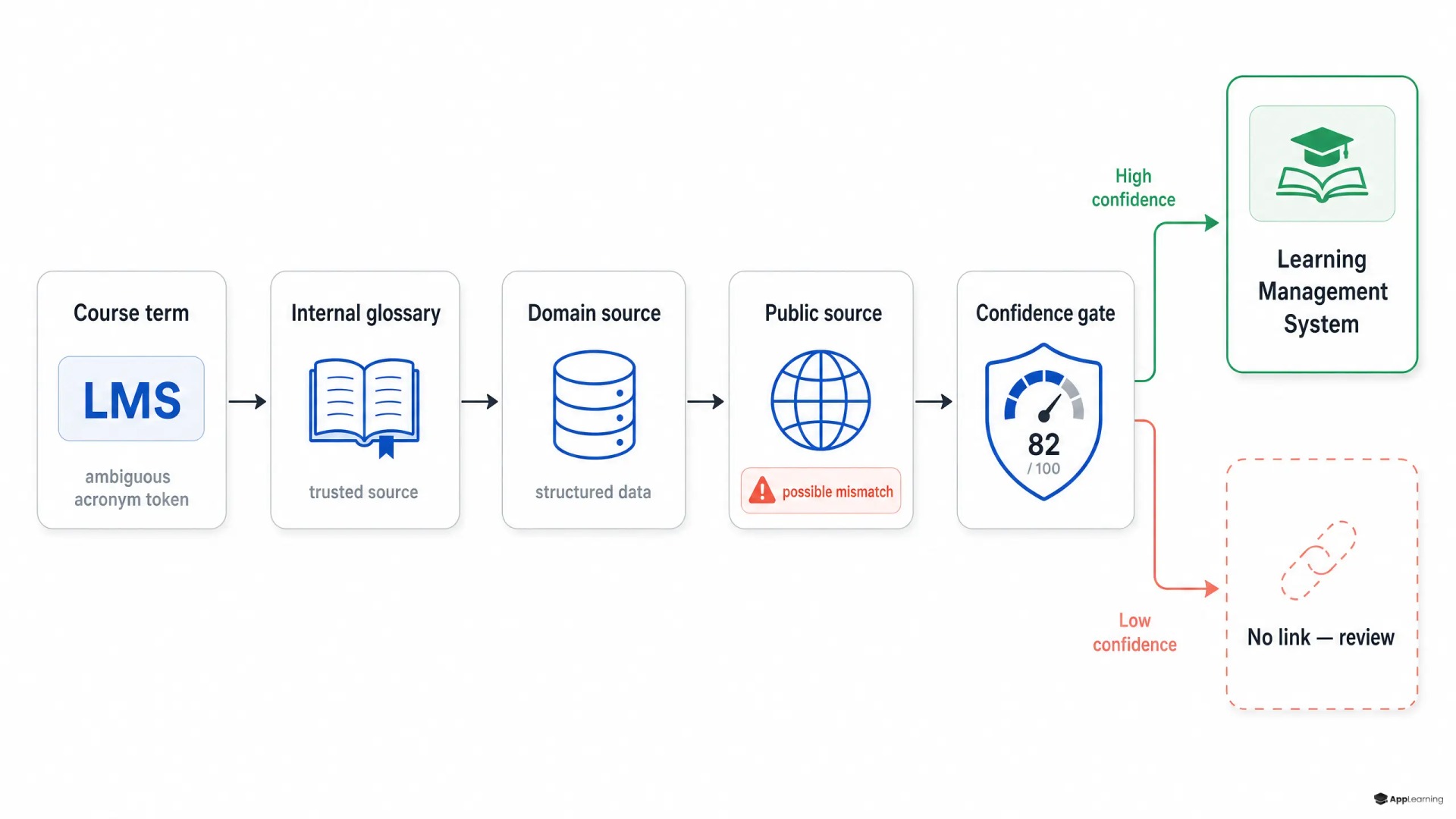
A recent production incident showed the failure mode clearly. The course content correctly explained a domain-specific payment term. An automated enrichment layer then linked that term to an unrelated public concept because the exact domain entity was absent from its external source. The learner saw a confident-looking definition that contradicted the lesson without any visible warning.
This is more damaging than a missing glossary link. A missing link leaves the course intact. A wrong link adds false authority, interrupts the learning path and makes learners question the product’s own explanation. Removing the enrichment fixed the learner-facing issue without changing the approved course text.
- String match answers whether labels look alike.
- Entity resolution answers whether the labels mean the same thing here.
- Learning infrastructure must optimize for the second answer.
Source precedence protects course truth
The system needs an explicit hierarchy of authority. The course author and the organization already know which product, process or concept the lesson intends to teach. That source should not lose to a broad public knowledge base simply because the latter returns an exact string match.
For semantic content enrichment, use a precedence order that is simple enough to enforce and inspect:
- Internal glossary and approved product terminology
- Curated domain sources selected for the course area
- Public knowledge sources only when context supports the match
This turns a glossary from a search add-on into a governed content layer. It also makes a knowledge graph LMS practical: each course term can have a stable internal identity, approved aliases, market or product scope, a definition, and permitted external references. The visible word is only one attribute of the entity.
Good to know
What is the difference between keyword matching and entity resolution?
Keyword matching finds the same or similar text. Entity resolution decides whether that text refers to the intended concept in the course context.
Which source should define a product term first?
Use the organization’s approved glossary first, then curated domain sources. Treat public sources as a fallback, not as the default authority.
What should happen when the system cannot identify a term confidently?
Add no definition or link. Record the unresolved mention for review rather than presenting learners with an uncertain answer.
Confidence must control the fallback
A resolver should score candidate matches using more than lexical similarity. Useful signals include the lesson topic, nearby terms, product area, country or regulatory market, content language, source authority and whether the candidate entity exists in the organization’s glossary. A high score can add enrichment automatically. A middle score can enter review. A low score should produce no link at all.
This is a fail-closed rule. It accepts that helpful automation is optional, while content correctness is not. The enrichment record should also retain its decision trail: source, entity ID, confidence score, matching signals, model or rules version, and date. W3C PROV-O provides a widely used model for representing provenance, including entities, activities and attribution.
Provenance gives content teams an operational control surface. When a source changes, a definition is challenged or a product term is renamed, they can find affected lessons, review the enrichment and remove it without rewriting approved learning material.
Build glossary enrichment that protects content truth.
Talk to usAutomation should serve the learning system
For product teams, this approach avoids a false trade-off between rich embedded education and editorial control. App-Learning can connect approved terminology, source-aware content data and in-app learning journeys so users get help at the point of friction without importing generic definitions that do not fit the product.
The implementation should begin with the terms that affect activation, feature adoption and support demand. Build the internal glossary around those concepts first. Add external enrichment only where it extends the learner’s understanding and passes the same identity checks. Measure unresolved mentions, rejected candidates and definition overrides alongside completion and quiz results.
A good glossary does not link the most words. It protects the meaning of the words that matter. When identity is uncertain, silence is safer than a polished explanation for the wrong thing.