

Key takeaways
- Product education is broader than documentation and in-app prompts.
- Structured learning builds confidence before users face complex decisions.
- Platform fit depends on product risk, complexity, and adoption goals.
- App-Learning fits products where education must drive measurable activation.
There is no single winner among the best product education platforms. The right choice depends on the job the platform must do. Help content answers a known question. In-app guidance helps a user complete a known task. A product education platform builds the understanding that makes a complex task feel safe and worthwhile.
Product education carries work that support content cannot
A help center remains essential. Zendesk defines self-service around knowledge-base articles that help customers find answers without contacting support. That model works when users know what they need and can apply the answer alone. It is weaker when users must understand unfamiliar concepts, compare trade-offs, or make a financial decision before they can act.
That distinction matters in fintech. A user may need more than instructions to complete verification, fund an account, configure security, or use an advanced investment feature. They need a clear mental model of the step, its purpose, and its consequences. Product education turns that model into a repeatable learning journey rather than leaving it to support tickets, webinars, or scattered articles.
Four models solve different adoption problems
- Help centers are the reference layer. They are best for searchable answers, troubleshooting, release notes, and policy information.
- In-app guidance platforms are the action layer. Pendo guides, Appcues checklists, and Userpilot experiences help teams target prompts, walkthroughs, checklists, and feature discovery inside the product.
- Customer academies are the structured learning layer. Skilljar’s customer education LMS supports learning paths, certifications, branding, integrations, and training monetization for broader customer education programs.
- Extended-enterprise LMS platforms are the multi-audience layer. Docebo’s extended-enterprise offering is designed to manage distinct customer, partner, and employee learning environments at scale.
These models can work together. A tooltip should point to the next click. A help article should resolve a specific issue. A learning path should prepare a user for a high-context workflow. Problems start when a team asks one layer to perform all three jobs.
Confidence needs a curriculum
A product training platform becomes valuable when product use depends on knowledge that has an order. Users should learn basic concepts before they meet advanced features. They should see realistic examples before a high-risk decision. They should complete a short knowledge check when the team needs evidence of understanding, not only evidence that a screen was viewed.
This is where an academy differs from a video library. It creates paths by role, product state, market, or level of experience. It also creates a usable operating loop: identify a friction point, teach the prerequisite, test comprehension, link the learner back into the product, and measure the downstream activation event.
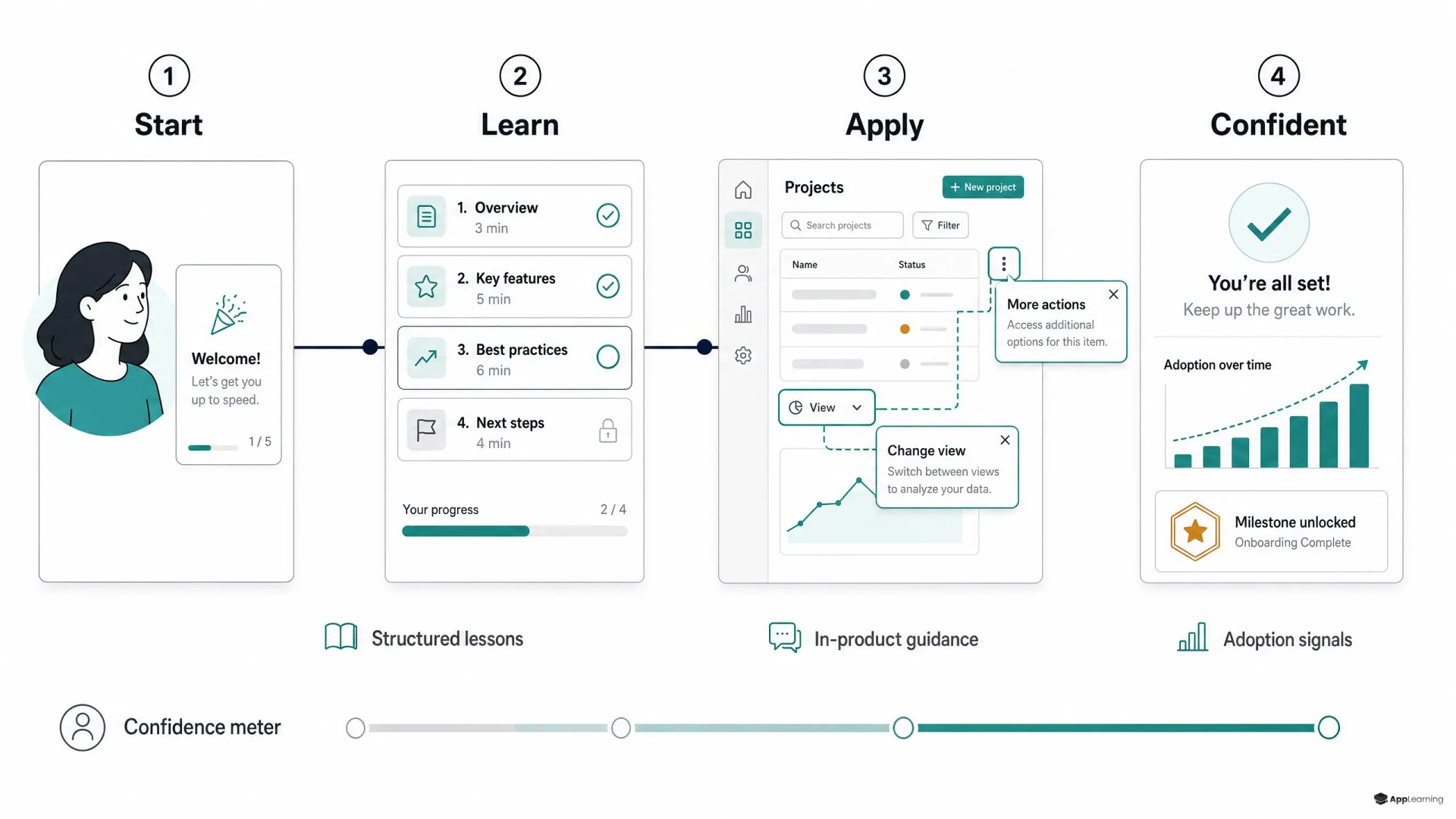
App-Learning makes education part of the product system
App-Learning’s academy platform is built for branded customer and employee academies with microlearning modules, quizzes, role-based paths, gamified mechanics, and progress analytics. Teams can turn approved product documents, slides, videos, and expert input into short learning modules instead of asking product managers to maintain a parallel content operation.
For a fintech product team, the practical fit is an education layer that supports activation without replacing product onboarding. Deep links, embeds, and single sign-on can connect a lesson to a product moment. Learning analytics can then show completion, quiz results, drop-off, and knowledge gaps. The useful question is not whether users finished a course. It is whether prepared users reach the intended product milestone with more confidence and less support demand.
Evaluation should follow the risk in the workflow
Use these criteria to compare a product education platform rather than scoring vendors on feature count alone.
- Learning depth — Can the platform sequence concepts, provide assessments, and support deliberate practice rather than only display content?
- Product connection — Can users enter learning from web or mobile journeys and return to the right feature or workflow?
- Measurement design — Can the team connect learning progress and assessment data to activation, feature use, retention, support demand, or safe completion?
- Content operations — Can non-technical teams update modules, localize them, enforce expert review, and reuse core content across markets?
- Audience control — Can the platform separate new users, power users, partners, and employees while keeping each experience on brand?
Good to know
What is a product education platform?
A product education platform helps customers understand a product through structured lessons, learning paths, assessments, and progress data. It goes beyond support documentation by building knowledge before or alongside product use.
Should a customer academy replace a help center?
No. A help center is the reference system for searchable answers and troubleshooting. A customer academy is the learning system for complex, sequential, or high-context knowledge. Most complex products need both.
When is in-app guidance enough?
In-app guidance is enough when users understand the goal and only need help completing a low-risk task. Use structured learning when users need context, judgment, or risk awareness before the task makes sense.
How should a fintech team measure product education?
Track learning starts, completion, assessment results, and drop-off. Then connect those signals to downstream activation, advanced-feature use, repeat support contacts, retention, and safe completion of the target workflow.
Product maturity determines the stack
Early products usually need clear onboarding copy, a focused help center, and a few contextual guides. The aim is to learn where users stop. Growth-stage products need a structured academy when repeatable confusion blocks activation or advanced-feature adoption. Mature products often need a wider system for customers, partners, and employees, with separate paths, certifications, localisation, and governance.
Do not buy a large learning stack because a course catalog looks complete. Buy the smallest system that can teach the knowledge users need before the next meaningful action. Add guidance, support content, and enterprise learning operations only when the user journey requires them.
Build a learning layer that turns product complexity into customer confidence.
TalkRollout turns content into an adoption signal
Start with one high-friction workflow, not a full academy. Define the activation event first. Map the concepts users must understand before that event. Build short modules from existing approved material, add one or two knowledge checks, and place entry points where hesitation occurs. Compare learning and product behavior by cohort, then revise the path before expanding it to new features or markets.
The strongest product education systems do not compete with the interface or the help center. They close the gap between a user seeing a feature and trusting themselves to use it. When that gap is measured and managed, education becomes part of the adoption system rather than a library users find only after they are already stuck.