

Key takeaways
- Content versioning and learner progress cannot be designed independently.
- Stable content identifiers make safe learner progress migration possible.
- Every change needs rules for preserved, invalidated, and newly required progress.
- Certificates and audit records should name the version actually completed.
History alone does not protect in-flight learners
Most LMS course versioning features solve the author’s problem first. They show who edited a page, let teams restore an earlier draft, and create a publish history. That is useful, but it is only half the system. Once a course has active enrolments, a new release changes the relationship between a learner and the course structure.
A course is not just a set of screens. It is a set of requirements linked to individual learner states: started, completed, passed, overdue, exempt, or certified. If a mandatory module changes after someone completes it, the platform must decide whether that completion still satisfies the requirement. Training version control becomes a policy and data-model problem, not a publishing feature.
Structural edits create state conflicts
A renamed lesson rarely needs a learner-state change. A reordered path may not either. But splitting one module into three, replacing an assessment, changing a passing score, or adding a new mandatory policy does. A system that simply counts completed items by their place in a course can produce false completions after any of those edits.
This risk matters most for compliance training versions. For EU financial entities, the Digital Operational Resilience Act requires compulsory ICT security awareness and digital operational resilience training within staff training schemes. When training obligations evolve, teams need to show both what a learner completed and whether it remains sufficient for the current requirement.
Identity must outlast the course layout
The foundation is a stable ID for every learning object: course, module, lesson, assessment, question, and credential rule. A title, screen order, or URL is presentation data. It is not identity. The xAPI specification applies the same principle to learning activities: an Activity ID must be unique and must always reference the same activity.
With stable IDs, a platform can see that a lesson moved from position four to position seven without treating it as new. It can also see that an old lesson was retired and a different lesson now occupies its former position. That distinction makes LMS backward compatibility possible without freezing a course forever.
Migration needs explicit decisions
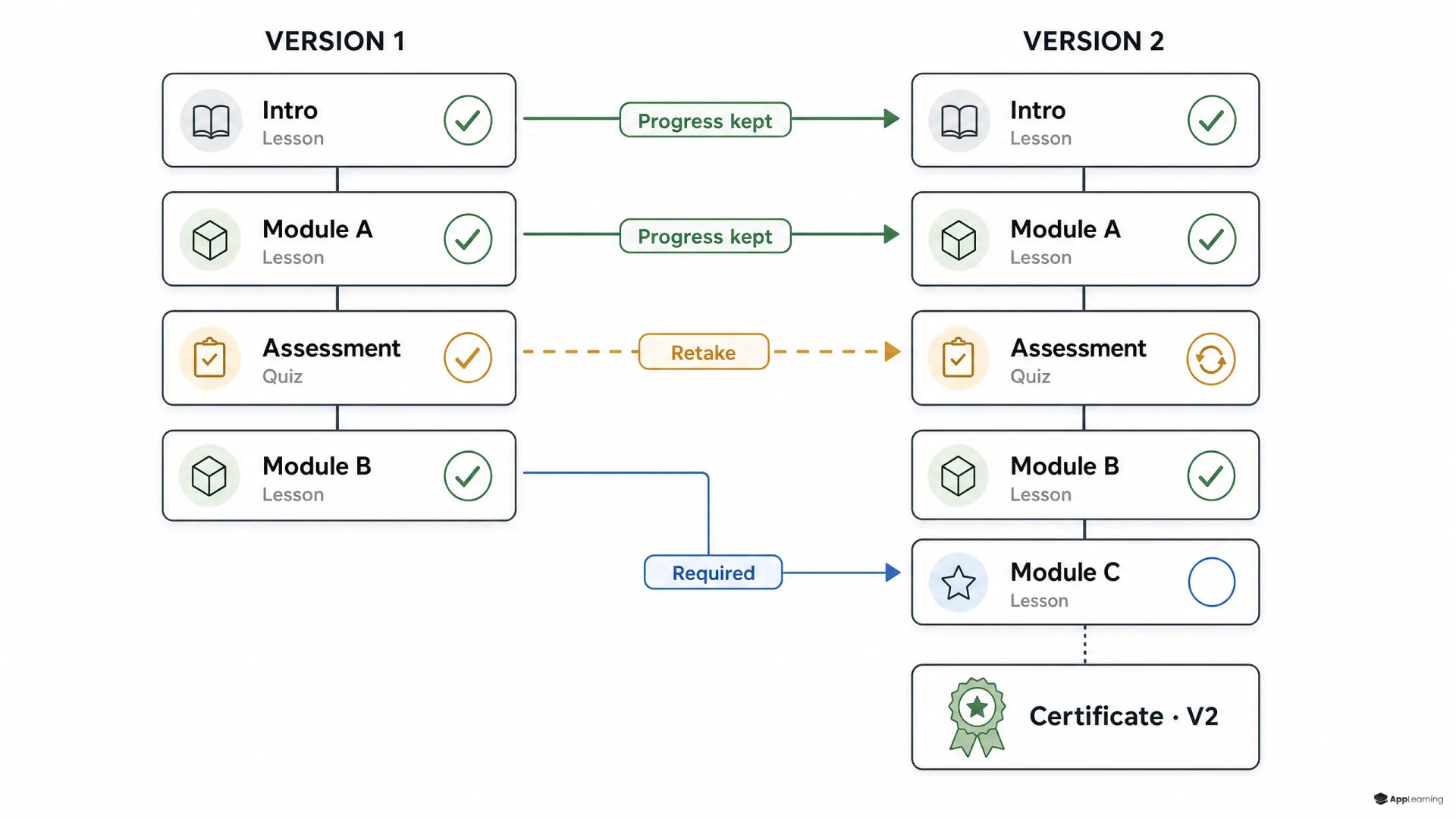
A published release should generate a migration plan before it reaches active learners. The plan should classify every change by its learning and compliance impact, then write a durable decision against affected learner records.
- Preserve completion when an object is unchanged or receives an editorial-only update.
- Preserve completion with a review flag when content changes but the learning objective and evidence remain valid.
- Invalidate assessment evidence when scoring logic, correct answers, required knowledge, or pass criteria change materially.
- Mark newly mandatory objects as incomplete and assign a clear completion deadline.
- Retain completed and retired objects in the historical record rather than deleting them from the learner trail.
The key word is explicit. A migration should not silently recalculate progress because an editor clicked publish. It should record the source version, target version, affected object IDs, rule applied, time of migration, and the person or automated policy that approved it. That creates a defensible answer when HR, compliance, or an auditor asks why a learner was marked complete.
Good to know
When should learner progress be preserved after a course update?
Preserve it when the learning object and its completion evidence remain valid. Editorial changes, visual updates, and reordering usually qualify if the underlying requirement has not changed.
Should a new mandatory module reset course completion?
Usually, no. Keep the historical completion record, then mark the new requirement as outstanding for affected learners. This preserves auditability and makes the retraining obligation clear.
What should a certificate include for version control?
Include the course version, completion date, relevant assessment result, and the credential rule used at issue. That makes the certificate evidence of a specific completed requirement.
Credentials must describe the evidence
A certificate should represent a completion snapshot, not merely a current course title. It should identify the course version, completion date, assessment result where relevant, and the rules in force at the time. If a later release adds a new mandatory module, the existing certificate remains historical evidence of what was completed; it does not automatically prove compliance with the new release.
Version-aware reporting should therefore separate three questions: who completed a named historical version, who meets the current requirement, and who needs migration or retraining. Combining those populations in one completion rate hides operational risk.
Make every course update safe for learners and defensible for compliance.
Talk to usA living academy needs controlled change
At App-Learning, this means treating content and learner state as related but separate layers. Authors need freedom to improve onboarding, product knowledge, and policy learning. Administrators need controlled release workflows. Learners need a clear explanation when a completed item remains valid, needs a refresh, or has been replaced by a new requirement.
The practical architecture is straightforward: stable content identities, immutable release records, version-aware completion evidence, and migration rules that are visible before publication. It lets a finance or crypto academy update fast without corrupting progress, overstating compliance, or erasing the evidence behind an issued credential.
Course versioning becomes reliable when the platform stops asking only what changed in the course. The harder and more valuable question is what the change means for every learner already inside it.