

Key takeaways
- Keep a canonical reward ledger inside the learning platform.
- Separate queued, submitted, confirmed, settled and final-failure states.
- Reconcile provider records against actual settlement before closing exceptions.
- Treat funding and payout-budget checks as preconditions, not learner errors.
- Design idempotent retries and learner messaging before launching rewards at scale.
A reward status becomes a product promise
Once a learning reward has monetary value, its payout status is part of the learner experience. A completed quiz or onboarding module can establish eligibility, but it cannot prove that money reached the intended destination. Treating a provider response as the final answer creates avoidable trust failures in LMS gamification rewards.
For a Bitcoin fintech, this distinction matters. Education may help a new user understand a wallet, recurring buy, or security choice. If the reward flow then reports a false failure, the platform undermines the confidence the learning experience was built to create. Learning success and payment success must be connected, but they must not be the same state.
Three records can tell different stories
A reward payout system usually spans three records: the academy’s eligibility and claim record, the provider or middleware submission record, and the settlement record from the relevant payment rail or wallet. Each can be correct at a different point in time while still disagreeing with the others.
Operational incidents tend to expose the gaps. Funding can run low and stop new claims. A technically valid funding method may not work with the operator’s chosen wallet. After a provider change, an intermediary may label a payout as failed although settlement succeeded. None of these events should erase a learner’s completed learning event.
The academy needs a canonical state machine
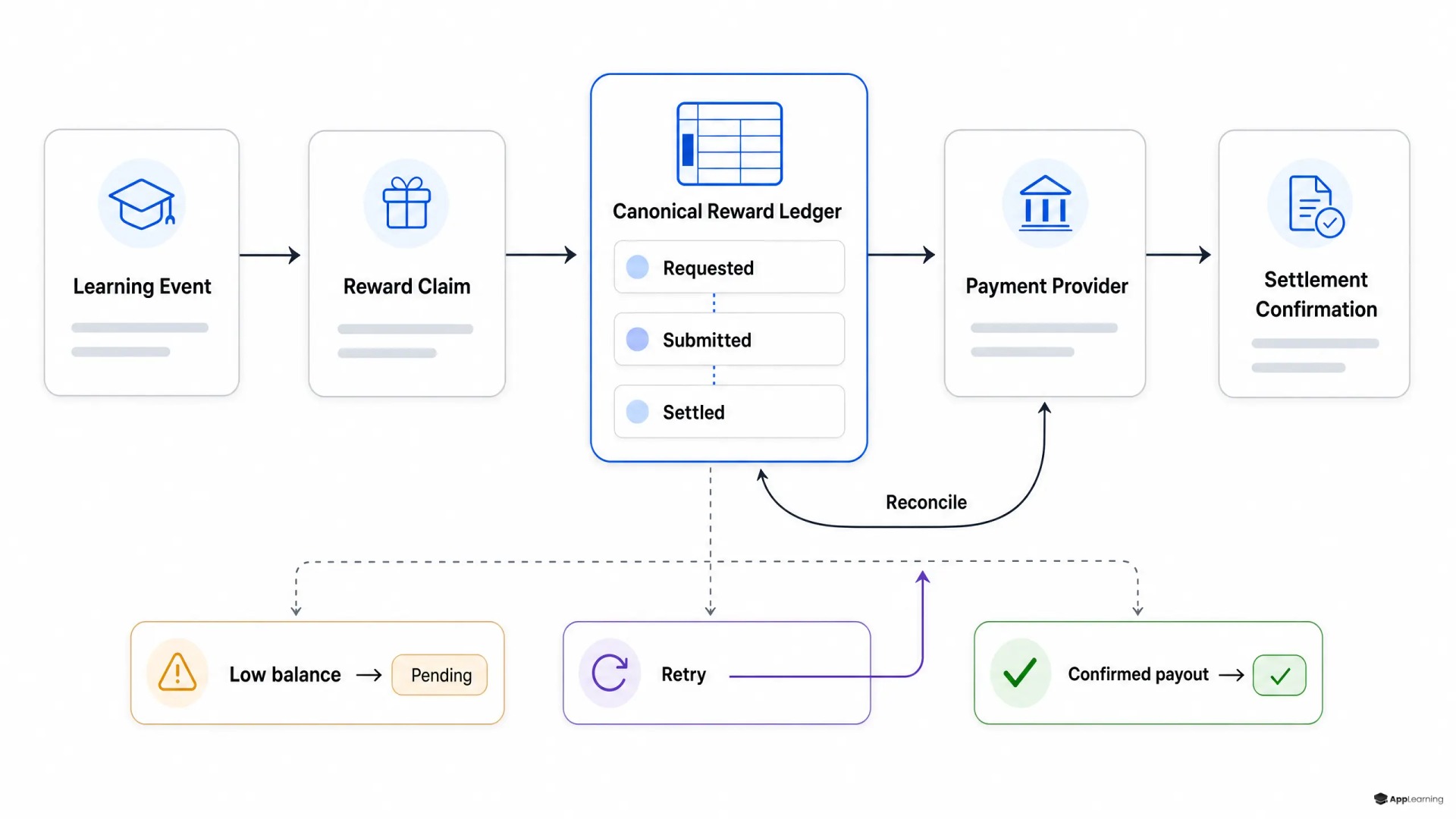
The academy should own an append-only reward ledger with one stable reward ID. External statuses are evidence attached to that record, not the record itself. This creates the canonical state needed for payment reconciliation and gives support, finance, product, and learners one shared history.
- Eligible — the learner met the learning rule.
- Claimed — the learner requested the reward.
- Queued — budget and funding checks passed, but no payout request left the platform.
- Submitted — the provider received the request or the outcome remains ambiguous.
- Confirmed — the provider reports success.
- Settled — reconciliation confirms that value moved.
- Final failure or exception — an explicit failure is confirmed, or a case needs review.
Retries need identity and evidence
A timeout after a payout request is not proof that the payout failed. The request may have reached the provider even when the response did not return. AWS reliability guidance on idempotent operations describes this exact distributed-systems problem: a mutating action can occur before the caller knows its outcome.
Use the academy reward ID as the durable correlation key, then store the provider payout ID, idempotency key, timestamps, amount, destination, and every status change. Reconciliation jobs should compare requested, submitted, provider-confirmed, and actually settled records. Retry only transient or unresolved cases, with a stable idempotency key and bounded backoff. As AWS notes in its retry guidance, retries without idempotency can corrupt state through partial or duplicate updates.
Funding failures belong before the claim
Funding balance, payout budget, destination eligibility, and supported funding routes are operating preconditions. Check them before accepting a claim where possible, reserve budget when the claim enters the queue, and alert operators before the reward pool reaches a critical threshold. If a funding route is unsupported, route the case to an approved alternative instead of turning an operator configuration problem into a learner-facing rejection.
Good to know
Why is a provider success response not enough?
It records one provider-side outcome at one moment. It may not prove that the destination received value, and a missing response does not prove that no payout occurred.
Should confirmed and settled be separate states?
Yes. Confirmed can mean the provider accepted or completed its process. Settled should mean the academy has reconciliation evidence that the value movement is final enough for the chosen payment rail.
What should happen when a payout is ambiguous?
Freeze duplicate payment attempts, retain the learner’s earned status, reconcile using the reward and provider identifiers, then retry or close the case only when the evidence supports it.
Uncertainty needs honest learner language
Do not show “failed” when the system only knows “not yet confirmed.” Learners need clear states such as “Reward earned,” “Payout processing,” “Payout sent,” and “We are checking your payout.” A final failure message should state what happens next, including whether the platform will retry, use another route, or request support. This is not cosmetic copy. It preserves trust while infrastructure catches up with reality.
Build reward flows that remain trustworthy when payment infrastructure becomes uncertain.
DiscussLearning remains complete when payment rails wobble
Strong incentive platform architecture isolates the learning ledger from payment-rail volatility without hiding either. App-Learning can combine eligibility, claim, queued payout, submission, confirmation, retry, and settlement in one auditable flow. That makes learning rewards infrastructure fit for real value: the academy can protect learner progress, resolve payment exceptions accurately, and keep the reward promise credible as the programme scales.