
Key takeaways
- Reusable agent skills should be governed like SOPs, not treated as disposable prompts.
- A shared library needs clear ownership, permissions, version history, and review cycles.
- Portability makes one canonical instruction source more valuable and more exposed.
- Human learning must cover rationale, exceptions, escalation, and supervisory judgment.
- Material skill changes should trigger targeted refreshers for affected employees.
Most AI work starts as an individual prompt. Someone finds a useful sequence, adds the right context, and gets a reliable result. The problem begins when that know-how remains in a chat history, a private note, or an undocumented workflow. The team cannot find it, assess it, improve it, or know which version an agent used.
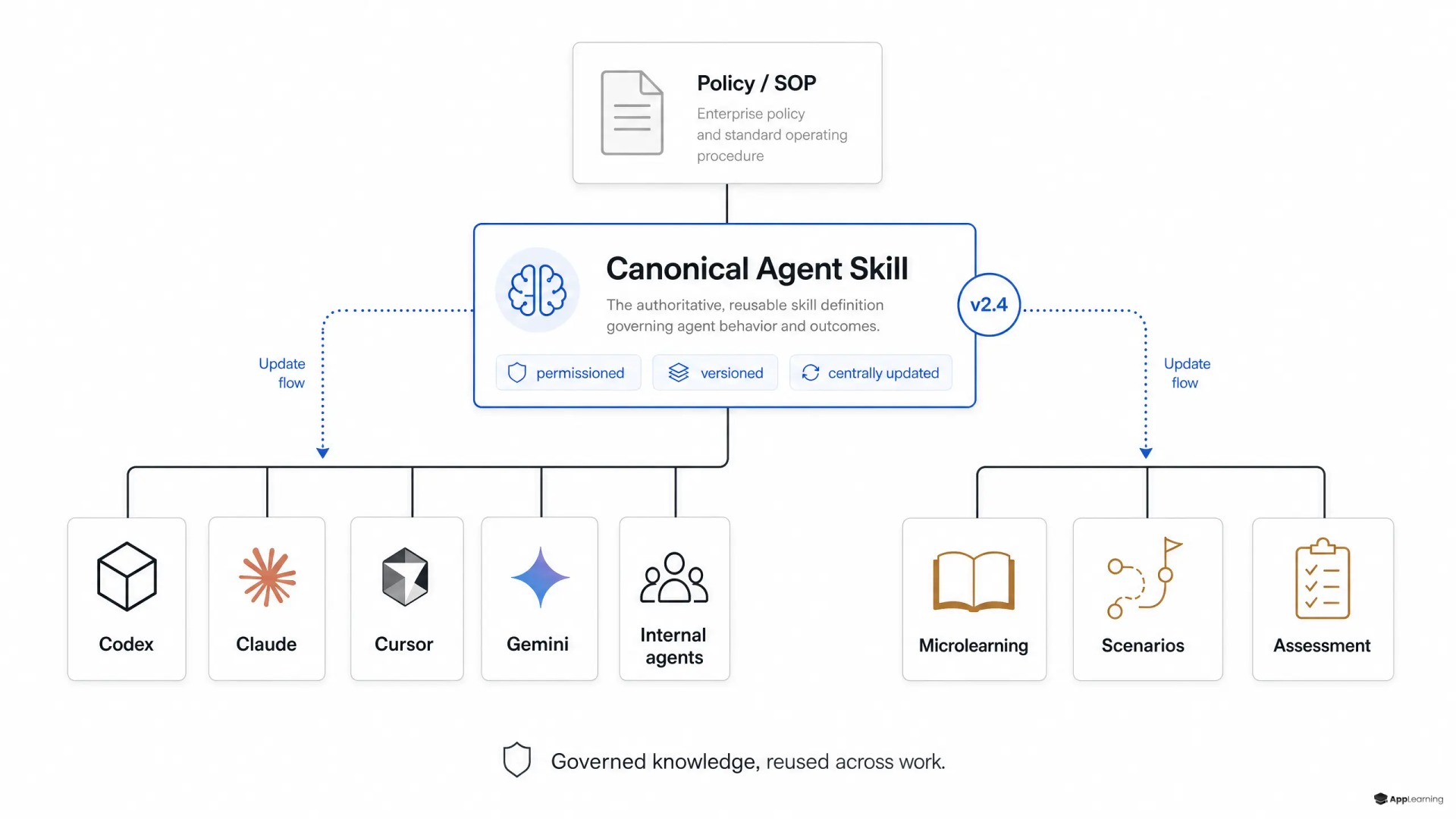
On September 15, 2026, Notion 3.7 introduced shared Agent Skills as reusable instructions held in a team library, runnable manually or automatically, and exportable as `SKILL.md` packages with approved supporting files for Claude Code, Codex, Cursor, Gemini, and Grok. This is a product signal, not a complete operating model. But it points to a material shift in how enterprises should treat reusable AI prompts.
The prompt becomes a reusable operating artifact
A prompt becomes an operating artifact when it repeatedly shapes work that matters. It may classify incoming requests, prepare a customer communication, create a control summary, or draft an exception report. At that point, it encodes a procedure: inputs, decision rules, constraints, output format, and escalation points. That makes it closer to an SOP than a one-off instruction.
For a bank, the test is simple. If a skill affects customer treatment, risk decisions, controlled communications, or operational handoffs, it needs a named owner and an approved purpose. The asset should not be governed because it uses AI. It should be governed because it directs work.
Shared libraries reset knowledge ownership
A shared agent skills library moves useful instructions from personal productivity into organizational knowledge AI. In a September 17 post, Notion described agent-neutral skills as a critical store of organizational knowledge that needs collaboration, permissions, version history, analytics, and controls over who receives which skills. That framing is useful because it names the ownership problem directly.
- A business owner is accountable for the procedure and intended outcome.
- A risk or control owner reviews material constraints and escalation rules.
- A technical owner manages runtime compatibility, access, and deployment.
- A learning owner translates changes into role-specific capability support.
Version control becomes a learning-operations concern
Version history alone is not governance. Teams need to distinguish a wording improvement from a material procedural change. A new data source, approval step, control, customer threshold, or escalation path changes how work is done. It may also change what employees need to understand before they can supervise the output safely.
This is where reusable AI prompts enterprise programs often fail. They govern the model, tool access, and prompt text, but not the human consequences of a changed instruction. SKILL.md governance should include a change classification, an accountable approver, an effective date, the affected roles, and a decision on whether refresher learning is required.
Agent instructions cannot replace human judgment
The agent skill should tell the system how to execute a bounded procedure. The employee curriculum should explain why the procedure exists, where it can fail, which exceptions matter, and when to stop or escalate. Combining both into one artifact creates a weak prompt and a weak learning experience.
Consider a skill that drafts a response for a vulnerable customer or flags an onboarding anomaly. The instruction can constrain the agent's steps. It cannot prove that a relationship manager or operations specialist understands the rationale, recognizes a novel edge case, or can challenge an unsafe result. Those are human performance requirements, and they need practice and assessment.
Good to know
When should a prompt become a governed agent skill?
Treat it as governed when it is reused across people or workflows, affects a controlled business process, relies on approved knowledge, or produces outputs that employees must review or act on.
Should the agent instruction and employee training be the same artifact?
No. They should draw from the same canonical procedure but serve different purposes. The skill directs execution, while the learning experience builds understanding, judgment, exception handling, and supervisory confidence.
Which changes should trigger employee refreshers?
Trigger targeted refreshers when a change alters decisions, controls, escalation paths, inputs, approvals, customer impact, or the employee's oversight responsibility. Minor wording changes usually do not need formal learning.
One procedure can create two controlled artifacts
Maintain one canonical procedure record, then publish distinct views for the agent and the learner. This preserves a governed source of truth without pretending that machine execution and human understanding are the same task.
- Policy defines the rule, control intent, and accountable authority.
- Agent skill defines the inputs, permitted actions, decision logic, and output format.
- Workflow defines the trigger, handoffs, approvals, and runtime context.
- Learning evidence shows that each affected role can apply judgment, handle exceptions, and supervise the workflow.
This structure also makes AI skills operations measurable. Leaders can see which procedure version is live, which agent runtimes received it, which roles completed a relevant refresher, and where assessment results show uncertainty. That is more useful than tracking prompt usage alone.
Turn AI skill changes into measurable workforce readiness with App-Learning.
ExploreOperational changes should trigger targeted refreshers
A material skill update should create a focused learning event, not a blanket course assignment. Map the change to the roles that create inputs, review outputs, approve exceptions, or own customer outcomes. Then deliver a short explanation of the change, a scenario that tests the affected judgment, and an attestation only where the control requires one.
App-Learning can provide the human-learning layer around governed agent skills: concise role-based explanations, mobile practice, assessment, and refreshers triggered by approved changes. The goal is not to make every employee a prompt engineer. It is to ensure that people understand the process they now share with an agent.
The emerging stack is clear: policy shapes the skill, the skill drives the workflow, and learning evidence demonstrates human readiness to oversee it. Banks that build this connection early will turn scattered AI experiments into operating knowledge that can scale without losing control.