

Key takeaways
- Standalone AI literacy loses value when it is detached from real workflows.
- Domain knowledge is the basis for judging AI output and risk.
- Each role needs approved AI tasks, verification steps and escalation boundaries.
- Assessments should reproduce job tasks and require defensible human judgment.
- Modular role overlays keep enterprise AI upskilling current without rebuilding the academy.
AI moves into the profession
On 1 September 2026, Siemens announced that AI had become an integral part of learning and working processes across all of its German vocational-training and dual-study pathways. The company is not presenting AI as a separate subject. It is placing it inside existing professional learning, while keeping specialist knowledge as the foundation for responsible use.
That is a useful operating-model signal for enterprise L&D. AI vocational training works best when it follows the shape of the job. A payments-operations analyst, AML investigator, customer-support agent and engineering manager may use similar tools. They do not face the same decisions, data restrictions, quality standards or consequences when an output is wrong.
Generic literacy has a short half-life
A common AI course can establish a baseline. It can explain core concepts, approved tools, basic prompting, confidentiality and known failure modes. That baseline matters. But it is not job-specific AI literacy, and it should not be the endpoint.
Generic training becomes stale because the real questions emerge at the workflow boundary. Can a relationship manager use AI to prepare a client brief? Can an analyst use it to summarise a policy update? Can a fraud team use it to draft a case narrative? The answer depends on source data, approved systems, required evidence, review duties and who owns the final decision.
For EU-facing firms, this distinction is also aligned with the current text of Article 4 of the EU AI Act, which calls on providers and deployers to support AI literacy with regard to people's knowledge, experience, training and the context in which systems are used. Context is not an implementation detail. It is the design requirement.
Capability lives at the task boundary
Role-based AI training should begin with a task inventory, not a catalogue of AI features. For each priority role, identify the recurring tasks where AI may improve speed, clarity or consistency. Then classify each task by risk and decision impact.
- Name the role, workflow step and business outcome.
- Define the approved AI use case and the approved tool or environment.
- State which inputs are allowed, prohibited or must be redacted.
- Specify the evidence needed to verify an output.
- Set the human decision owner and the escalation boundary.
This turns enterprise AI upskilling into a usable control system. It also gives compliance, risk and security teams a concrete object to review. They are no longer asked to approve a vague promise of AI literacy. They can approve or restrict a defined use case in a defined workflow.
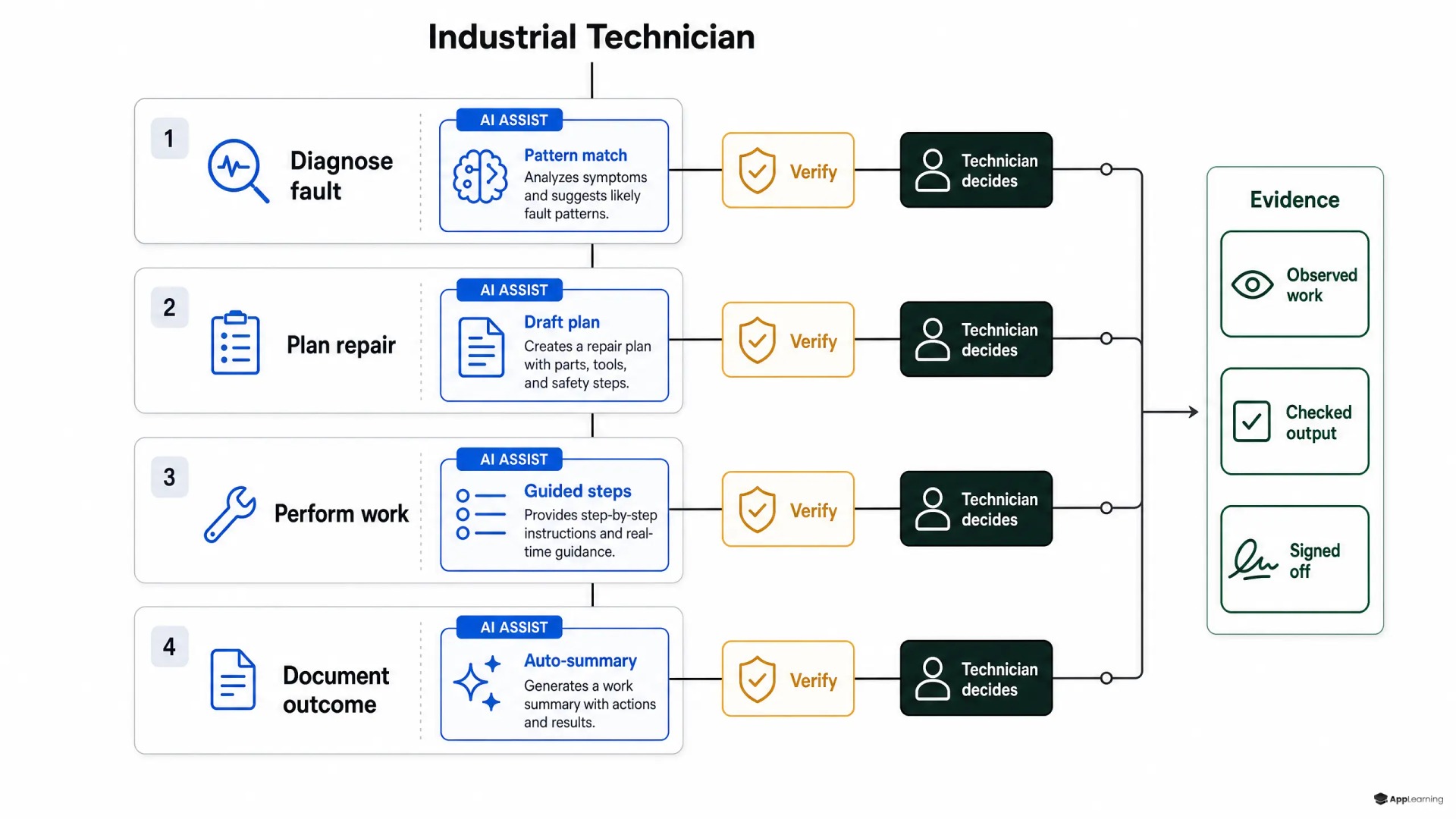
Domain knowledge is the control layer
AI can draft, summarise, classify and suggest. It cannot carry professional accountability. Learners need enough domain knowledge to spot missing evidence, false certainty, unsuitable language and decisions that do not fit policy or customer context.
That is why embedded AI skills should sit beside domain modules, not replace them. In finance, an AI-assisted alert summary still requires an investigator to assess transaction context, document rationale and follow escalation rules. In crypto, a draft response to a customer may still need checks against product controls, sanctions exposure and communications policy. The learner must know when the output is useful, when it is incomplete and when it must not be used.
Good to know
Should every employee complete the same AI foundation course?
Yes, but keep it short. Use it to establish shared rules, approved tools and basic risk awareness, then move learners into role-specific practice.
Which roles should receive AI overlays first?
Start where work is frequent, structured and measurable, but where a human already owns the final decision. Prioritise workflows with clear evidence standards and known review steps.
How can L&D measure embedded AI skills?
Measure performance on realistic tasks. Track whether learners select approved use cases, verify output correctly, handle sensitive data safely and escalate when required.
Assessment must test a defensible decision
Completion data cannot show whether someone can use AI safely in the job. A stronger assessment recreates a realistic task: a customer case, a policy change, an exception report or a suspicious-activity scenario. The learner uses an approved AI workflow, checks the result against evidence, records edits and explains the final decision.
The rubric should score more than prompt quality. It should test source selection, handling of restricted information, factual verification, policy alignment, escalation and the quality of the human rationale. This creates measurable evidence of competence without treating the model output as proof of competence.
Modular overlays keep pace with tool change
Do not rebuild the whole academy whenever a model, policy or approved use case changes. Keep durable domain learning in the core pathway. Add small AI overlays for specific roles and tasks. Each overlay can include a use-case brief, a short practice scenario, a verification rubric and an evidence record.
App-Learning can support this structure inside an existing employee academy. Instead of launching one generic AI course, teams can attach approved, task-based AI modules to onboarding, compliance refreshers and role pathways. That makes updates faster, keeps the learner experience coherent and gives L&D a clearer view of performance by role and use case.
Turn approved AI work into measurable learning.
Plan itLearning operations shift from delivery to evidence
The practical change for L&D is substantial. Content owners must work with operations, risk, compliance and frontline experts to maintain a live map of approved tasks. Managers need visibility into where learners can apply AI independently and where review remains mandatory. Analytics should show task performance, verification failures, escalation patterns and confidence gaps, not only enrolments and completions.
The durable capability is not knowing the latest AI interface. It is knowing how to apply an approved tool to a real task, test its output against domain evidence and retain human responsibility for the decision. When learning is designed around that standard, AI stops being a separate course and becomes part of competent work.