
Key takeaways
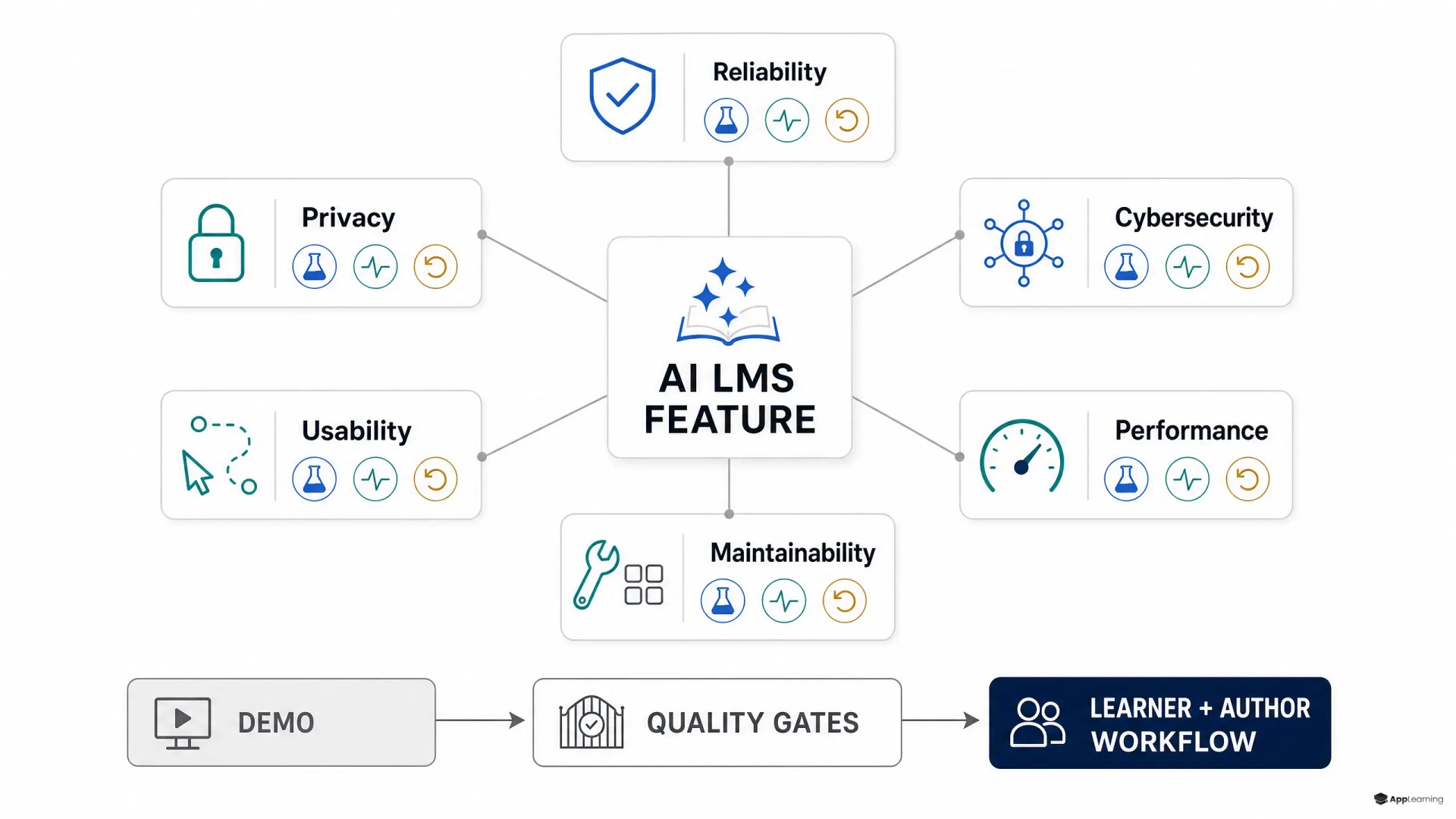
- AI LMS quality needs six gates, not one accuracy score.
- Reliability includes clear fallback behavior when AI cannot answer safely.
- Privacy controls and LMS cybersecurity tests address different failure modes.
- Usability and performance determine whether employees keep using the feature.
- Every gate needs an owner, evidence artifact, and rollback path.
A demo proves possibility, not readiness
A compelling demo shows that a model can generate a course outline, answer a learner question, or draft an assessment. It does not show that the feature belongs in an LMS used for regulated capability building. The NIST AI Risk Management Framework frames trustworthy AI as a balance of characteristics, including reliability, security, privacy, and accountability. That is the right starting point, but a production learning product also has to work clearly, quickly, and predictably inside a real workflow.
For a bank, the distinction is practical. An AI tutor that gives useful explanations but exposes the wrong internal material has failed. An authoring assistant that creates strong first drafts but leaves experts unable to see, correct, or approve its work has failed. AI LMS quality is the discipline of treating those outcomes as separate release decisions rather than accepting one impressive output as proof.
Reliability includes the failure path
AI learning platform reliability is not just a score for correct answers. It is predictable behavior when the feature lacks context, encounters conflicting source material, receives an unclear prompt, or cannot complete a task. A learner must see an honest boundary, not a confident invention. An author must be able to recover work without rebuilding it.
The reliability gate should require a defined evaluation set, known failure scenarios, answer-quality thresholds by use case, and a fallback path. That path may route the learner to approved content, ask for clarification, preserve a draft for human review, or escalate an assessment exception. The product owner should sign a release artifact that shows both successful and failed cases.
Privacy and security need separate proof
Privacy asks whether personal, learning, and organisational data is collected, retained, processed, and shared for an approved purpose. Security asks whether someone can misuse the system, bypass permissions, manipulate instructions, or access content they should not see. Combining the two creates blind spots.
The LMS cybersecurity gate needs tests for identity, permissions, tenant separation, prompt injection, unsafe tool use, and sensitive-information disclosure. These are not theoretical edge cases: the OWASP GenAI Security Project identifies prompt injection and sensitive-information disclosure among the major risks for generative AI applications. The privacy gate needs its own evidence: a data-flow record, approved processing rules, retention controls, and a clear decision on what may never enter a prompt.
The workflow sets the usability standard
A feature can be technically correct and still create friction. In a bank, relationship managers, operations teams, compliance specialists, and leaders do not have time to decode vague loading states or compare hidden model versions. AI outputs must show their status, limits, and next action. Authors need visible source context, simple editing, approval controls, and a human override that works without specialist knowledge.
Performance is equally concrete. Set latency budgets for learner questions, generation tasks, and assessment feedback. Set cost budgets for high-volume workflows. Test peak conditions, slow dependencies, and degraded service. Production AI education software should fail gracefully under pressure instead of making a required learning journey feel broken.
Maintainability starts before launch
A feature is not maintainable because its code is clean. It is maintainable when a team can identify which model, prompt, source corpus, policy, and dependency produced an outcome; detect a change in quality; and reverse a release without disrupting users. The NIST Secure Software Development Framework similarly treats secure delivery as an ongoing practice that includes protecting software, producing well-secured releases, and responding to residual vulnerabilities.
This gate needs observability across the full learning flow. Log the right operational signals without storing prohibited content. Version prompts, models, retrieval sources, and assessment logic. Monitor quality drift, errors, latency, and cost. Rehearse rollback. Dependency risk belongs here too: a useful AI capability is only as dependable as its model provider, content pipeline, and access controls.
Good to know
What makes an AI learning feature production-ready?
It has passed explicit reliability, privacy, cybersecurity, usability, performance, and maintainability gates with documented release evidence.
Why is accuracy not enough for an AI tutor?
A helpful answer still fails if it reveals restricted information, misleads learners without a fallback, responds too slowly, or cannot be traced and corrected.
Who should own AI feature governance in a bank?
Ownership should be shared, but never vague. Product, privacy, security, learning design, platform engineering, and operations each need a defined release responsibility.
Release evidence turns principles into governance
AI feature governance becomes real when every gate has a named owner, a pass standard, and evidence that can be reviewed before release. A simple scorecard prevents product teams from treating risk, learner experience, and operations as work for someone else after launch.
- Reliability — product owner signs evaluation results, failure tests, and fallback design.
- Privacy — privacy lead approves data flows, retention rules, and prohibited inputs.
- Cybersecurity — security owner reviews permissions, abuse paths, and dependency exposure.
- Usability — learning design or research lead validates critical learner and author tasks.
- Performance — platform engineering signs latency, capacity, and cost budgets.
- Maintainability — engineering owner provides monitoring, version records, incident runbook, and rollback proof.
One scorecard across authoring, tutoring, and assessment
The same six gates apply across the AI surface of an LMS, but the evidence changes by workflow. AI authoring needs approval, provenance, and recoverable drafts. Content transformation needs fidelity checks so key policy meaning survives a format change. Tutoring needs grounded responses and safe escalation. AI-supported assessment needs clear boundaries on feedback, scoring, learner appeals, and human review.
That is where learning design and product engineering meet. App-Learning can treat AI authoring, transformation, tutoring, and assessment as capabilities inside a controlled learning system rather than isolated model demonstrations. The result is not slower innovation. It is a repeatable way to move useful features into sensitive employee workflows with evidence that they are ready.
Build release evidence into every AI learning workflow.
DiscussQuality is the capability behind the feature
A bank does not need an AI feature that looks advanced for one meeting. It needs a learning system that helps people build capability while protecting trust, operating under load, and improving over time. Six explicit gates make that standard visible. They turn a promising model output into a feature that can earn a durable place in the workforce workflow.