
Key takeaways
- Fragmented learning stacks create ownership gaps and slow down improvement.
- Content alone does not make new ways of working stick.
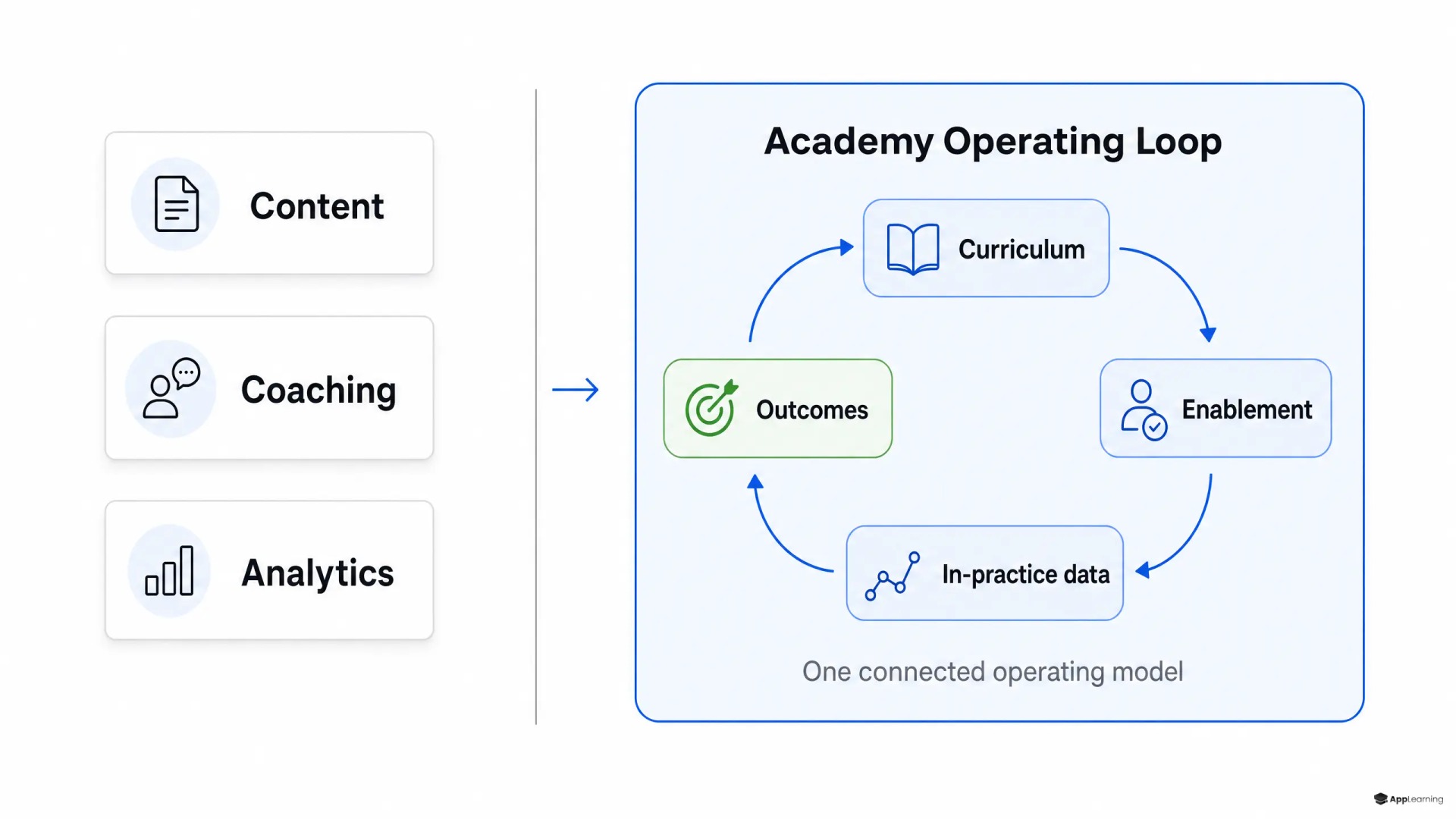
- Coaching and analytics turn training into an operating loop.
- A managed academy can simplify onboarding without adding an L&D team.
- Bundle the core workflow and keep specialist services modular.
The cost sits between the tools
Growing startups often buy learning in separate layers: an LMS for delivery, a content provider for courses, a consultant for rollout, and spreadsheets for reporting. Each purchase can look sensible alone. Together, they create gaps in ownership. When a new hire is slow to productivity, nobody owns the whole chain from source knowledge to manager reinforcement to demonstrated capability.
This is not only a procurement problem. It is an operating problem. Founders and functional leaders become the fallback support desk for onboarding, process questions, and missing documentation. Learning remains informal precisely when the company needs repeatable ways of working.
A K–12 transaction points to a broader shift
On August 25, 2026, CSA Education acquired BetterLesson and launched BetterLesson Learning, combining curriculum, teacher coaching, and professional learning under one organization. The announcement also said curriculum and analytics support could expand over time. One transaction does not prove that every enterprise buyer wants one vendor. It does show the commercial logic of reducing handoffs across the learning system.
The model is already visible in the BetterLesson Learning catalog, which spans courses, coaching, workshops, learning walks, and support across planning, launch, targeted support, and progress assessment. The relevant lesson is not to copy K–12. It is to design learning as a connected workflow rather than a shelf of separate products.
Implementation is where good content fails
A company can have strong onboarding content and still get uneven execution. Employees may complete modules but lack context for their role. Managers may explain the process differently. Teams may keep using old documents because the new material has no clear place in the workflow.
Implementation needs an owner and a cadence. That means assigning content owners, setting launch milestones, briefing managers, collecting learner friction, and updating the material when processes change. Coaching does not have to mean expensive one-to-one sessions. For a startup, it can mean manager enablement, office hours, role-based practice, and structured feedback at the moments where new hires apply knowledge.
Analytics closes the operating loop
Completion rates are useful hygiene metrics, but they do not show whether people can perform. The stronger question is whether the learning system exposes blockers early enough to fix them. BetterLesson’s Leader Hub frames observational data against learning goals, linking professional learning, practice data, and next investment decisions. The enterprise equivalent is simpler but follows the same logic.
For onboarding, track progress through required pathways, assessment results on critical knowledge, manager sign-off on applied tasks, time to role readiness, and recurring questions. Corporate learning analytics should then trigger an operational response: revise a module, clarify a process, brief managers, or add a practice task. Without that response loop, reporting becomes a dashboard that documents problems without resolving them.
Good to know
Is one K–12 acquisition proof that B2B learning buyers want bundled vendors?
No. It is a market signal, not universal proof. The practical test is whether the bundle removes real ownership gaps for the buyer without locking them into services they do not need.
What should a startup measure beyond course completion?
Measure readiness for the role: critical knowledge checks, applied tasks, manager validation, time to productivity, and the questions that repeat after onboarding. Choose a small set that leads to a clear improvement action.
Where should a managed academy start?
Start with the highest-frequency learning workflow, usually new-hire onboarding or a core role transition. Capture the knowledge, define the required proof of readiness, equip managers, and establish a monthly review cycle before expanding.
The managed academy becomes the operating layer
For a startup with 50 or more people, an integrated learning platform should function as a managed academy, not merely as an LMS or a content library. It should connect the materials people need, the support that makes those materials usable, and the signals that show where the system needs work.
- Structured role-based onboarding and internal academies
- Learning content services that turn scattered company knowledge into maintained pathways
- Manager enablement and rollout support for new processes
- Assessments and applied tasks tied to real work
- Corporate learning analytics that inform continuous improvement
This approach reduces operational complexity because it makes the handoffs explicit. A founder does not need to build an L&D department to establish content governance, onboarding standards, and a review cycle. The platform carries the workflow; the managed service helps the company run it.
Bundle the workflow and preserve choice
The core bundle should cover the workflow that repeatedly breaks when suppliers are split: platform access, initial academy setup, content operations, onboarding pathways, essential reporting, and a regular improvement review. Price this against an outcome the buyer can understand, such as reliable onboarding for a defined employee population or a role-readiness program for a growing team.
Keep services modular when need and intensity vary. Custom content production, deep systems integrations, executive coaching, specialist compliance work, and major change-program support should remain selectable. This keeps the managed academy clear and affordable while avoiding a false promise that every customer needs the same level of service.
Build onboarding as an operating system, not another tool.
ExplorePosition around the system, not the feature
An LMS vendor risks being compared on course libraries, seats, and feature checklists. A learning operations platform can instead own the path from source content to employee action to measured improvement. That is a stronger position because it addresses the work leaders are already doing manually across documents, managers, meetings, and disconnected tools.
For App-Learning, the practical offer is a managed academy that helps growing companies professionalize onboarding and internal training without creating another system to manage. The defensible product is not content, coaching, or analytics in isolation. It is the operating layer that makes all three work together as the company scales.