

Key takeaways
- Vendor academies can create value beyond support deflection.
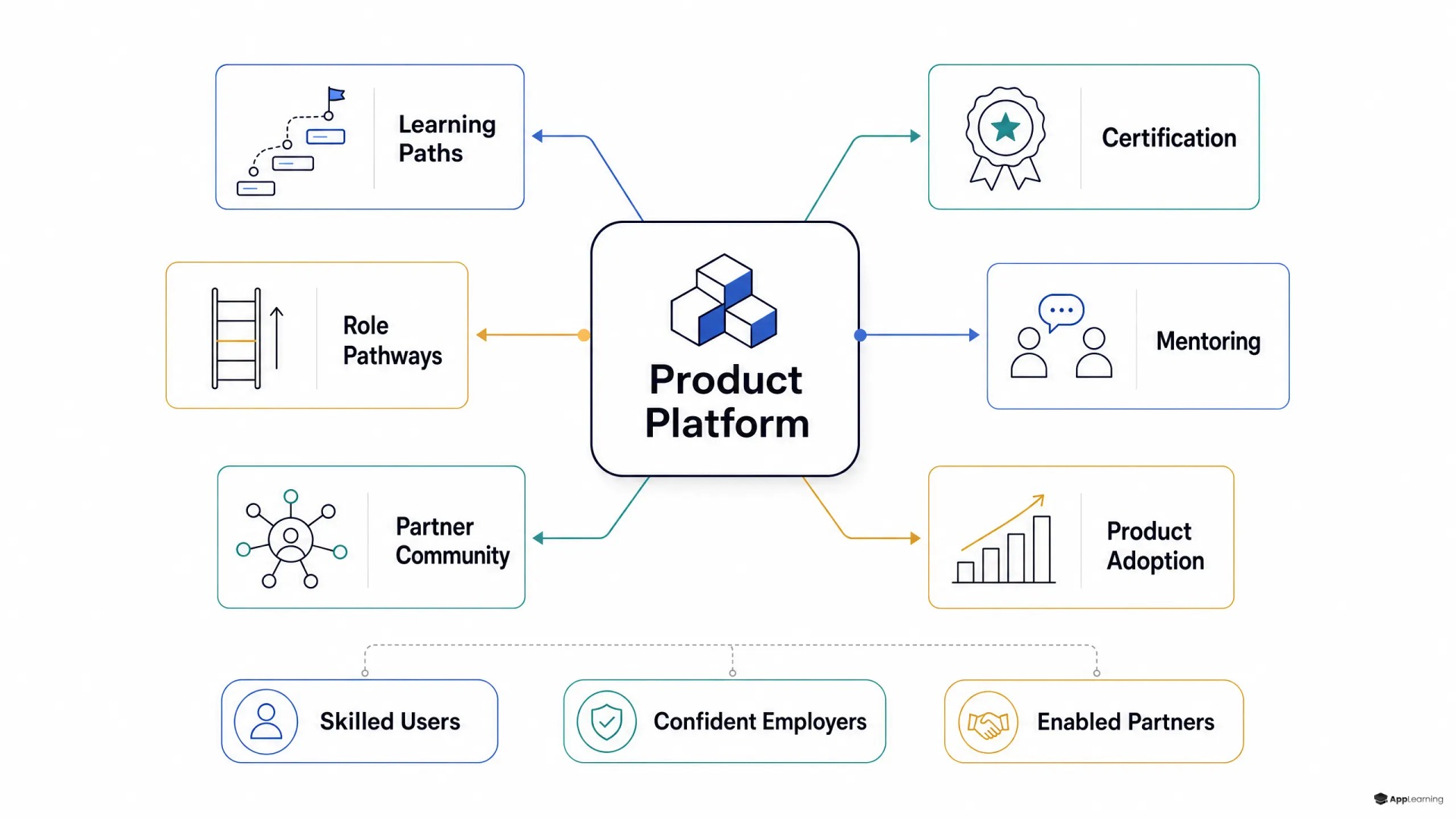
- Certifications and role journeys turn product knowledge into portable learner value.
- Mentoring and community strengthen partner and user ecosystems.
- Academy metrics should connect learning progress with adoption and ecosystem participation.
The academy moves past onboarding
Most product education starts as a support function. It explains features, reduces avoidable tickets, and helps new users complete setup. That work matters, especially in fintech, where unclear concepts can block trust before a user reaches first value. But it leaves value on the table when learning ends at product comprehension.
A stronger vendor academy makes expertise useful beyond the immediate session. It helps a user operate the product with confidence, gives a partner a repeatable delivery method, and gives an employer a clearer signal of capability. The academy becomes part of the product academy strategy, not a library sitting beside it.
ServiceNow offers a clear signal of this shift. Its May 2026 launch added AI-guided recommendations and simulations to a learning environment already serving customers, partners, employees, and independent learners. The stated aim was a faster path from learning to real-world capability on the platform.
Career value changes the course catalog
A course catalog organizes content. Career infrastructure organizes outcomes. It starts with a role that exists in the market, maps the work that role must perform, and gives the learner evidence that they can perform it. Courses are only one component.
This distinction matters for a certification academy. A badge has little value if it only proves that someone watched content. A credible credential should sit behind practical tasks, a defined standard, and a path that employers or partners can understand. That makes product knowledge more portable for the learner and more valuable for the platform ecosystem.
- Define a small number of high-value roles or use cases.
- Map each role to product workflows, judgement calls, and common errors.
- Use short learning units before real product actions.
- Add practice, review, or simulation before issuing a credential.
- Show the next role, specialization, or partner opportunity after completion.
Community turns learning into ecosystem capacity
Certification alone does not create an ecosystem. Learners need places to compare implementation patterns, ask questions, find peers, and build professional reputation. Mentoring adds another layer: experienced practitioners can help newer users apply knowledge in live contexts that a course cannot predict.
This is why the academy should connect to partner education rather than operate as an isolated content operation. ServiceNow describes its Career Journeys as combining technical training, credentials, power skills, resources, and community engagement for defined ecosystem roles. The important design move is not the scale of that model. It is the connection between learning, proof, people, and work.
Academy KPIs need to follow product value
Completion rate is a production metric. It tells you whether people finished learning, not whether they became more capable or more likely to stay. A customer education platform needs a measurement model that follows the learner into product use and ecosystem participation.
For fintech and crypto products, that means tracking education against the moments that create trust and durable usage. Measure activation of the first meaningful workflow, repeat use of the relevant feature, error reduction, verified capability, partner readiness, and contribution to the community. Compare educated cohorts with similar non-educated cohorts, while treating correlation as a starting point rather than proof of causation.
Good to know
What makes a vendor academy different from a help center?
A help center resolves immediate questions. A vendor academy builds capability through structured paths, practice, credentials, and ongoing support around real product roles or use cases.
Should a fintech offer certification to end users?
Only when the credential signals a meaningful capability. Start with lightweight completion proof for users, then reserve formal certification for advisers, operators, developers, implementation teams, or partners.
Which academy metric should a growth leader prioritize first?
Track the activation event that best predicts retained value. Then measure whether learners reach it faster and repeat it more often than comparable users who did not take the journey.
A lean academy can start with one valuable journey
Scaleups do not need to build a university. They need one coherent journey for an audience whose success matters commercially. That could be a new retail user learning risk controls, a finance team adopting treasury workflows, or an implementation partner configuring the product for clients.
Build the journey around three to five critical product actions. Add plain-language explanations for the financial concepts behind them, contextual prompts inside onboarding and lifecycle messages, a practical completion standard, and a small peer or expert layer. A live monthly office hour and a well-moderated discussion space often create more value than a large catalog of passive lessons.
Build the academy layer that turns product skill into lasting ecosystem value.
TalkThe infrastructure layer should stay lightweight
The operational challenge is not recording courses. It is keeping role pathways, product changes, credentials, communications, and measurement connected without creating a separate learning organization. App-Learning can provide this infrastructure layer: branded, engaging education flows that support adoption and certification while giving product, growth, marketing, and CX one system to work from.
The best vendor academy does not compete with the product experience. It extends it. When learners can gain confidence, prove capability, meet useful peers, and carry that value into their next role or project, education becomes a durable reason to adopt, remain, and participate in the ecosystem.