

Key takeaways
- The OECD findings concern responding public institutions, not all African education providers.
- Shared objectives make partner results interpretable without erasing local context.
- Participation, understanding, retention and behaviour are distinct measures of programme performance.
- Scam recognition and crypto-risk education need no investment recommendation.
- Language, device access and attrition belong alongside assessment results.
Only 11 of 28 Institutions Report Evaluating Financial Education Impact
In the OECD’s Africa Capital Markets Report 2026, (oecd.org) only 11 of 28 responding public institutions report assessing programme impact or effectiveness. The April–May 2026 stocktaking covers 20 jurisdictions, with some responses drawn from February 2025. These are self-reported practices, not representative findings for all African providers or causal estimates of programme effects.
A distribution contract is not an evaluation plan
When a partnership funds content and distribution but leaves assessment unassigned, reach becomes the available evidence. Registrations show participation, not understanding. Financial literacy partnerships need a shared definition of success before launch, especially when a fintech funds education distributed by a public institution or nonprofit.
The design principle is simple. Learning objectives belong in the education contract; activation and conversion belong in a separate commercial dashboard. Choosing not to invest must remain a valid learner decision.
A small measurement contract makes results interpretable
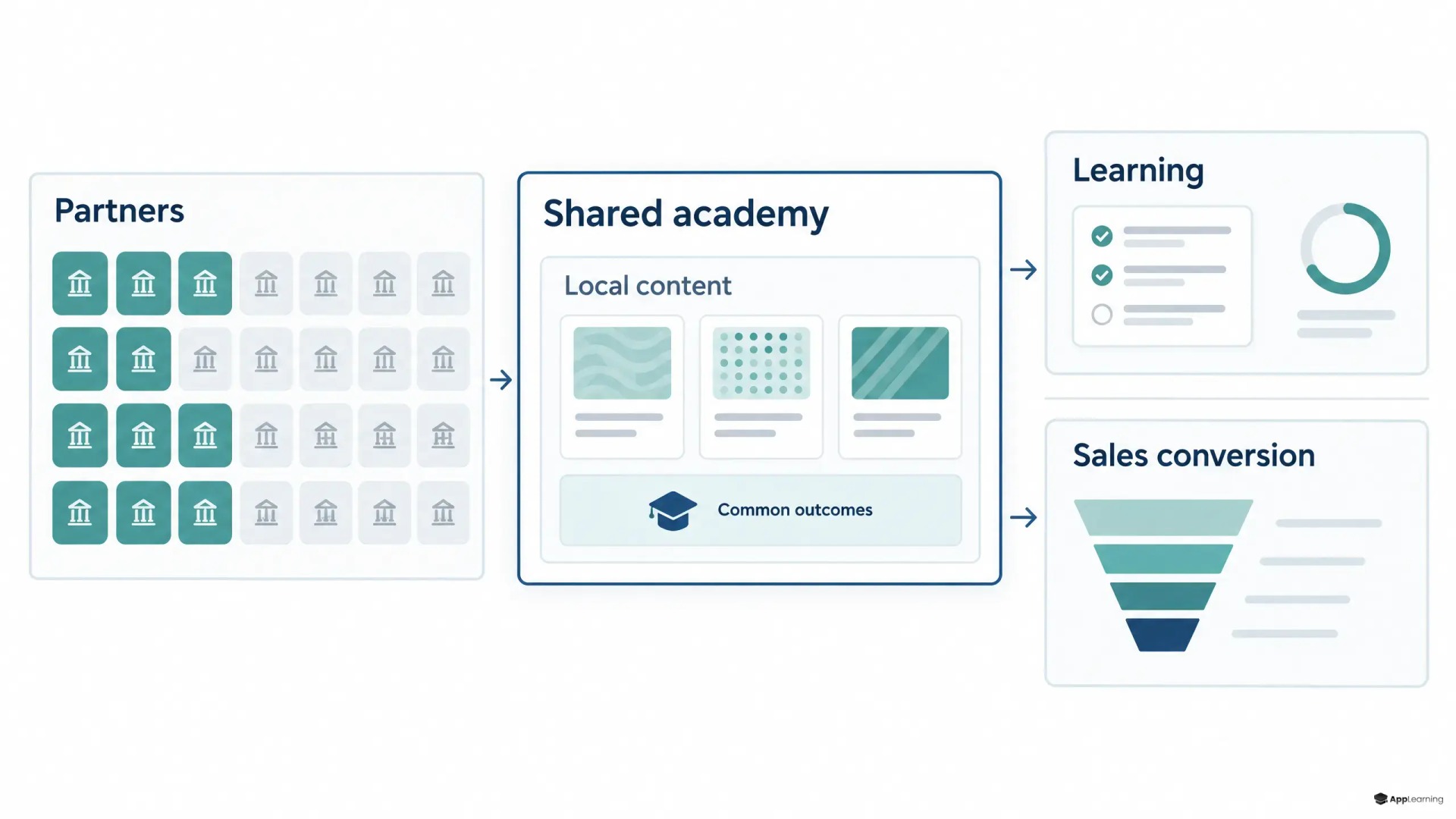
Under the OECD Recommendation on Financial Literacy, (legalinstruments.oecd.org) evaluation belongs in programme design. For a shared academy, the proposed contract would specify five elements.
- Population and denominator — eligibility, invitations, unique starts and completion rules.
- Baseline — a short knowledge check before content, with language and prior experience recorded.
- Assessment — common objectives, scoring rules and equivalent pre/post questions.
- Follow-up — a delayed knowledge check and separately optional behaviour survey.
- Privacy — pseudonymous identifiers, restricted access, deletion dates and separate follow-up consent.
Financial education impact measurement should distinguish observed learning change from attributable impact. Each partner would use the same definitions while documenting recruitment and audience differences.
Local language can change without changing the objective
Consider a hypothetical investment-risk module. Partners adapt language, currency examples and branding. The common rubric assesses whether learners recognise guaranteed-return scam cues, explain possible crypto-asset losses and identify an independent verification step. No asset recommendation or investment conversion target is included.
A white-label, modular academy could hold those objectives constant across distribution partners. This is the App-Learning design angle: shared assessment logic beneath local presentation. Translated items would need learner testing before scores were compared.
Good to know
Can partners compare results across languages?
Only cautiously, after testing translated assessments and documenting audience differences. A common rubric alone does not establish equivalent difficulty.
Where should activation and retention metrics sit?
In separate product reporting, with distinct hypotheses and evaluation designs. They should not replace learning measures or become conditions for educational success.
A pilot needs a scorecard rather than a leaderboard
A proposed pilot could involve three partners, one module and a 30-day follow-up. Its fintech education analytics would report the following fields without inventing a local baseline or promising improvement.
- Participation — invited, started and completed, with denominators.
- Understanding — matched pre/post sample size and score change.
- Retention — delayed-check response rate and retained knowledge.
- Behaviour — opt-in responses about verification practices, labelled self-reported.
- Access — reach and completion by language and device, accessibility barriers and attrition at each stage.
As GAO’s evaluation guidance explains, (gao.gov) comparison groups help separate programme effects from other influences. Pre/post gains alone would remain descriptive, not proof that the academy caused learning or changed financial outcomes.
Build a shared academy around measurable learning with App-Learning.
DiscussEvaluation needs an owner and protected funding
In World Bank guidance, (documents1.worldbank.org) evaluator independence supports credibility. The proposed partnership would assign the funder an evaluation budget, the academy operator instrumentation and version control, distribution partners local review and outreach, and an evaluator responsibility for analysis and limitations.
For investor education in Africa, scale should mean more than repeating content across channels. A credible partnership makes access visible, learning comparable and uncertainty explicit. Its evidence should show what people understood and retained—not how effectively education moved them towards a sale.