

Key takeaways
- Public sentiment does not establish an individual investor’s needs or justify a trade.
- Human approval turns trending confusion into a verified risk explainer.
- Education, product promotion and investment advice need clear boundaries.
- Learning rewards should recognise understanding rather than transaction frequency.
- Randomised rollout tests comprehension, not returns or increased speculation.
A fixed onboarding course cannot answer every new market story. Contextual financial education should add timely explanations without turning attention into a trading prompt.
Public mood is not personal intent
In the ECB Blog post published on 12 November 2026, (ecb.europa.eu) researchers describe the Reddit Retail Investor Sentiment Indicator, or R-RISI. A language model classifies posts by sentiment, topic and asset across communities including r/Bitcoin. The indicator aggregates public discussion into a high-frequency measure of retail investor sentiment. The authors report associations with next-day market returns, particularly during downturns.
Those associations do not establish causation, individual trading intent or educational effectiveness. The product implication is narrower than a trading signal. Public discussion can suggest a learning question for editors to investigate.
Timely education remains a hypothesis
A meta-analysis published in 2022, (iza.org) found positive average effects of financial education on knowledge and financial behaviour. That supports investment in education, not a claim that any short module works.
In a randomised mortgage-information experiment, (link.springer.com) decision-time explanations improved hypothetical financial choices. This is relevant evidence for just in time financial literacy, but it does not validate narrative-triggered crypto lessons. That transfer needs testing.
Bitcoin risk education explains mechanics
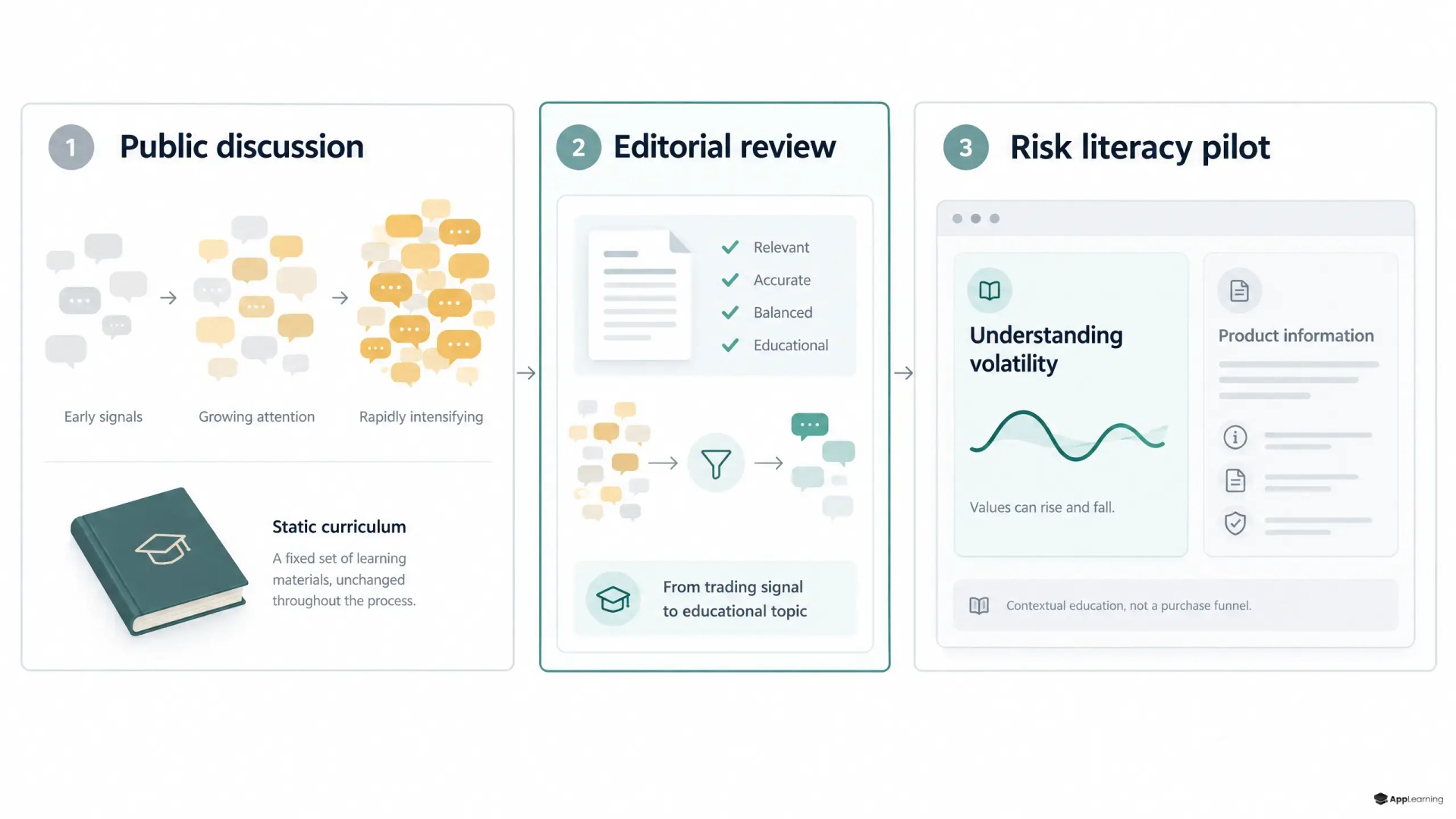
Consider a hypothetical surge in posts claiming that a Bitcoin price fall guarantees a rebound. Editors could approve a 90-second lesson distinguishing price movements from evidence about future returns. It could explain volatility, liquidity and uncertainty through a fictional scenario, followed by a comprehension check. No price target, buy button or instruction to hold belongs in that lesson.
A narrative-to-lesson pipeline needs owners
The trigger should open an editorial task, not automatically publish a notification. A practical workflow has five steps.
- Flag an unusual rise in aggregate discussion about an approved topic.
- Have an editor verify the narrative and identify one teachable misconception.
- Draft from approved sources, with AI assistance limited to summarising and formatting.
- Require editorial and compliance approval of wording, placement and targeting.
- Publish an optional academy card with an owner, version and expiry date.
For App-Learning, the useful system is a reusable lesson structure with controlled updates—not an endless stream of generated market commentary.
Education needs more than a disclaimer
For EU-regulated firms, MiFID II Article 24 and MiCA Article 66, (eur-lex.europa.eu) require fair, clear and non-misleading client information and identifiable marketing within their respective scopes. Compliance review must distinguish financial instruments from crypto-assets and assess each target market.
In its guidance on investment advice, (esma.europa.eu) ESMA explains that a disclaimer cannot prevent a communication from constituting advice when the relevant tests are met.
The pilot should therefore separate in-app investor learning from promotions and order entry. Invitations remain dismissible. Targeting uses aggregate topics, not Reddit identities, holdings or inferred anxiety. Privacy review sets analytics permissions, data limits and deletion schedules. Any gamification rewards demonstrated understanding, never deposits or trading streaks.
Build a neutral risk-literacy pilot with App-Learning.
DiscussThe experiment measures learning
A randomised invitation or randomised phased rollout can compare the module with existing education while preserving mandatory disclosures. Predefine comprehension and delayed recall as primary outcomes. Track opt-in, completion and customer-question themes as diagnostics. Analyse assigned groups, not only completers. Retention remains secondary; trading volume, returns and speculative activity are not success measures.
The aim is not to match Reddit’s emotional speed. It is to shorten the distance between a confusing narrative and a trustworthy explanation—without making the investment app another source of pressure.