

Key takeaways
- The Commission proposed the Digital Fairness Act on 11 November 2026; it is not enacted law.
- Coverage of educational streaks needs product-specific legal review, including relevant exclusions.
- Ethical gamification separates useful feedback from penalties for taking a break.
- Voluntary return and delayed assessment gains reveal more than daily activity alone.
- A controlled experiment can test redesigned mechanics before a wider rollout.
The proposal targets pressure rather than points
A streak can recognise practice or make absence feel costly. The distinction matters when the product’s purpose is understanding rather than daily attendance.
The European Commission’s 11 November 2026 Digital Fairness Act proposal (commission.europa.eu) targets dark patterns and addictive design. As of 12 November 2026, it is a proposal, not enacted law.
Proposed Article 17 (commission.europa.eu) would require disablement tools for specified features encouraging compulsive or excessive use, including penalties for missed engagement. This is not a blanket ban on learning streaks.
Attendance is not evidence of knowledge
An app opening cannot establish whether someone understands withdrawal fees or recognises a recovery-phrase scam. Fintech academy engagement should distinguish attendance, useful practice and demonstrated understanding.
A vocabulary-learning experiment (research-portal.uu.nl) found that points and progress bars improved reported motivation but not delayed recall. That does not establish how fintech learners will respond. It shows why motivation and knowledge need separate measures.
Motivation can survive a missed day
Ethical gamification need not remove feedback. A proposed redesign can preserve encouragement through three patterns.
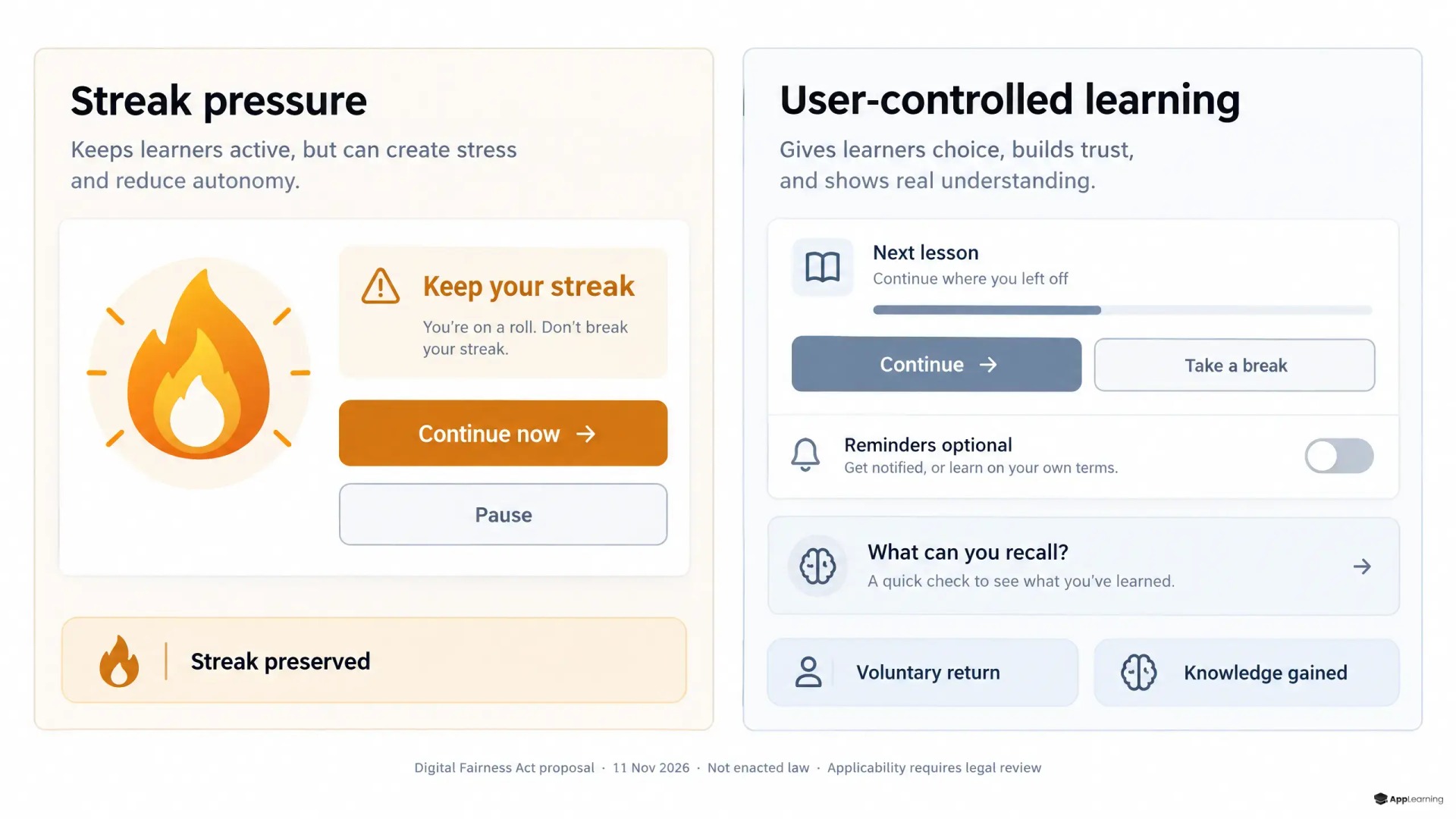
- Optional streaks remain learner-controlled, with pause settings and no punitive resets or loss of earned progress.
- Mastery milestones recognise demonstrated understanding, such as explaining custody risks, rather than consecutive visits.
- Spaced recall brings concepts back after a delay, with corrective feedback and an easy route to resume.
Roediger and Karpicke’s experiments (psychologicalscience.org) found better delayed retention after retrieval testing than repeated study. For microlearning retention, this supports testing what learners can recall later—not treating completion as proof.
Learning controls belong to the learner
As a design rule, reminder permission should be separate from lesson access. Learners choose timing and frequency, can stop reminders easily and return without a guilt message.
Learning rewards should also remain separate from financial transactions. A badge can recognise understanding of risk without rewarding a deposit, trade or purchase. Assessment quality should not depend on whether the learner buys the product.
The experiment needs two scorecards
A proposed A/B test would compare a legally reviewed baseline with an optional, non-punitive streak version. Content, assessments and reminder settings would remain constant.
- Behaviour measures include return sessions without a recent reminder, meaningful practice, reminder opt-outs and complaints.
- Learning measures include baseline-to-post-assessment gain and delayed recall using equivalent, unfamiliar scenario questions.
Unprompted return is a proxy for voluntary return, not proof of intent. The test plan should define its reminder-free window, acceptable learning-loss margin and decision rules before launch. Analysis should include all assigned learners and disclose missing assessments.
Test a learner-controlled reward loop with App-Learning.
DiscussThe release needs a scope check
The proposal’s education-related exclusions (commission.europa.eu) make product-specific legal review essential. Neither automatic coverage nor automatic exemption is a safe assumption for an embedded fintech academy.
The release checklist should cover reward logic, pause behaviour, reminder controls and consistent settings across web, mobile and languages.
For App-Learning’s mix of short lessons, quizzes and gamification, the strongest design test is straightforward. Learners should be able to leave without punishment and return to demonstrate understanding—not rescue a counter.