

Key takeaways
- Mandatory completion and voluntary adoption measure different things.
- Self-enrolment signals perceived value, not proven competence.
- Internal word of mouth can expand learning beyond assigned cohorts.
- Fast friction resolution matters because learners experience the academy as a product.
- Combine organic adoption with assessment, progression, and on-the-job outcome metrics.
Completion records a process, not demand
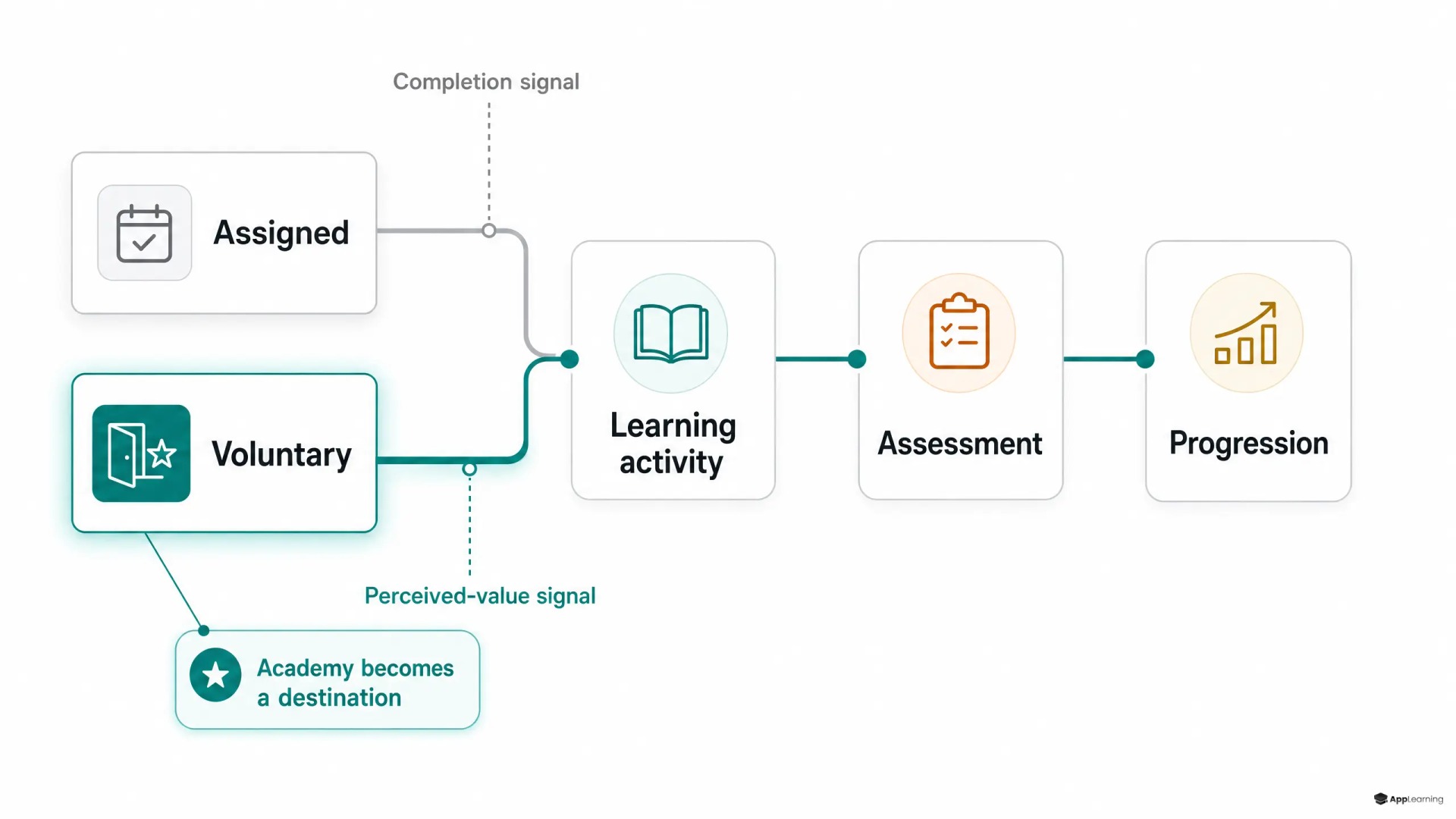
A completion rate answers a narrow but necessary question: did the assigned learner reach the required endpoint? In banking, fintech, and crypto, that evidence matters. Compliance paths must be completed, recorded, and auditable. But completion cannot tell an HR or L&D lead whether employees found the academy useful, relevant, or worth returning to.
An academy can achieve perfect mandatory completion through reminders, deadlines, manager escalation, and policy. None of those mechanisms creates employee academy engagement. They create compliance with an assignment. Treating that number as a proxy for learner demand leads teams to overestimate the value of a platform that employees only visit when they have no alternative.
Organic adoption reveals a different kind of signal
Voluntary learning starts when an employee who was not assigned a course chooses to join, browse, begin, and continue. That choice is a product signal. It suggests that the academy has crossed a basic threshold of perceived value: someone expects it to help with a role, a career move, a current problem, or a topic colleagues have recommended.
This distinction has support in workplace-training research. A study of employees in an insurance company found that voluntary enrolment had a stronger association with autonomous motivation to transfer learning than mandatory enrolment. That does not make self-enrollment training a measure of performance. It does make it a useful signal that the learner’s reason for joining differs from simple compliance.
The operational question is therefore not whether mandatory or voluntary learning is better. Regulated organizations need both. The question is whether the internal academy has enough pull to serve people beyond the assigned cohort.
Interest is not evidence of capability
Self-enrolment can be misleading when teams treat it as proof of impact. Employees may enroll because a manager mentioned a topic, a certificate looks useful, a launch campaign created curiosity, or a colleague shared a link. Those are positive signs, but none proves new knowledge, skill application, or improved performance.
Use voluntary enrollment as an early indicator, then test the rest of the chain. The U.S. Office of Personnel Management’s evaluation guide defines training effectiveness through on-the-job application and measurable results, not participation alone. The distinction protects L&D from two common errors: dismissing organic demand because it is not an outcome, and overselling demand as an outcome.
Pull depends on product conditions
People experience an academy like any other internal product. If access fails, search is weak, catalog names are vague, or support tickets sit unresolved, employees will not separate those faults from the learning offer. They will decide that the academy is not worth the effort.
Learning platform activation improves when the experience makes a clear promise and keeps it. The core conditions are practical:
- Frictionless access through the systems employees already use.
- Clear packaging that states the audience, time commitment, and job-relevant outcome.
- Role-specific content that sits beside mandatory compliance rather than hiding beneath it.
- A simple path from discovery to first learning action.
- Fast resolution of login, assignment, and content issues during rollout.
- Visible trust signals such as current content, accountable owners, and credible subject-matter experts.
This is where internal LMS adoption becomes a product discipline as well as an L&D discipline. Content quality matters, but so do discovery, navigation, service response, and the small moments that decide whether an employee starts now or closes the tab.
Good to know
Is voluntary enrolment a better metric than completion rate?
No. Completion rate is essential for mandatory and compliance training. Voluntary enrolment adds a separate signal about perceived relevance and academy pull.
How should we define a voluntary learner?
Define voluntary learners as eligible employees who enroll without a policy assignment, manager enrollment, or automatic cohort rule. Keep campaign-driven enrollments as a separate source where possible.
What should L&D investigate when voluntary enrolment is low?
Check access friction, catalog clarity, content relevance, manager support, launch communication, and whether employees can see a direct benefit for their current role.
A dashboard needs both assigned and self-directed behavior
Do not merge mandatory and voluntary activity into one adoption number. That hides the very behavior the academy needs to understand. Instead, separate assigned cohorts from self-directed learners at the event level and review the pattern by role, business unit, location, tenure, and topic.
A useful reporting set combines demand, learning, and application:
- Voluntary enrolment rate among eligible but unassigned employees.
- Activation rate after self-enrolment, such as a meaningful first session or first module completion.
- Progression through a pathway rather than one-off course starts.
- Assessment performance and confidence at relevant decision points.
- Repeat visits, further voluntary enrollments, and recommendations to colleagues.
- Evidence of skill application or business outcomes for priority capability areas.
App-Learning can make this analysis practical by retaining enrollment source as a first-class data point. Record whether a learner was assigned by policy, enrolled by a manager, joined through a campaign, or chose a course independently. That segmentation shows whether a rollout merely moved a required cohort through training or began to create voluntary learning demand.
See the adoption signals your academy can reveal.
ExploreAn academy becomes a destination through earned relevance
The strongest internal academies do not replace compliance. They make the required experience reliable, then build a second layer of value that employees choose. When people enroll without a reminder, the organization has not yet proven capability. It has earned something equally important: permission to keep improving a learning product that employees believe is worth their time.