

Key takeaways
- Reuse removes duplicate work but creates downstream dependencies.
- A chapter’s position and its underlying content identity are different records.
- Editors need a used-in view before changing shared learning content.
- Scope-limited review must stop when a shared dependency reaches an unapproved course.
- Versioning rules make reusable content safer than global overwrites.
Reuse trades duplication for dependency
Reusable course components are a sensible response to a real production problem. A financial product team should not rewrite the same explanation of fees, risk, security settings, or Bitcoin transfers for onboarding, feature education, support deflection, and partner training. One maintained object can keep language, visual standards, and product facts consistent across web and mobile learning journeys.
But LMS content reuse changes the nature of editorial work. A chapter is no longer only a chapter. It may be a reference to a shared record that also appears in two other modules, a localized journey, or a course for a different customer segment. The reduction in duplicate content creates a dependency graph that must be managed.
Placement is not content identity
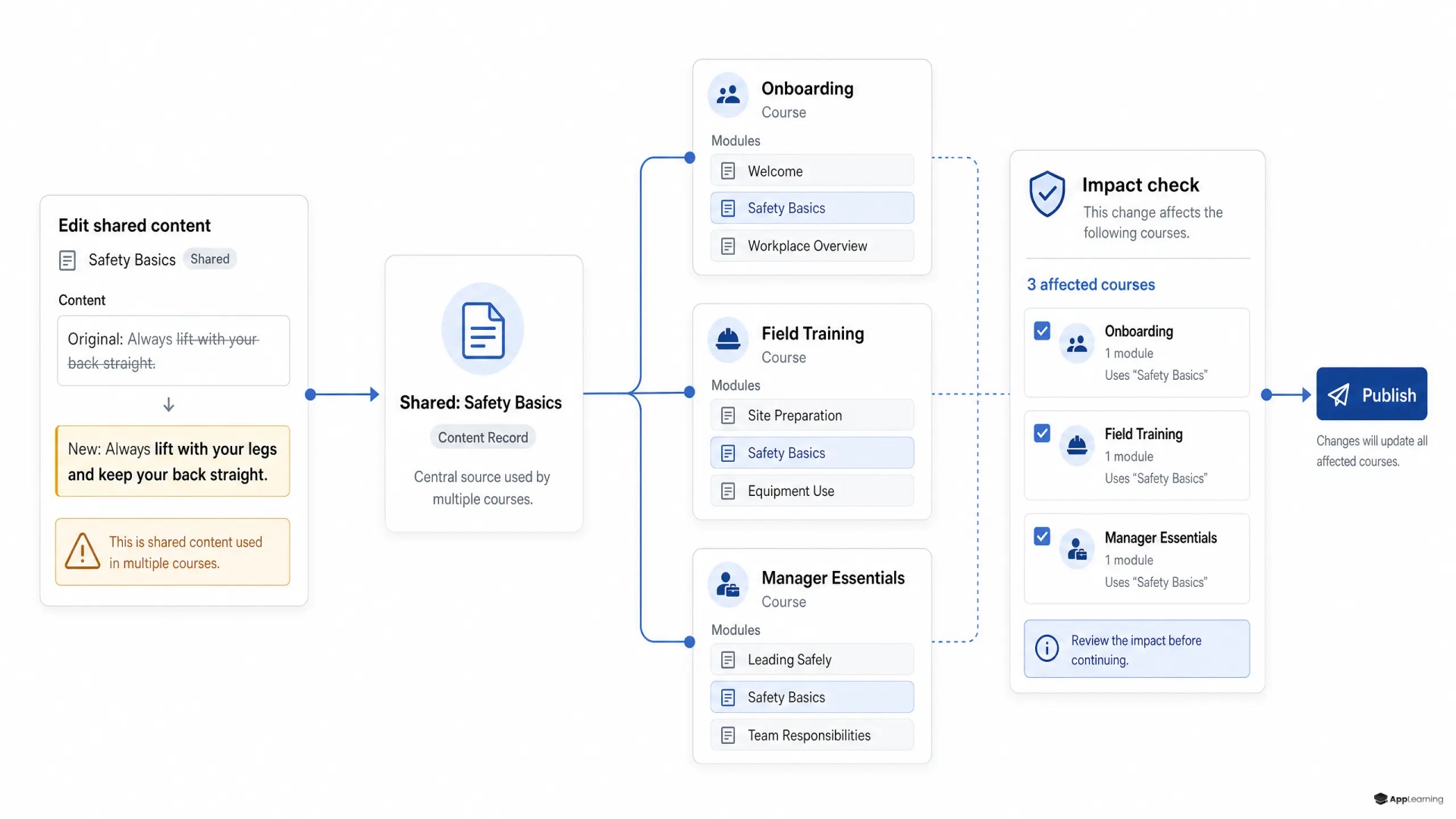
A course position answers where a learner sees something: module three, after account setup, before an assessment. Content identity answers what editable object supplies that experience: a stable chapter, card set, question bank, video, or compliance notice. These are separate concerns and should remain separate in the data model.
When a platform collapses them into one record, editors lose the ability to distinguish a local course change from a global content change. An editor may open a chapter from an activation journey, correct one sentence, and unknowingly update the same chapter in an advanced trading course. The visible location suggests local ownership while the underlying record has wider reach.
Invisible references turn corrections into releases
The failure is rarely dramatic at the moment of editing. The text may be more accurate. The design may be cleaner. The assessment may be better aligned with a feature. The problem is that another learning journey now carries a change that no one reviewed against its own goal, audience, language, release timing, or approval scope.
For a fintech product, that can mean an onboarding flow receives wording intended for an experienced-user module. It can also mean a local team loses a carefully adapted explanation because a global object was overwritten. The operational issue is not reuse itself. It is the absence of curriculum dependency management around reuse.
Impact analysis belongs before publication
Course impact analysis should be a standard publish control, not a manual investigation when something goes wrong. Before an editor changes a shared object, the platform should resolve its stable content ID and return every active placement that references it. The result must be useful to a person making a release decision, not merely available in an engineering log.
- Show every course, journey, locale, and product surface that uses the record.
- Separate direct references from inherited or nested references.
- Mark placements outside the editor’s approved scope.
- Show whether each placement uses the live object or a pinned version.
- Require an explicit decision to update globally, create a new version, or stop.
This turns a hidden side effect into a visible choice. It also creates an audit trail: which object changed, who approved the reach of that change, and which learner-facing experiences received it.
Good to know
What makes a learning object shared?
A learning object is shared when several course placements reference the same editable content record rather than separate copies. Updating that record can therefore change every placement that follows it.
When should a team create a new version instead of editing globally?
Create a new version when the change affects audience level, learning sequence, local context, assessment logic, or an approval boundary. Use a global update only when every active placement should receive the same change.
What should a used-in view include?
It should show all affected courses, learner journeys, locales, release states, content owners, and whether each placement follows a live or pinned version.
Scope isolation protects unrelated journeys
A narrowly scoped review needs a firm stop rule. If an approved correction targets a shared record and the impact view shows that the same record appears in a course outside the review scope, the workflow should stop before changing the live object. The editor should not infer permission from technical access.
At that point, the owner can widen the approval, create a course-specific variant, or publish a new version for selected journeys. This is less convenient than clicking save, but it prevents an apparently small content fix from becoming an unreviewed release across the curriculum.
Versioned reuse beats permanent global coupling
Not every change deserves a fork. A typo correction or a universal product-name update may belong everywhere. But an explanation that changes learning intent, audience level, sequence, regulatory framing, or assessment logic should usually become a new version rather than overwrite the shared baseline.
The practical pattern is simple. Keep a canonical content identity, preserve a version history, and let each placement either follow the current approved version or pin to a known release. Global reuse then remains available for truly global updates, while course owners retain control when their learning journey needs to diverge.
Make shared content safe before it becomes invisible.
Talk to usShared curriculum needs a visible control plane
App-Learning can make this model operational by separating stable content identity from chapter placement, maintaining reference maps across learning journeys, and presenting a used-in view before publication. The same system can flag an out-of-scope dependency, guide the editor toward a versioned alternative, and keep local changes local when that is the safer choice.
Reusable learning content is not a library feature alone. It is release management for curriculum. Platforms that expose dependencies can scale education across onboarding, feature adoption, and international markets without asking editors to remember every place a chapter might be used. That is how reuse becomes controlled leverage rather than hidden change risk.