

Key takeaways
- Ticket resolution reveals confusion patterns but does not measure customer learning.
- Agent diagnoses need human validation and privacy-safe aggregation before content creation.
- Contextual microlearning should address a specific misunderstanding at the relevant product moment.
- Comprehension checks and controlled comparisons matter more than raw ticket counts.
The investigation is not the learning outcome
Retool’s November 18, 2026 engineering report describes 851 support-agent investigations since June, with 94% fully or partially correct among 138 assessable graded cases. (retool.com) That is internal reporting, not an independent benchmark or evidence of 94% accuracy across all investigations.
These figures concern investigations, not customer understanding. The opportunity for in-app product education begins after a diagnosis has been checked, when repeated misunderstandings become candidates for a lesson—not instructions for a bot to publish.
One repeated misunderstanding becomes the brief
Consider a proposed fintech workflow, not a deployed client case. Customers repeatedly ask why a pending transfer has not increased their spendable balance. Support ticket insights should distinguish a knowledge gap from a misleading label, processing failure or outage. Education is appropriate only when the explanation—not the product—is missing.
The content boundary excludes customer histories
The European Data Protection Board distinguishes pseudonymisation from anonymisation, which makes data unlinkable to an individual. (edpb.europa.eu) Removing names alone should therefore never be treated as proof that a ticket is safe for content production.
The European Commission’s guidance also requires purpose limitation and data minimisation when processing personal data. (commission.europa.eu) The proposed workflow keeps raw cases inside approved support systems and sets a separate boundary for lesson creation.
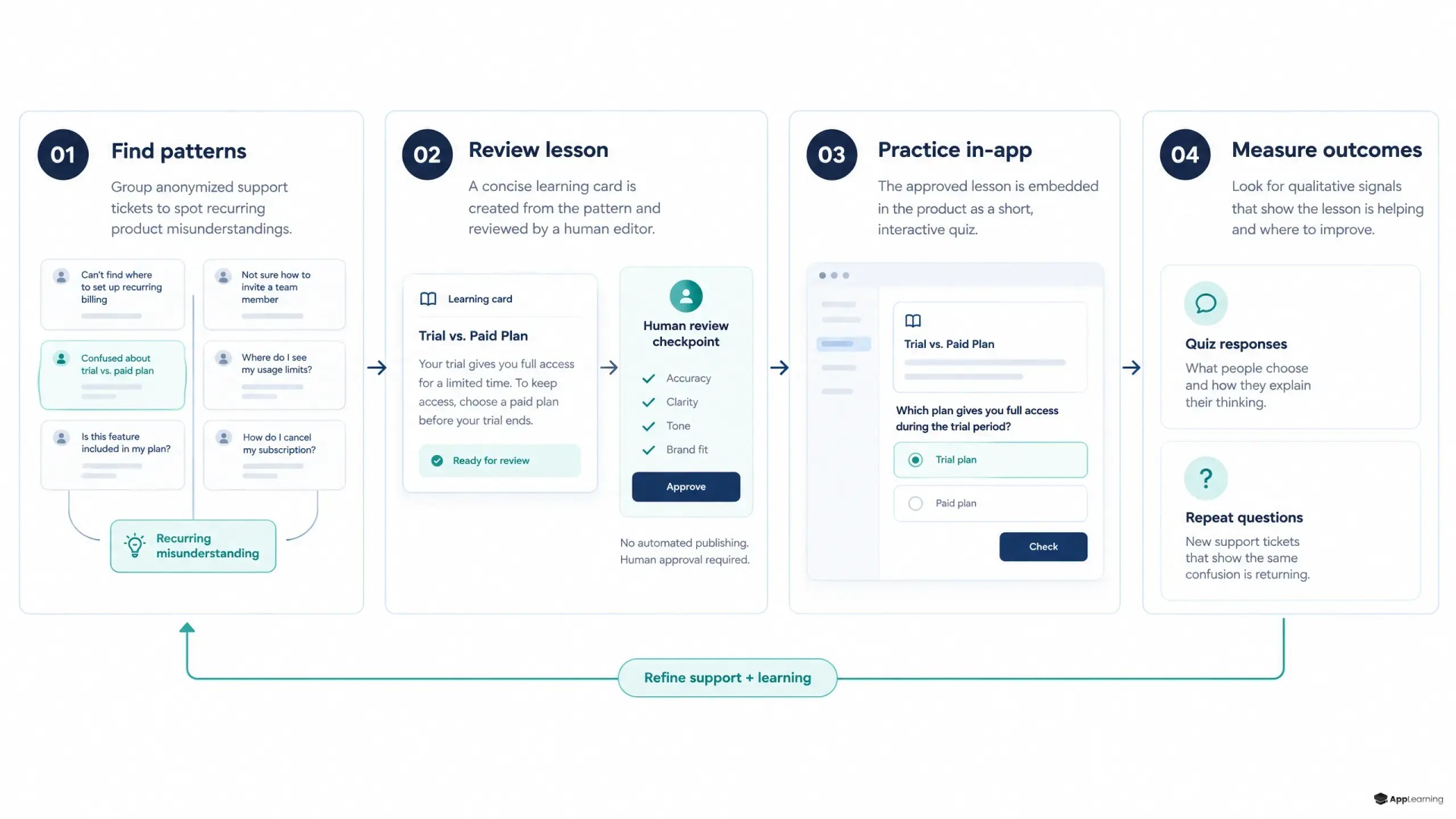
- Validate the agent’s diagnosis against the closed case and assign a confirmed issue category.
- Remove personal identifiers and identifying transaction details within the approved environment.
- Aggregate recurring misunderstandings and replace customer histories with synthetic examples.
- Have product and compliance reviewers approve accuracy and wording before publication.
- Record the owner, product version, review date and withdrawal trigger.
Two minutes should resolve one distinction
For the illustrative balance issue, contextual microlearning could appear beside the pending status. The design target is 60–90 seconds of explanatory swipes followed by one diagnostic scenario, within roughly two minutes overall.
- A visual distinguishes pending funds from spendable funds using the product’s approved definitions.
- A synthetic scenario shows how the balance changes when settlement completes.
- A knowledge check asks which balance is available before settlement, then explains the correct answer.
The lesson remains optional, with support accessible throughout. App-Learning’s proposed role is this short-form learning layer at the point of friction, rather than another generic FAQ wall.
The ticket taxonomy connects explanation to outcomes
The measurement plan should connect issue category, lesson version, exposure and first-attempt answer accuracy through privacy-reviewed identifiers. It should compare same-issue repeat contacts over a defined window, using eligible customers as the denominator. The taxonomy can also inform fintech customer support training without confusing staff readiness with customer comprehension.
Lower contact volume needs a credible comparison
A field experiment at a cloud infrastructure provider found fewer support questions after proactive education, but the effect faded within a week. (pubsonline.informs.org) That supports testing the hypothesis, not promising equivalent results for fintech customer self-service.
Government A/B testing guidance recommends random allocation between comparison groups. (gov.uk) Here, eligible users would receive either the lesson offer or the existing experience. Baseline rates, observation windows and success criteria should be fixed beforehand. A phased rollout without randomisation remains weaker evidence; a simple before-and-after decline cannot establish causation.
Turn one recurring support issue into a reviewed in-app learning pilot.
DiscussA narrow pilot makes responsibilities visible
- Product owns the trigger, integration and outcome definition.
- Support owns the taxonomy and diagnosis review.
- The learning team owns approved content, localisation, versioning and rollback.
Support automation and education should remain complementary loops. One investigates today’s problem; the other tests whether a reviewed explanation prevents tomorrow’s misunderstanding. Neither loop removes the need for human judgement.