

Key takeaways
- Binance limits eligibility by registration date and region rather than offering rewards universally.
- The 0.00001 BTC vouchers require KYC, have a 5,000-user monthly cap and expire after 14 days.
- Quiz completion, comprehension, verification, redemption and retained usage need separate metrics.
- Reward-seeking can inflate completion figures without demonstrating transferable knowledge.
- Reward and non-reward cohort differences are not automatically causal effects.
The KYC Gate Inside a Bitcoin Learning Reward
Bitcoin learn and earn can connect education to account activation. But passing a quiz, verifying an identity and becoming a retained customer are different outcomes. One completion rate cannot explain all three.
The voucher sits behind several gates
Binance’s November 11, 2026 announcement offers qualifying new users registered after November 1, 2026 at 00:00 UTC a 0.00001 BTC voucher for answering every quiz question correctly. Rewards are limited to the first 5,000 new users monthly. KYC is required, and regional restrictions apply.
The stated distribution window is 48 hours for qualified learners. Vouchers expire 14 days after distribution, not quiz completion. Binance may change the terms or end the campaign. The announcement supplies no conversion, acquisition-cost or learning-retention results.
The funnel needs separate denominators
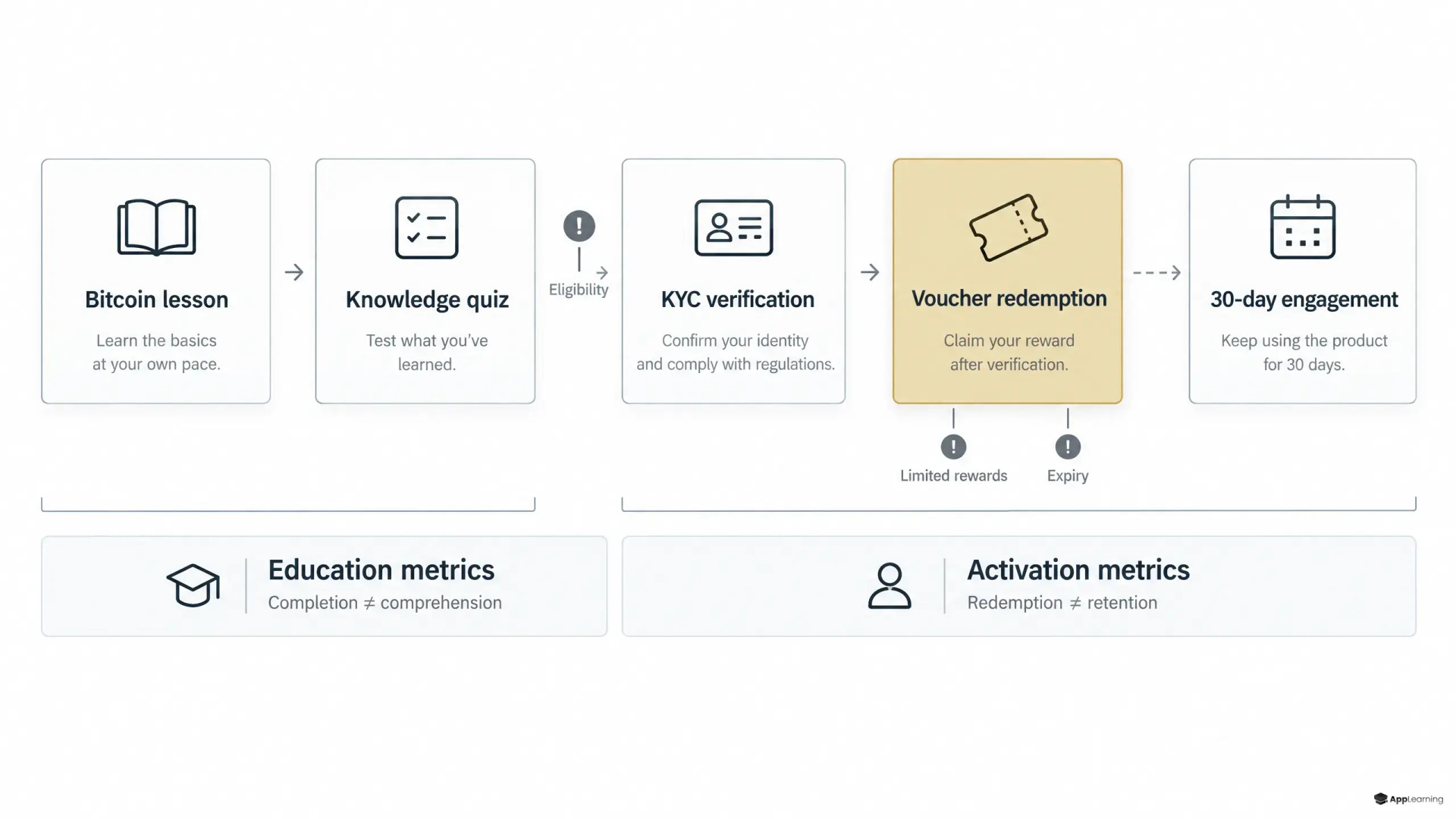
For an App-Learning-style embedded academy, the proposed fintech activation funnel would separate these stages rather than report one blended success rate.
- Eligibility and enrollment record qualification, academy entry and lesson starts.
- Learning records lesson completion, quiz attempts and first-attempt accuracy.
- Verification records KYC starts, submissions and approved, rejected or pending decisions.
- Rewards record qualification, voucher issuance, redemption and expiry.
- Retention records a predefined meaningful product action 30 days after activation, excluding reward collection.
Each transition needs its own denominator and elapsed time. These are proposed measurement stages, not a claim about Binance’s screen order. Learning analytics should receive verification status, not identity documents.
Abandonment needs a reason code
A failed quiz, unfinished identity check, pending review, exhausted reward pool and expired voucher require different responses. Treating them all as educational drop-off would direct effort at the wrong problem.
The reward budget should distinguish committed vouchers from redeemed rewards, verification costs and support costs. Proposed anti-abuse controls should include duplicate-claim checks and review paths. Neither fast completion nor a perfect score should alone establish abuse.
Local rules define the reward boundary
The EBA’s remote-onboarding guidelines address safe onboarding under AML and data-protection requirements for covered institutions. In crypto onboarding KYC, educational completion cannot substitute for identity controls.
For covered EU crypto-asset service providers, MiCA Article 66 requires fair, clear and non-misleading communications. The UK’s cryptoasset promotion rules prohibit incentives to invest. Bitcoin education rewards therefore need jurisdiction-specific review before launch; an educational label should not be treated as an exemption.
Learning needs evidence beyond the rewarded quiz
A rewarded pass could reflect comprehension, prior knowledge or answer-seeking. A stronger measurement plan would add a baseline question and a delayed, unrewarded scenario using different wording. Explaining a custody risk is a different test from recognising a repeated answer.
Reward and non-reward cohorts also need careful interpretation. As J-PAL explains in its evaluation guidance, participant selection can undermine causal comparisons. Random assignment among eligible users, where lawful and feasible, offers a stronger design than comparing volunteers with everyone else.
Map your academy’s learning and activation gates with App-Learning.
DiscussThe academy needs a job after redemption
Gamified financial education should connect to the learner’s next decision, not another payout. Short, localisable modules could explain custody before a transfer or recurring-buy settings before confirmation.
- Define comprehension and retained-use outcomes before launch.
- Track reward availability and verification delays by cohort.
- Compare cohorts over equal follow-up windows.
- Report uncertainty alongside conversion differences.
The reward is an entry mechanism, not the educational result. A durable academy makes the next product decision more understandable—and measures that separately from the voucher collected along the way.