

Key takeaways
- Customer training needs separated audiences, branded access, and low-friction sign-in.
- Product adoption and time to value matter more than course completion alone.
- Customer-facing learning should feel like part of the product, not an HR portal.
- App-Learning fits fintech teams using education to improve activation, trust, and retention.
Customer learning behaves like a product surface
An LMS for customer training is not simply a place to host courses. It must help external users understand a product, make safer decisions, and reach value without creating a support dependency. For fintech and crypto products, that may mean explaining verification, account funding, fees, risk, custody, or a new feature at the moment a user hesitates. The platform therefore needs audience separation, simple access, strong branding, short learning formats, and data that connects education to product behaviour.
Internal LMS logic creates external friction
Many LMS configurations start with an employee assumption. Learners have company accounts, HR owns enrolment, managers need compliance reports, and a standard portal is acceptable. Customers are different. They may arrive through a product prompt, email, help centre, partner, or public search. They expect a familiar brand, a fast answer, and no exposure to internal content. If external access, segmentation, and administration are bolted on late, the customer training LMS becomes harder to manage just as adoption needs to scale.
Academy-led design closes the journey gap
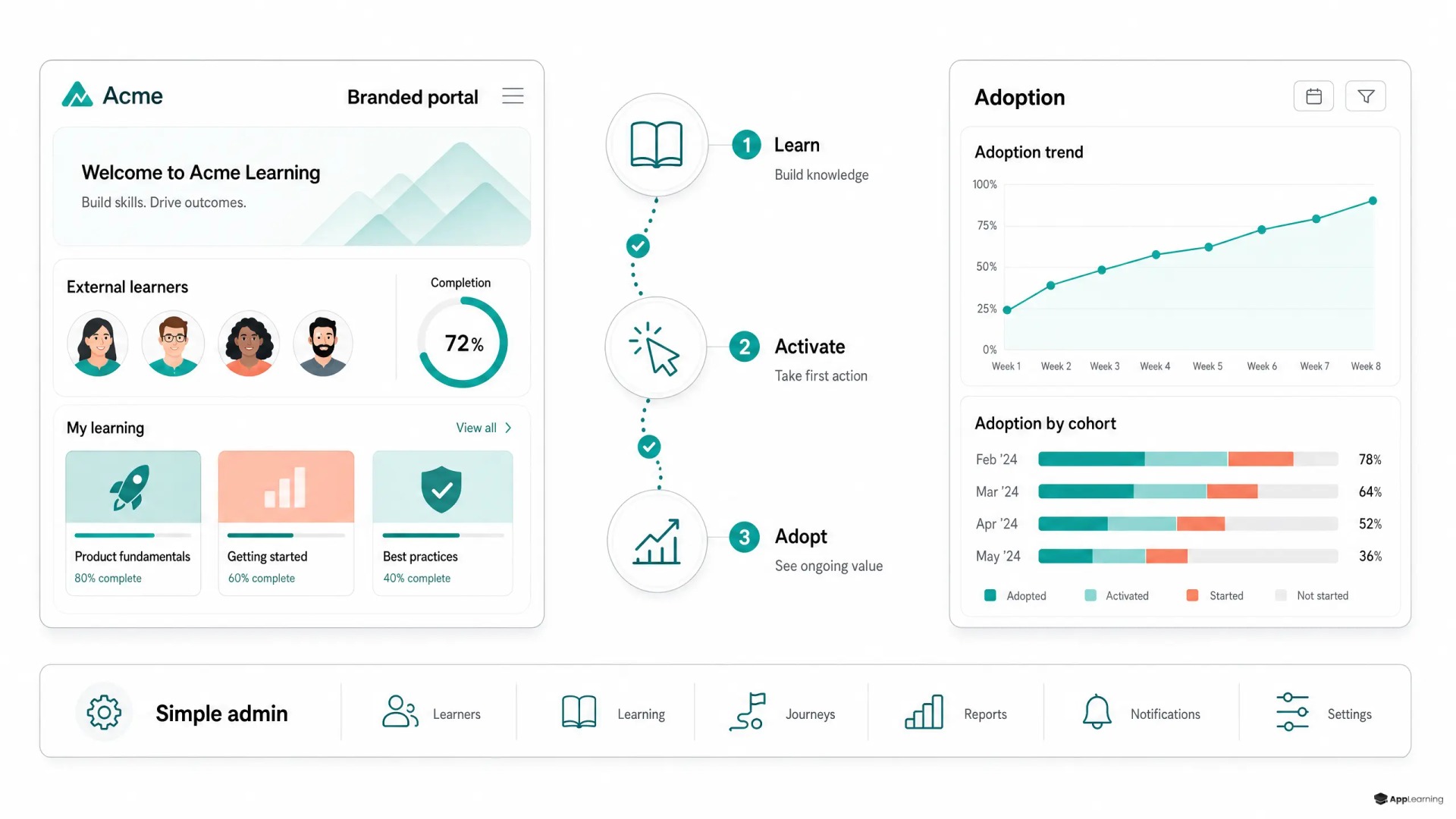
An academy-led model is useful when learning must support activation and retention rather than operate as a separate enablement function. App-Learning’s customer education approach centres on branded academies, short lessons, quizzes, gamified progression, and analytics that can connect education to onboarding and lifecycle journeys. This is a better fit when the core job is making a complex financial product easier to understand and use with confidence.
Platforms worth shortlisting by fit
There is no universal winner. The best LMS platforms for customer training match the operating model behind the program.
- Skilljar is a strong fit for dedicated customer education teams that need an academy, in-app learning, account-level insight, and connections to customer systems.
- Docebo suits organisations managing customers, partners, and employees across distinct branded external-learning environments.
- LearnUpon is worth evaluating when CRM-led provisioning, lifecycle-based learning journeys, and centralised customer data are priorities.
- TalentLMS fits teams that need separate customer portals, local admins, tailored catalogues, and clear audience boundaries without a heavy enterprise setup.
- Absorb LMS is relevant for organisations that want targeted customer training and branded experiences managed from one learning system.
- Moodle Workplace belongs on the list when certifications, reporting, gamification, and deeper platform configuration justify more implementation ownership.
Procurement criteria that expose weak fits
Do not start with course authoring. Most platforms can publish a module and issue a completion record. Test the mechanics that determine whether customers will use the system and whether your team can run it.
- Audience architecture with public, gated, SSO, account-based, and partner access options.
- Brand control across domain, login, navigation, catalogue, emails, and mobile experience.
- Content operations that let Product, Growth, CX, and Compliance update approved modules without breaking governance.
- Certificates and assessments for users who need proof of knowledge or recurring training.
- Data export, APIs, and integrations that make learning events available beside product and CRM data.
- Admin roles and workflows that keep customer operations simple as regions, products, and audiences expand.
Good to know
Can an internal LMS also support customer training?
Yes, if it can separate external audiences from employees, provide customer-grade access and branding, and share learning data with product, CRM, and customer-success systems. The test is not whether customers can log in. The test is whether the experience and operating model work at customer scale.
Which customer training metrics should a fintech team prioritise?
Start with the product action that signals value, such as completed verification, first deposit, first transaction, activated card, or adoption of a high-value feature. Then measure whether learners reach that action faster or more often than a comparable non-learning cohort.
When is an academy-led platform a better choice than a traditional LMS?
Choose an academy-led approach when education must support product onboarding, trust, activation, and retention. It is especially useful when users need short, repeated explanations across product screens, lifecycle messages, and a branded learning destination.
Analytics must show customer movement
Completion is a diagnostic metric, not the outcome. A customer may finish a course and still fail to fund an account, activate a card, complete a first transaction, or use a high-value feature. Define one learning cohort and compare it with a similar non-learning cohort. Track progression from invitation to lesson start, quiz confidence, target action, time to first value, feature adoption, repeat use, and relevant support contacts. This does not prove education caused every change, but it gives Product and Growth a practical basis for testing whether the learning journey removes friction.
Turn product education into a measurable customer journey with App-Learning.
TalkA shortlist becomes a decision through a real pilot
Run the evaluation around one customer problem, not a generic demo. For a fintech team, choose a point of friction such as identity verification, first deposit, wallet setup, or feature discovery. Build the same short journey in the final two or three platforms and test the operating reality.
- Invite a defined user segment through the real onboarding or lifecycle channel.
- Measure access success, learner drop-off, target product action, and admin effort.
- Ask whether the experience feels like a useful product extension rather than mandatory corporate training.
The best LMS for customer education is the one that lets your team turn hard product concepts into timely, branded learning moments while keeping customer data, content updates, and reporting manageable. If it cannot connect education to the next valuable user action, it is still a course platform. It is not yet a customer growth system.