

Key takeaways
- Choose customer training software by the customer behavior it must change.
- Complex fintech products need structured paths, not only support articles.
- Measure learning against activation, repeated support, and deeper feature use.
- App-Learning fits teams where customer understanding drives trust and retention.
The category hides five different jobs
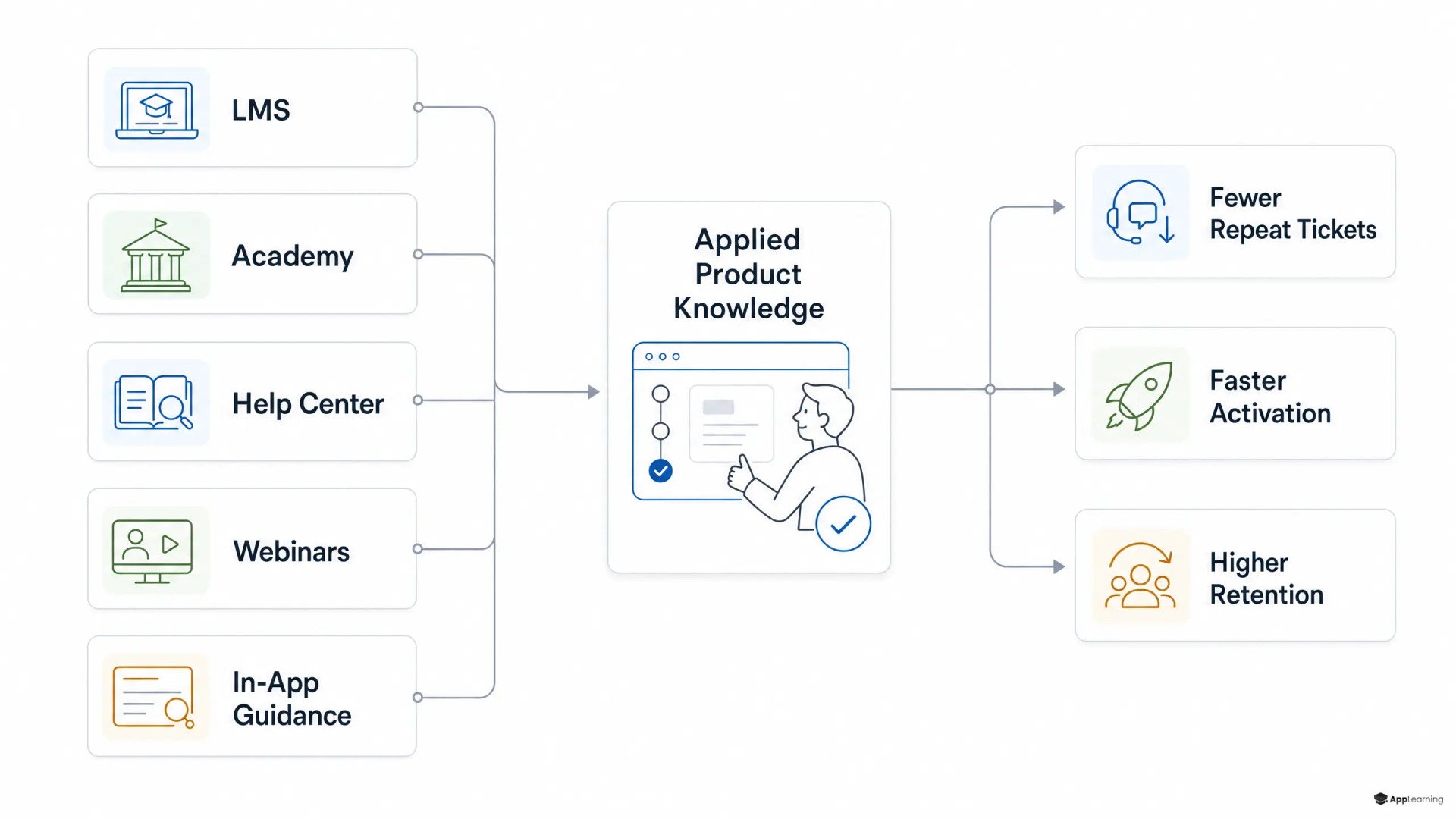
Customer training software is an umbrella term, not one product class. The best customer training software reduces the explanations customers need from support, helps them reach first value, and makes complex product knowledge usable at the moment of action. That is different from simply hosting courses. The market spans external LMS platforms, customer academies, help centers, webinars, and in-app guidance, with vendors such as Skilljar and Docebo combining several of these capabilities for customer and extended-enterprise audiences. (skilljar.com)
- Customer LMS: Best for formal curricula, certifications, large external audiences, and account-level administration.
- Customer academy: Best for a branded destination that turns product knowledge into guided learning paths.
- Help center: Best for fast answers to known problems and support-led self-service.
- Webinar platform: Best for live launches, complex demonstrations, implementation workshops, and questions that need an expert.
- In-app education tool: Best for prompting the next action inside the product, such as completing setup or trying a feature.
These tools overlap, but they do not replace one another. A help center gives customers searchable answers; Intercom positions its Help Center as an on-brand knowledge base for self-service. In-app checklists keep activation tasks visible while users work through the product; Appcues describes them as persistent task lists that can launch flows or route users to the right page. (intercom.com)
Start with the blocked behavior
Do not begin with a course catalog or a vendor scorecard. Begin with the behavior that currently stalls. In fintech, that may be completing identity verification, funding an account, understanding risk settings, making a first transaction, enabling security controls, or adopting an advanced feature. Each blockage needs a different learning response.
- Known interface question: Use contextual help or an in-app prompt.
- Multi-step workflow: Use a short sequence that explains the decision, then guides the action.
- New or risky financial concept: Use a structured learning path with plain-language examples and a knowledge check.
- High-value implementation or account rollout: Add live webinars and expert support to the self-paced path.
- Ongoing feature adoption: Trigger focused lessons from product events and lifecycle messages.
This is where customer education software becomes a growth system. It should connect what a customer learns to the next safe, valuable action. A video library may explain features well, yet still fail if it is not tied to onboarding milestones, product moments, and the questions that create repeated support demand.
Complexity determines the platform mix
Simple products with familiar workflows can often start with a strong help center and concise in-app guidance. Products with multiple roles, configurations, or feature dependencies need learning paths that sequence knowledge. Products that involve money, risk, compliance, or irreversible actions need more than a tooltip. They need customer confidence that is built before the decision point.
Customer maturity matters as much as product complexity. New users need a narrow path to first value. Activated users need explanations for the next feature or use case. Advanced customers may need certification, release education, or role-specific guidance. LearnUpon, for example, supports separate branded portals and reusable content for different audiences, which reflects the operational need to differentiate training without rebuilding it from scratch. (learnupon.com)
The operating layer decides whether education scales
A polished learner interface is necessary, but it is not enough. Evaluate how the system will run after launch. The right platform should let Product, Growth, CX, Marketing, and Compliance work from a shared content model without turning every update into a project.
- Branding and access: Can the experience feel like part of your product and support SSO or controlled access?
- Learner paths: Can you tailor journeys by customer stage, plan, role, region, or product behavior?
- Analytics: Can you see completion, quiz gaps, drop-off points, and the downstream activation or support signals that matter?
- Content operations: Can a team update one module quickly when a product flow, policy, or risk disclosure changes?
- Integration: Can product events, CRM attributes, lifecycle messages, and academy data inform each other?
Treat analytics as a decision tool, not a reporting feature. Completion is useful, but it is not the outcome. Track whether educated cohorts complete the intended product action, need fewer repeated explanations, return to use deeper features, or progress faster through onboarding. If the platform cannot support that measurement model, it risks becoming another content destination with no clear role in retention.
Good to know
Is a help center enough for customer education?
A help center is enough when customers mainly need answers to known questions. Add structured learning when they must understand concepts, follow multi-step workflows, or make higher-consequence decisions.
When should a fintech company use a customer academy?
Use an academy when product understanding affects activation, trust, security behavior, feature adoption, or retention. It is most useful when the same explanations must reach many customers in a consistent format.
Which metrics should customer training software track?
Track learning progress and knowledge gaps, then connect them to activation milestones, feature adoption, repeat support demand, and retention by cohort.
Where App-Learning fits
App-Learning fits teams that need a customer academy to operate as part of activation and lifecycle education rather than as a separate training department. Its platform supports branded web and mobile academies, short lessons, quizzes, learning paths, certificates, audience analytics, and deep links from product interfaces to specific learning modules. (app-learning.com)
That model is well suited to fintech and crypto products where users must understand concepts before they can use the product with confidence. Instead of asking Product to explain mechanics in a tour, Marketing to explain benefits in an email, and Support to repeat the same answers in tickets, teams can build one reviewed learning layer. It can then be used across onboarding, feature launches, customer lifecycle campaigns, and support flows.
Build customer education into the journey where confidence becomes action.
PlanA decision checklist that survives launch
Shortlist tools only after you can answer five implementation questions: Which customer action is blocked? Which audience needs a different path? Where should learning appear in the journey? Who owns content accuracy and updates? Which business metric will show that learning changed behavior?
The best customer training software is the system that makes product complexity easier to act on, not the system with the longest feature list. For a fintech team, that means building education into the path from uncertainty to a confident first action, then maintaining it as the product and customer base change. When customer understanding is treated as product infrastructure, training can support activation, trust, and retention at the same time.