

Key takeaways
- Customer education is not course hosting. It must support activation and retention.
- Branded UX, segmentation, and analytics shape adoption more than catalog size.
- Buyer fit depends on audience, product complexity, launch speed, and ownership model.
- App-Learning fits teams that need fintech education to drive confidence and usage.
Course libraries are the wrong starting point
Teams searching for the best customer education platforms often start with the wrong question. They compare course builders, SCORM support, certificates, and admin screens. Those things matter. But they do not answer the real operating problem.
A customer education platform should help users understand the product fast enough to act with confidence. For fintech and crypto companies, this is not cosmetic. Users may need to understand risk, identity checks, wallet flows, fees, yield mechanics, compliance boundaries, or security behavior before they reach value. If education sits outside onboarding, lifecycle, and product analytics, it becomes a passive library.
The better test is simple. Can the platform connect learning experience, onboarding outcomes, and operational scalability? If not, it may host courses well while still failing the business case.
Adoption starts with the learning journey
Customer training software should be evaluated around the moments where confusion creates drop-off. That means first activation, first transaction, first advanced feature, first support escalation, and renewal readiness. The platform must deliver the right explanation at the right time, not only store the right content somewhere.
- Branded learner experience that feels like part of the product, not a detached LMS.
- Lifecycle segmentation by role, plan, product usage, region, risk profile, or customer stage.
- Fast content operations for updates when product flows or regulation change.
- Analytics that connect learning behavior to activation, adoption, support, and retention signals.
- Integration options for SSO, CRM, customer success, product analytics, and lifecycle messaging.
- Clear ownership between Product, Growth, Customer Success, Marketing, and Education.
This is where many buying processes break. The team asks whether a platform can publish a course. The better question is whether it can reduce the amount of human explanation needed before a user succeeds.
The platform map is not one category
The market uses similar language for different systems. Some tools are enterprise LMS products with customer training use cases. Others are customer learning management platforms. Others are course-commerce platforms that can be adapted for academies. Official platform positioning shows the spread across customer academies, external training, analytics, integrations, and white-label delivery.
- Skilljar is built around customer and partner education, with strong emphasis on academies, customer-facing integrations, account insights, and links to business metrics.
- Docebo fits companies that want a broader enterprise LMS for internal and external audiences, including customer education at scale.
- Intellum suits larger learning ecosystems that need customer, partner, and employee education with analytics and AI-supported learning operations.
- Thought Industries positions around customer learning management for companies that treat education as a customer ecosystem and revenue lever.
- LearnUpon is a practical extended enterprise LMS for managing employees, partners, members, and customers from one centralized system.
- LearnWorlds is stronger when teams need white-label academies, interactive course delivery, built-in site tools, and a faster path to customer-facing training.
None of these choices is universally best. The best customer education platform is the one whose tradeoffs match the job. A certification-heavy partner program needs different tooling than a mobile-first fintech onboarding academy. A paid training business needs different commerce and catalog logic than a product-led growth team trying to improve activation.
The App-Learning fit for complex fintech education
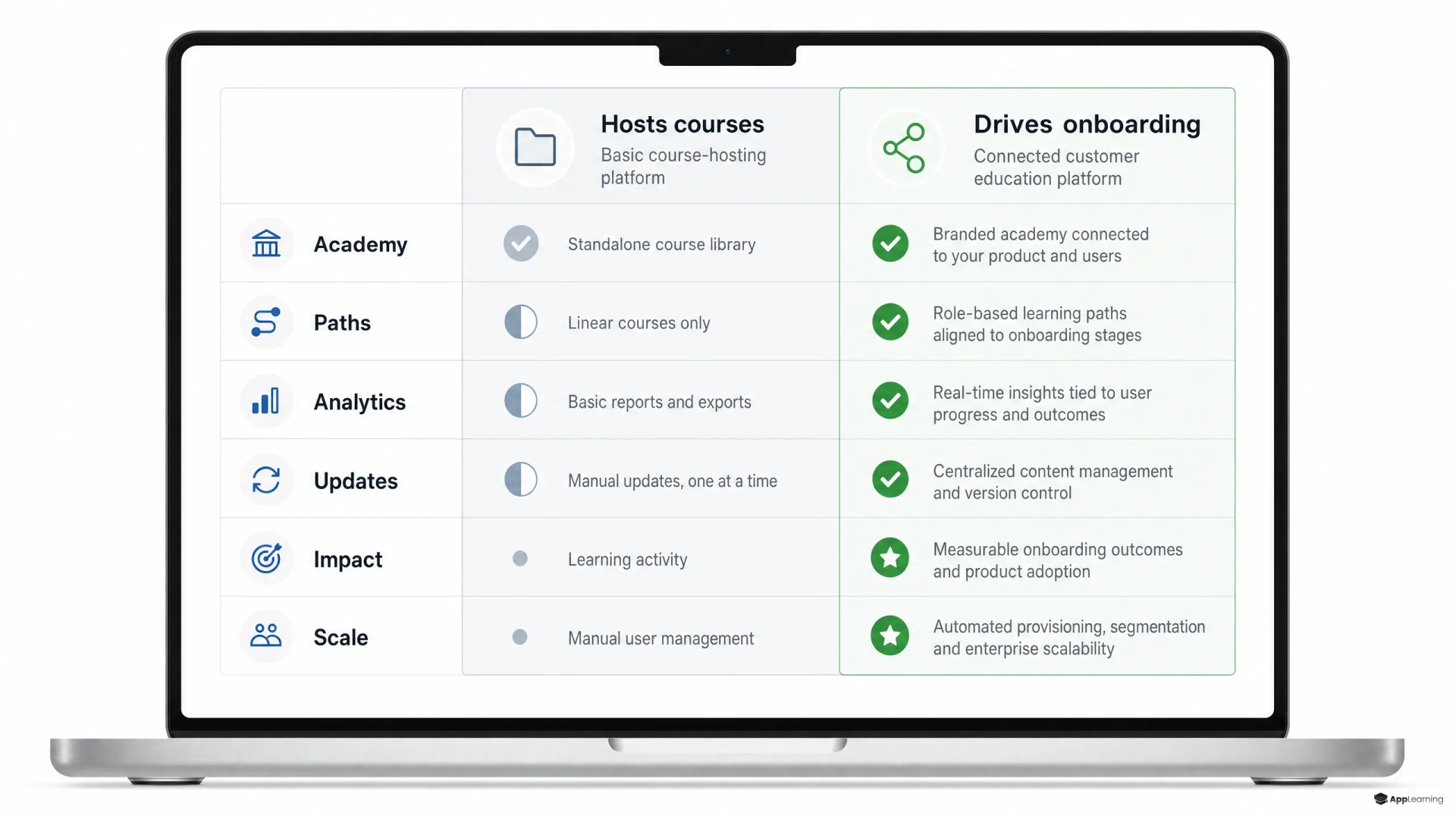
App-Learning fits best when education must become part of activation, trust, and retention rather than a separate training department. The platform focuses on branded web and mobile academies, microcourses, quizzes, gamification, analytics, and fast rollout. That makes it useful when a fintech product is valuable but difficult to explain in one screen or one email.
The App-Learning angle is not to replace every enterprise LMS use case. It is to turn complex product knowledge into structured, engaging learning journeys. That is the gap many fintech teams face. Product explains features. Marketing explains benefits. Support explains problems. The user still lacks a guided path from uncertainty to confident action.
Good to know
What is a customer education platform?
A customer education platform is software used to teach customers how to understand, adopt, and succeed with a product or service. Strong platforms combine learning delivery, branded experience, segmentation, analytics, and operational tools for customer-facing education.
How is customer training software different from an internal LMS?
An internal LMS usually serves employees, compliance, HR processes, and internal skill development. Customer training software must support external users, account-level reporting, product adoption, onboarding, customer success workflows, and often a more polished branded experience.
Which platform is best for a fintech company?
The best fit depends on product complexity, audience, regulatory review, launch speed, and the role education plays in activation. Fintech teams should prioritize platforms that explain complex concepts clearly, connect to lifecycle journeys, and prove impact on activation and retention.
When should a company choose App-Learning?
Choose App-Learning when customer education needs to feel like a branded product experience, not a course portal. It is strongest for microlearning, gamified academies, fast content rollout, and complex topics such as fintech, crypto, compliance, and product onboarding.
Fit changes with growth stage
Buying criteria should change as the company matures. A seed-stage fintech needs launch speed and clear content. A scale-up needs segmentation, analytics, and ownership. An enterprise needs governance, localization, permissions, integrations, security review, and change control.
- Early stage: choose speed, branded UX, reusable onboarding modules, and easy content updates.
- Growth stage: add lifecycle triggers, role-based paths, product analytics, and retention reporting.
- Enterprise stage: prioritize governance, localization, SSO, access control, data exports, and integration depth.
- Regulated markets: check review workflows, content versioning, audit needs, and regional risk messaging.
Do not overbuy for a future operating model you cannot run. Also do not underbuy if education already affects activation, support volume, and renewals. The platform must match the team’s real capacity to create, maintain, measure, and improve learning.
Design the education system before you buy the software.
PlanSelection must include the operating model
Before signing with any vendor, answer the implementation questions. Who owns the academy? Which product events should trigger education? Which concepts block activation? Which lessons must appear inside onboarding? Which metrics prove progress? Which content needs legal or compliance review? Which customer segments need a different path?
The answers will narrow the shortlist fast. If your core need is a formal external LMS, Skilljar, Docebo, Intellum, Thought Industries, LearnUpon, or LearnWorlds may fit. If your core need is a branded, gamified academy that turns complex fintech concepts into measurable learning journeys, App-Learning belongs in the evaluation.
The best customer education platforms do more than publish courses. They make product complexity usable. They help customers build confidence before confusion becomes churn. The winning system is the one your team can operate continuously and your users will actually use when the product asks them to learn, decide, and act.