
Key takeaways
- Branding affects trust before learners judge the content.
- External learners expect a product-grade education experience.
- The right platform depends on audience, operations, and measurement.
- App-Learning fits fintech teams turning education into activation and retention.
Branding is part of the learning system
Branded learning platforms are often evaluated as a design choice. Logo, colors, domain, done. That misses the real issue. In fintech and crypto, learners do not separate the academy from the product. If the learning environment looks generic, outdated, or disconnected, it weakens confidence at the exact moment users need clarity.
A branded learning platform should make education feel like part of the company experience while keeping learning operations simple and measurable. This matters most when the product is valuable but hard to understand. Users may need to learn a concept, a risk, a workflow, or a compliance boundary before they see value. If that learning step feels like a separate LMS portal, many will leave before the product earns trust.
The best choice depends on audience pressure
The best branded learning platforms are not the same for every company. Employee training can tolerate more friction because managers, deadlines, and compliance rules drive usage. Customer and partner education cannot. External learners compare the academy with your app, your onboarding flow, and your website. The platform must carry the same trust signals as the product.
The vendor positioning shows the tradeoffs clearly. LearnWorlds places white labeling around custom domains, branded logins, email notifications, certificates, website control, and branded mobile apps. CYPHER emphasizes complete white labeling across web, mobile, communications, and multi-tenant portals. Docebo’s Extended Enterprise documentation focuses on customized platform versions for different branches and URLs. TalentLMS lists practical controls such as logo, colors, domain mapping, SSO, custom messages, badges, and a branded mobile app.
- LearnWorlds fits course businesses and polished customer academies that need strong website, commerce, and mobile branding.
- CYPHER fits training providers, franchises, and partner networks that need separate branded portals from one system.
- Docebo fits enterprise extended enterprise programs with several branches, domains, and audience-specific environments.
- TalentLMS fits SMB and mid-market teams that want faster rollout with practical white label controls.
- App-Learning fits fintech and crypto teams that need branded microlearning tied to activation, trust, and retention.
Fintech education needs product logic
A fintech academy is not a content library. It should reduce confusion at the point where confusion blocks activation. A new user may need to understand custody, yield, risk, KYC, card limits, wallet recovery, fraud, or tax basics. A partner may need product positioning and objection handling. A support team may need short refreshers when a feature changes.
That is why a branded academy platform should map learning to product states. New account created. First deposit not completed. Risk feature viewed. Card ordered but not activated. Partner invited but not certified. Each state can trigger a short learning path, a quiz, a reward, or a certificate. The academy then becomes part of the growth system, not a side project owned by content alone.
Operations decide whether the brand holds up
A strong launch means little if the education cannot keep pace with the product. Financial products change. Regulations change. Screens change. Messaging changes. The branded experience breaks when lessons lag behind releases or when only one person knows how to update the academy.
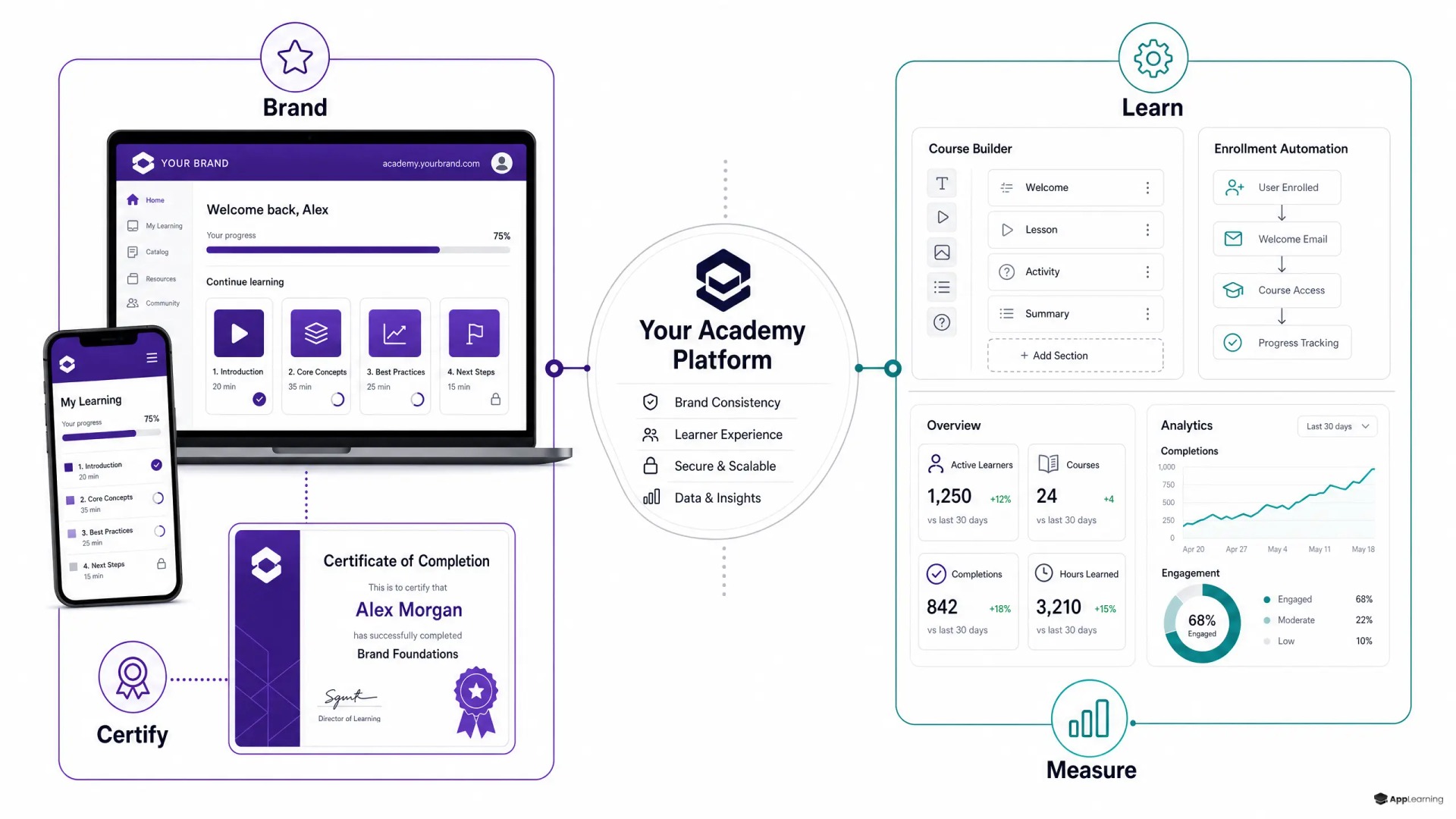
This is where App-Learning takes a more operational view. App-Learning describes microlearning academies for onboarding, compliance, and customer education, with role-based learning paths, quizzes, certificates, dashboards, SSO, web and mobile delivery, and the ability to turn existing material into short modules. The important part is not only the format. It is the content pipeline. Product, growth, CX, compliance, and subject-matter experts need a repeatable way to ship learning without rebuilding courses from scratch.
- Customer academies should remove friction from onboarding and explain product value before users churn.
- Employee academies should keep support, sales, and compliance teams aligned as the product changes.
- Partner academies should certify external teams without giving them an internal LMS experience.
- Lifecycle education should connect lessons, nudges, quizzes, and product milestones into one measurable loop.
Good to know
What is a branded learning platform?
A branded learning platform is a learning environment that uses your company identity across the learner experience, including domain, login, interface, content, certificates, emails, and sometimes mobile apps.
What is the difference between a branded learning platform and a white label LMS?
A white label LMS usually removes vendor branding and lets you add your own. A branded learning platform should go further by aligning UX, content, journeys, analytics, and operating workflows with your product or company experience.
Which branded learning platform is best for fintech customer education?
For fintech customer education, prioritize product-grade UX, short explainers, lifecycle triggers, trust-building content, fast updates, and analytics that connect learning to activation and retention.
When does App-Learning fit best?
App-Learning fits companies that want a branded academy with microlearning, gamification, quizzes, certificates, web and mobile access, and a content workflow built for fast product education.
Measurement separates platforms from portals
A branded training platform must still answer hard operating questions. Who started? Who finished? Where did learners drop? Which lessons correlate with activation, fewer tickets, better partner readiness, or higher retention? Completion alone is not enough, but it is a starting signal. The better signal is behavior after learning.
For a fintech product leader, the analytics model should connect learning data with product data. A lesson on bank transfers should be measured against first successful deposit. A fraud module should be measured against support escalation quality. A partner certification path should be measured against qualified referrals or fewer onboarding errors. If the platform cannot export or integrate the data, the academy will struggle to prove business impact.
See how a branded academy could support activation and retention.
DemoSelection criteria that prevent rework
Use a simple scorecard before choosing a branded learning platform. Start with the audience, then test the operating model. A beautiful academy that is slow to update will fail. A powerful LMS that feels like a back office tool will fail for external learners.
- Brand surface coverage across domain, login, email, certificates, mobile, and notifications.
- Audience separation for customers, employees, partners, regions, roles, and product tiers.
- Content operations that support fast updates, SME review, localization, and product release cycles.
- Learning formats that simplify complex financial topics through short lessons, scenarios, quizzes, and rewards.
- Analytics that connect learning progress with activation, retention, support, and partner performance.
- Integration readiness for SSO, lifecycle journeys, CRM, product analytics, and data exports.
The best branded learning platform is the one your team can keep alive. It should look like your brand, teach like your product, and measure like a growth system. For fintech companies, that means education is not placed after onboarding. It becomes one of the mechanisms that helps users trust the product, understand the value, and stay long enough to benefit from it.