
Key takeaways
- Agentic content operations need one approved source of truth.
- Treat expert review gates as mandatory for regulated learning content.
- CMS and workflow tools are becoming accessible to AI agents.
- Automate metadata, variants, and update worklists before final approval.
Volume Makes Weak Systems Visible
Learning content operations usually break before teams notice. Policies change, subject-matter experts answer questions in chat, and course updates sit in separate documents, LMS folders, and ticket queues. The result is slow release cycles, duplicate work, and no reliable way to show which version an employee completed. In finance and crypto, this is more than an efficiency problem. Regulated learning content must remain accurate, attributable, and reviewable after it reaches employees.
Adding an AI writer to this system increases output, but it does not create control. It can produce more drafts from more inputs, including outdated or unapproved ones. The operating problem is therefore not prompt quality. It is building an AI content workflow that knows which source is approved, what may be changed, who must decide, and what happens after a module is published.
Tool Access Does Not Create Governance
The tooling shift is real. Notion’s hosted MCP server lets approved AI tools work with workspace content, while Strapi’s public MCP Beta exposes CMS actions such as creating, updating, publishing, and unpublishing entries. n8n has also made its instance-level MCP server available in public preview for creating and updating workflows through compatible AI clients.
These capabilities matter because they connect agents to the systems where briefs, content models, workflow logic, and publishing decisions live. They do not make autonomous release safe. In fact, greater tool access makes permissions, approval states, and audit trails more important. Notion warns that an MCP connection can carry the same access as its connected user, so access design cannot be an afterthought.
A Workflow That Can Defend Its Decisions
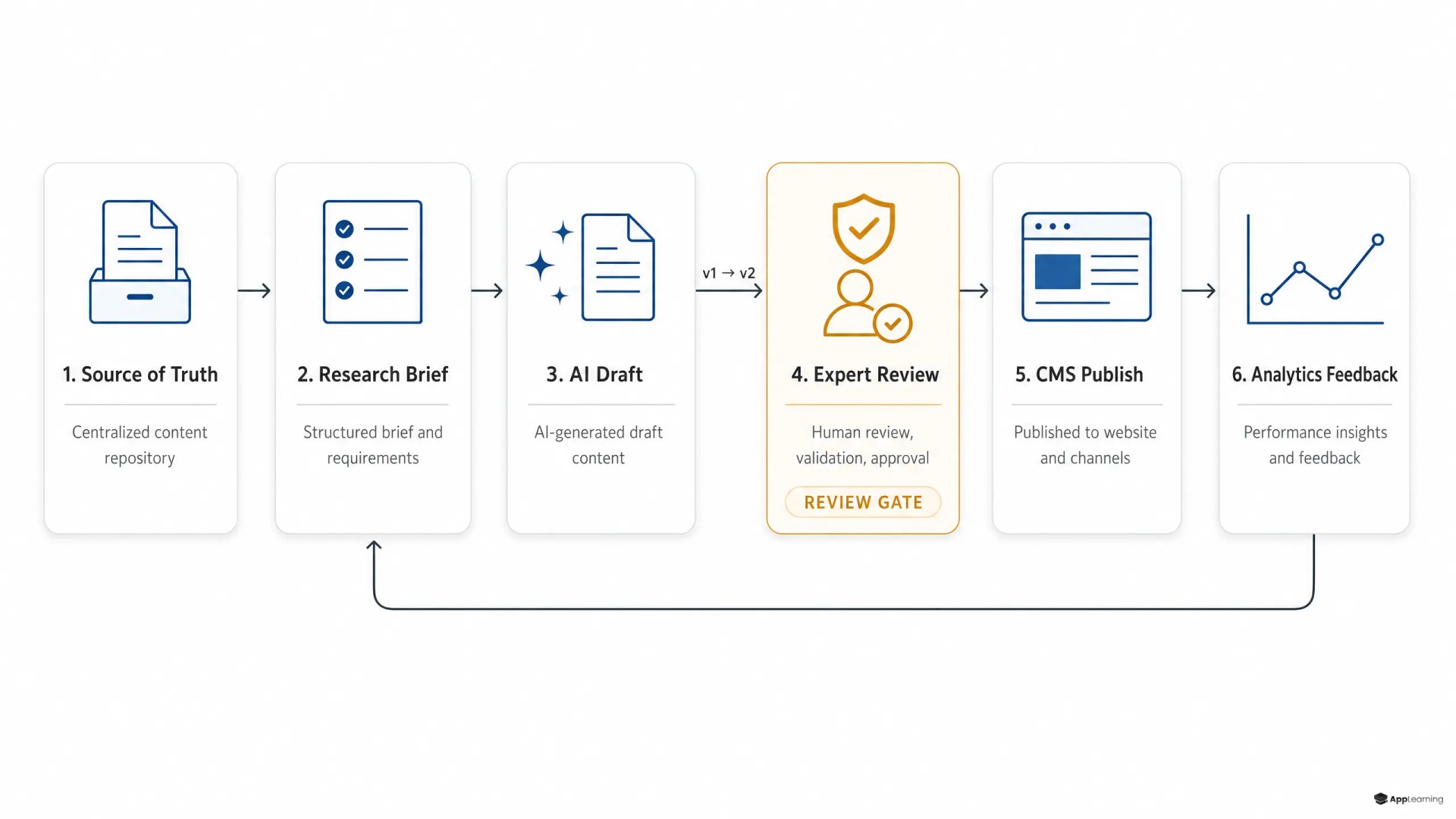
A governed model for agentic content operations has six clear stages. Each stage creates an artifact that the next stage can use and an owner who can be held accountable.
- Source of truth — approved policy, product documentation, legal guidance, and versioned internal standards.
- Structured brief — audience, learning objective, risk level, required evidence, expiry date, and accountable expert.
- AI draft — module copy, knowledge checks, metadata, summaries, and role-based variants created within defined constraints.
- Expert review — a named reviewer checks factual accuracy, regulatory interpretation, suitability, and escalation guidance.
- CMS publishing — approved content moves into structured fields with version, owner, review date, and release status.
- Analytics feedback — learner behaviour, assessment results, questions, and recurring errors inform the next brief.
This workflow changes the unit of work. The team no longer manages a course as a document that is occasionally updated. It manages a controlled content object with a source, decision history, distribution rules, and performance signal. That is the foundation for learning content operations that can scale without losing traceability.
Good to know
Can AI agents publish learning content automatically?
They can technically publish when connected to a CMS, but regulated teams should require a named expert approval before release. Automate preparation and routing, not final accountability.
What should be the source of truth for regulated learning content?
Use a versioned, access-controlled source that identifies the accountable owner, approval date, supporting evidence, and next review date. A shared document without these fields is not enough.
Where should n8n content automation start?
Start with low-risk, repeatable work such as draft creation, metadata tagging, review reminders, content expiry alerts, and routing approved modules into the CMS.
Automation Belongs Around Expert Judgement
Agents are well suited to repetitive, bounded tasks: extracting metadata from approved material, creating first drafts, mapping content to a competency framework, producing role variants, flagging content near its review date, and preparing update worklists. This is where n8n content automation can remove queue work and reduce manual copy-paste.
Humans must retain decisions that require judgement and accountability. They decide whether a source is authoritative, whether a regulatory statement is accurate in context, whether an example could mislead, whether a learner needs a different intervention, and whether a release is ready. A review gate is not a fallback for weak AI. It is the control that makes AI-assisted production usable in a regulated environment.
Build a governed learning content system with App-Learning.
DiscussOne Stack With Clear Boundaries
A practical setup can give each system a narrow job. Notion holds the editorial backlog, approved source links, briefs, owners, and review status. n8n routes triggers, prepares drafts, creates review tasks, and records workflow events. Strapi stores structured learning content and publishing states. The learning platform delivers the approved module, captures participation and assessment data, and returns useful signals to the content team.
App-Learning fits at the delivery and measurement layer: turning governed content into engaging learning experiences, then helping teams connect completion data with capability signals and business-relevant learning questions. The advantage is not a fully autonomous content machine. It is a system that can move faster while making the right decisions visible.
The strongest regulated learning teams will not compete on draft volume. They will compete on the speed and confidence with which they turn approved knowledge into measurable employee capability. Build the workflow first, assign the decision rights, and let agents accelerate the work inside those boundaries.