

Key takeaways
- AI literacy needs supervision, not only tool access.
- Regulated teams need role-specific scenarios and clear guardrails.
- Training should create evidence of readiness, not only completion records.
- App-Learning can package AI literacy into measurable learning journeys.
Access without capability creates unmanaged risk
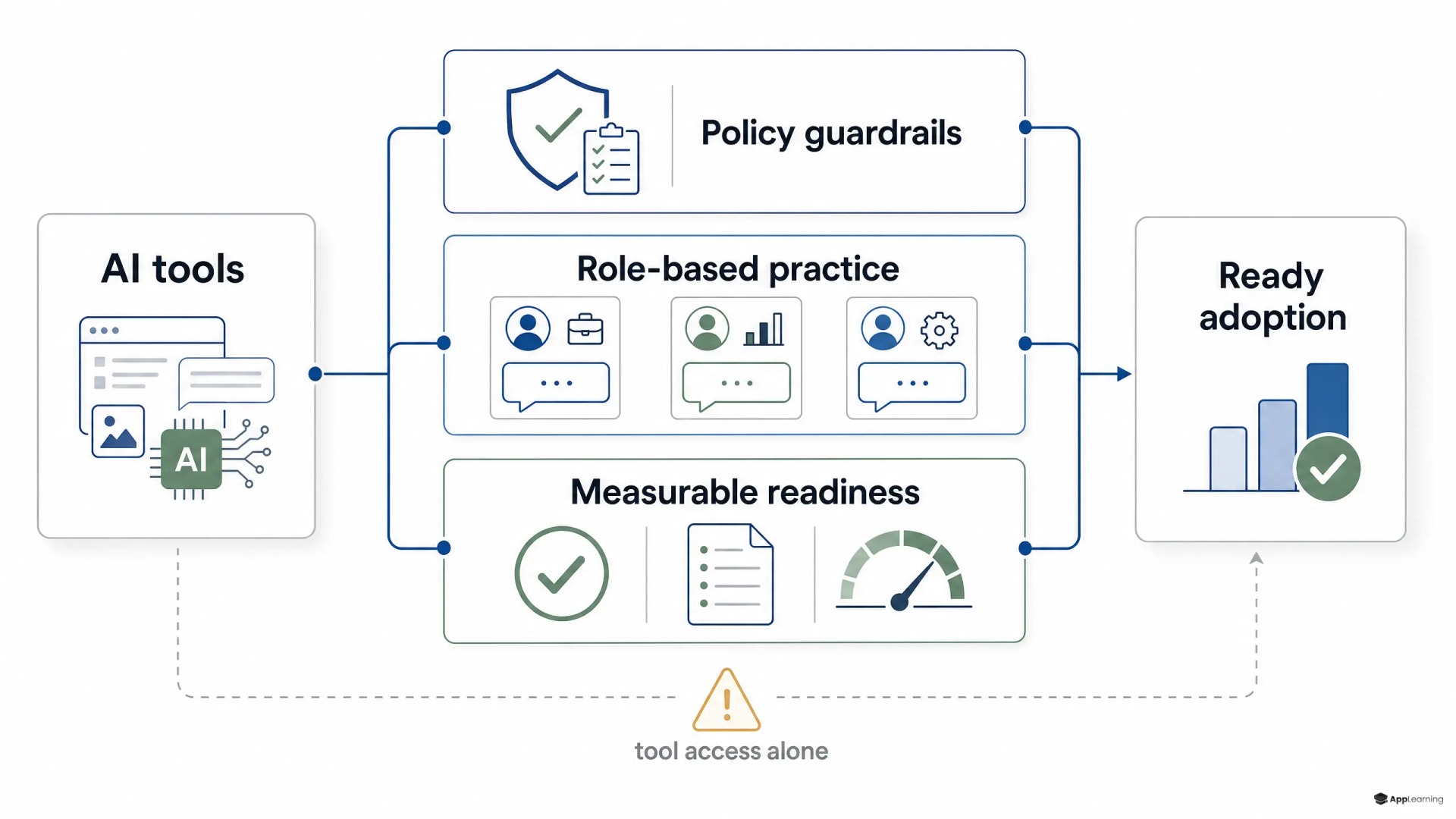
Giving employees an AI tool is not an adoption strategy. It is a distribution decision. A policy document may define prohibited behaviour, but it does not teach a payments analyst how to verify a generated summary, a customer-operations agent how to handle sensitive data, or a compliance specialist when to stop and escalate.
That gap matters in regulated work. Teams need to make sound decisions inside real workflows, under time pressure, with incomplete information. AI literacy training should therefore build judgement before it expands access. This is not legal advice or a substitute for governance. It is the operating layer that helps people apply governance consistently.
Education is moving toward supervised use
The education debate offers a useful signal. On 18 June 2026, the OECD and European Commission AI Literacy Framework framed AI literacy as knowledge, skills and attitudes that help people understand systems, evaluate outputs and use AI ethically. It also pairs the framework with practical learning examples. The model is not passive awareness. It is guided practice.
Norway made the same distinction in operational terms. Its 19 June 2026 guidance says pupils in grades 1 to 7 should generally be shielded from using AI in schoolwork, while lower-secondary schools can begin cautious trials with teachers and pupils. The Norwegian government’s recommendation is age-banded, supervised and tied to learning objectives rather than blanket access.
The pattern extends beyond national policy. In June 2026, UNICRI launched teacher training with OpenAI focused on knowledge, tools and pedagogical skills for responsible use. The business implication is clear: useful AI adoption starts with people who can guide, challenge and verify the tool.
Regulated teams need the same control layer
Finance and crypto companies face the same design problem in another form. The risk is not that every AI output is wrong. The risk is that an employee treats plausible output as approved judgement, introduces confidential data into an unapproved workflow, or uses an answer without a clear record of verification.
Generic responsible AI training will not solve this. AI readiness for finance teams must reflect role, permission level, data exposure and escalation paths. A risk analyst, product manager, customer-support lead and developer may use similar tools, but they need different boundaries and different evidence of competence.
Good to know
Is supervised AI literacy only compliance training?
No. It combines compliance boundaries with practical capability. Employees learn where AI can help, where it cannot be trusted alone, and how to work with it without bypassing review or escalation.
What evidence of AI readiness should L&D track?
Track scenario-based decision quality, verification behaviour, recurring risk errors, escalation choices and improvement over time. Completion should remain a record, but it should not be the main measure.
Which teams should begin first?
Start with teams that have clear, repeatable use cases and defined review routes. Avoid broad rollout where data boundaries, approved tools or accountable owners are still unclear.
Supervision turns guardrails into practice
Supervised AI literacy is a structured learning journey that connects policy to decisions people must make at work. It should include:
- Role-specific scenarios based on real tasks, approved tools and common failure modes.
- Clear data boundaries that show what may be entered, transformed, retained or shared.
- Verification routines that require source checks, calculations, human review and documentation where needed.
- Risk recognition exercises for hallucinations, bias, prompt injection, confidentiality and unsuitable automation.
- Escalation rules that make it easy to pause, ask for help and report uncertain use.
- Short assessments that capture decision quality, not only policy acknowledgement.
Build measurable AI readiness before you widen access.
TalkReadiness becomes visible when performance is measured
Completion rates only show that people opened a module. A measurable learning path captures whether they can act safely: which scenario decisions they get wrong, where verification breaks down, which teams need targeted support and whether performance improves after practice. These measures are internal capability signals, not a legal certification. They give L&D, compliance and operational leaders a shared view of where broad access is appropriate and where supervision should continue.
This is where a modern learning system earns its place. It can release role-based modules quickly, present realistic decision points, retain completion and assessment records, and refresh content when tools or policies change. App-Learning can turn this into a focused programme that connects compliance requirements with daily work instead of adding another static document to the LMS.
The safer AI rollout is not slower because it starts with learning. It is faster where it counts: teams know the boundaries, managers can see readiness, and the organisation can expand use with evidence rather than hope.