

Key takeaways
- Agentic workflows create risk at the tool and permission layer.
- Employees must know what an agent can read, change, send or delete.
- AI agent training should cover prompt injection, tool misuse and review gates.
- Learning operations can turn agent governance into practical role-based modules.
The shift from answers to actions
AI agents are moving beyond chat. They can retrieve files, call APIs, update records, send messages and trigger workflow steps. A large analysis of MCP tools shows the direction of travel: the tool layer is becoming more action-oriented. That is the point where agentic workflow security becomes a people problem as well as a technical one.
A model that produces a weak answer may waste time. An agent with access to a customer case system, a content repository or a payment-adjacent workflow can create a different class of failure. It can act on the wrong instruction, use the wrong tool or move sensitive information into the wrong place. The control question is no longer only whether the model is accurate. It is whether the employee understands the authority delegated to it.
Permission-aware judgment is the missing capability
In banking, fintech and crypto, teams already work inside defined controls. They know that not every person can approve a transfer, alter a risk flag or publish regulated customer content. AI agents need the same discipline. Employees must be able to state what an agent may read, what it may draft, what it may change, and what always requires a human decision.
This makes workflow automation security training a learning operations responsibility. Policy documents define the rule. Repeatable learning builds the behavior at the moment of use. If a content operations team connects an agent to a CMS, for example, it needs to know whether the agent can propose copy, publish copy, alter metadata or access source material. Those are different permissions and different risks.
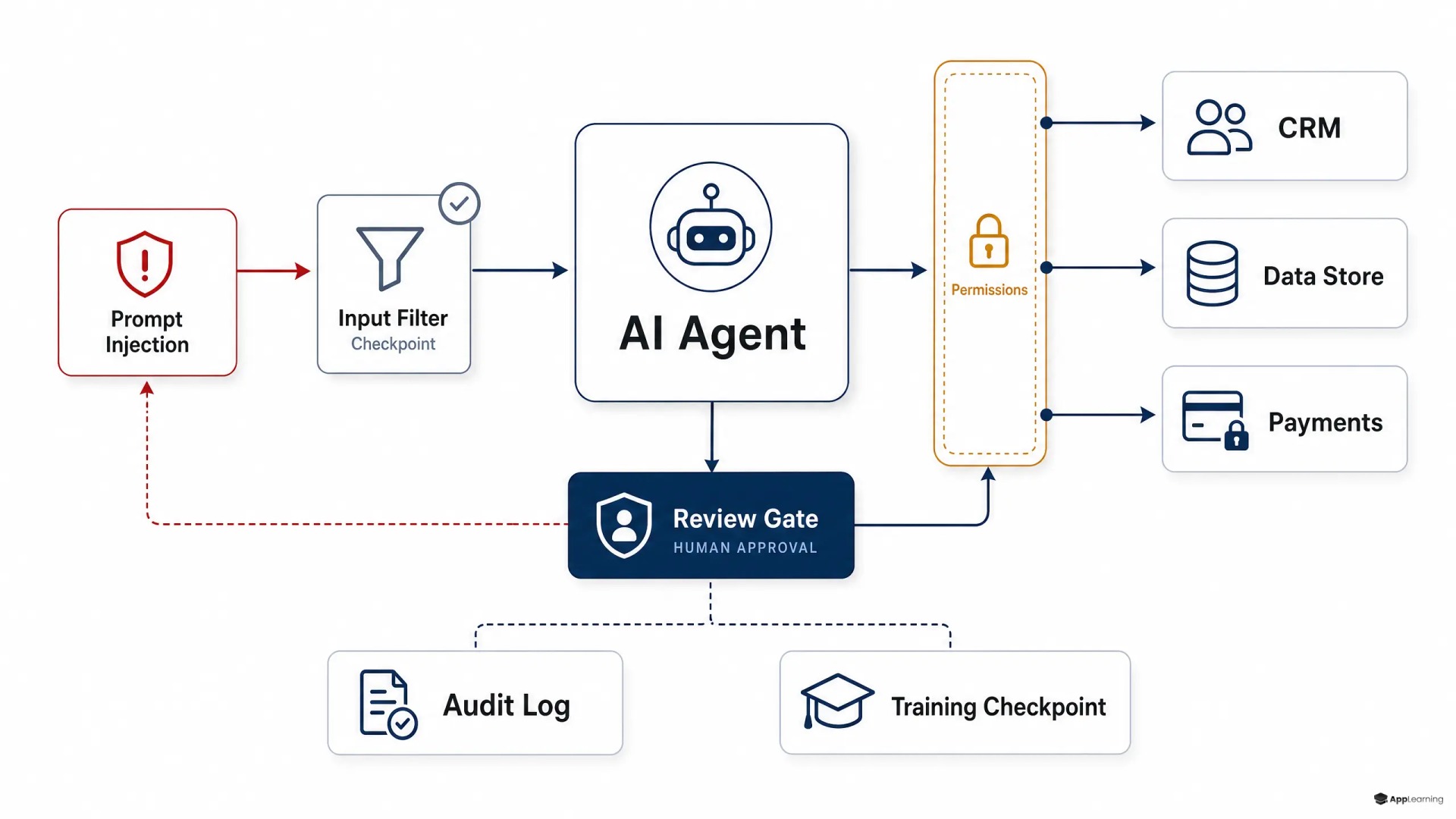
The workflow is now an attack surface
Prompt injection is no longer limited to a misleading chat response. An attacker can place hostile instructions in an email, webpage, ticket or document that an agent later reads. NIST describes agent hijacking as an indirect prompt-injection problem caused by weak separation between trusted instructions and untrusted data.
The consequences compound when the agent has tools. A manipulated input can lead to tool misuse, data exfiltration, workflow hijacking or an action taken with valid but excessive permissions. Research on agentic workflows in GitHub Actions and n8n templates demonstrates how attacker-controlled inputs can be used to steer agents toward credential leakage and arbitrary command execution. Teams do not need to become security engineers, but they do need to recognize the conditions that make those failures possible.
Good to know
Does this replace existing security awareness training?
No. It extends it into the workflow. Existing training may cover phishing, passwords and data handling, while agentic workflow learning covers tool permissions, untrusted inputs, approval gates and escalation during automated work.
Who should complete workflow-security learning?
Anyone who builds, configures, approves, monitors or regularly uses an agent-enabled workflow should receive a role-specific version. The depth should match the authority held by the person and the agent.
What should the first assessment test?
Test whether learners can identify an unsafe permission request, distinguish untrusted data from valid instructions, select the right review gate and stop or escalate a risky workflow.
Teach decisions rather than generic AI rules
Generic AI literacy is a weak control for an agent with production access. AI agent training should focus on the decisions employees make before, during and after an agent runs.
- Map tools and permissions. Learners should identify which systems an agent can access and which actions it can perform.
- Classify inputs. Employees need to treat external text, attachments, web content and user-submitted fields as data, not as trusted instructions.
- Apply review gates. Teams should know which actions require preview, approval, dual control or a human owner.
- Escalate exceptions. Learners need clear triggers for stopping a workflow, revoking access and reporting suspicious behavior.
- Preserve evidence. Workflow owners should understand what logs, approval records and change history must remain available for review.
This is also where MCP security becomes practical. The relevant question is not whether a team can explain a protocol. It is whether people can judge the scope of a connected tool and refuse an unsafe expansion of that scope.
Build role-based agent security learning before production access expands.
PlanA learning path that follows access and change
Build the path around roles, not one annual module. Builders need to design safe handoffs and least-privilege tool access. Business users need to recognize unsafe requests and review outputs before consequential actions. Approvers need to judge risk, ownership and rollback plans. Security and compliance teams need enough workflow visibility to challenge exceptions.
Start with a short access prerequisite before someone uses an agent in a live workflow. Follow it with scenario assessments based on actual tasks: an agent reads a support ticket containing hostile text, requests a new connector, or proposes publishing regulated content. Score the decision, not just recall. Then refresh learning when permissions change, a new action tool is added, an incident occurs or a workflow moves from draft to production.
NIST's work on software and AI agent identity and authorization highlights identification, authorization, auditing and non-repudiation as core concerns. For learning operations teams managing AI agents, that translates into a simple operating model: train each role on the authority it grants, the evidence it must review and the point at which it must stop the workflow.
The strongest control is not a longer policy or a more polished prompt. It is a workforce that can see an agent's authority in context and act with discipline when that authority crosses a business boundary. That is how agentic workflow security becomes an operational capability rather than an IT exception.