
Key takeaways
- One-day workshops activate confidence but do not build a durable system.
- Reinforcement must connect AI training to recurring workplace tasks.
- Role-based modules and use-case updates keep AI learning relevant.
- Organizations should measure application and confidence after the event.
The workshop is only the ignition
AI workshops work because they solve the first barrier. People need time, permission, and a trusted room to test tools with real tasks. A live AI jam can turn abstract fear into practical momentum. It can also surface questions that no policy document will reveal.
But an event is not a capability system. Education, finance, and crypto do not share the same workflows, but they share the same learning pattern. Initial confidence fades unless people return to a structured path that helps them apply AI safely in their own role. That is where AI workshop reinforcement becomes the operational layer, not an optional add-on.
OpenAI’s goal isn’t to just host a one-day workshop.
Confidence fades in the workstream
After the session, participants return to client reviews, onboarding flows, risk checks, policy updates, incident queues, and spreadsheets. They may remember that the tool can summarize, draft, classify, or compare. They often do not remember the safe pattern for their own task, the approved data boundary, or the quality check their manager expects.
This is where post-workshop learning usually breaks. The training was practical inside the room, but generic outside it. In regulated firms, that creates two bad outcomes. Some employees experiment in the shadows. Others avoid AI because the rules feel unclear. The UK government’s Skills for AI programme makes the same practical point from employer evidence: organizations need inclusive, safe, and sustainable AI capability, not just exposure to tools.
AI training retention is not only a memory problem. It is a transfer problem. The National Academies’ learning science synthesis identifies spaced practice and retrieval practice as strategies that support knowledge retention. For AI skills, that means repeated workplace scenarios, not one more recording in the LMS.
Reinforcement belongs near the task
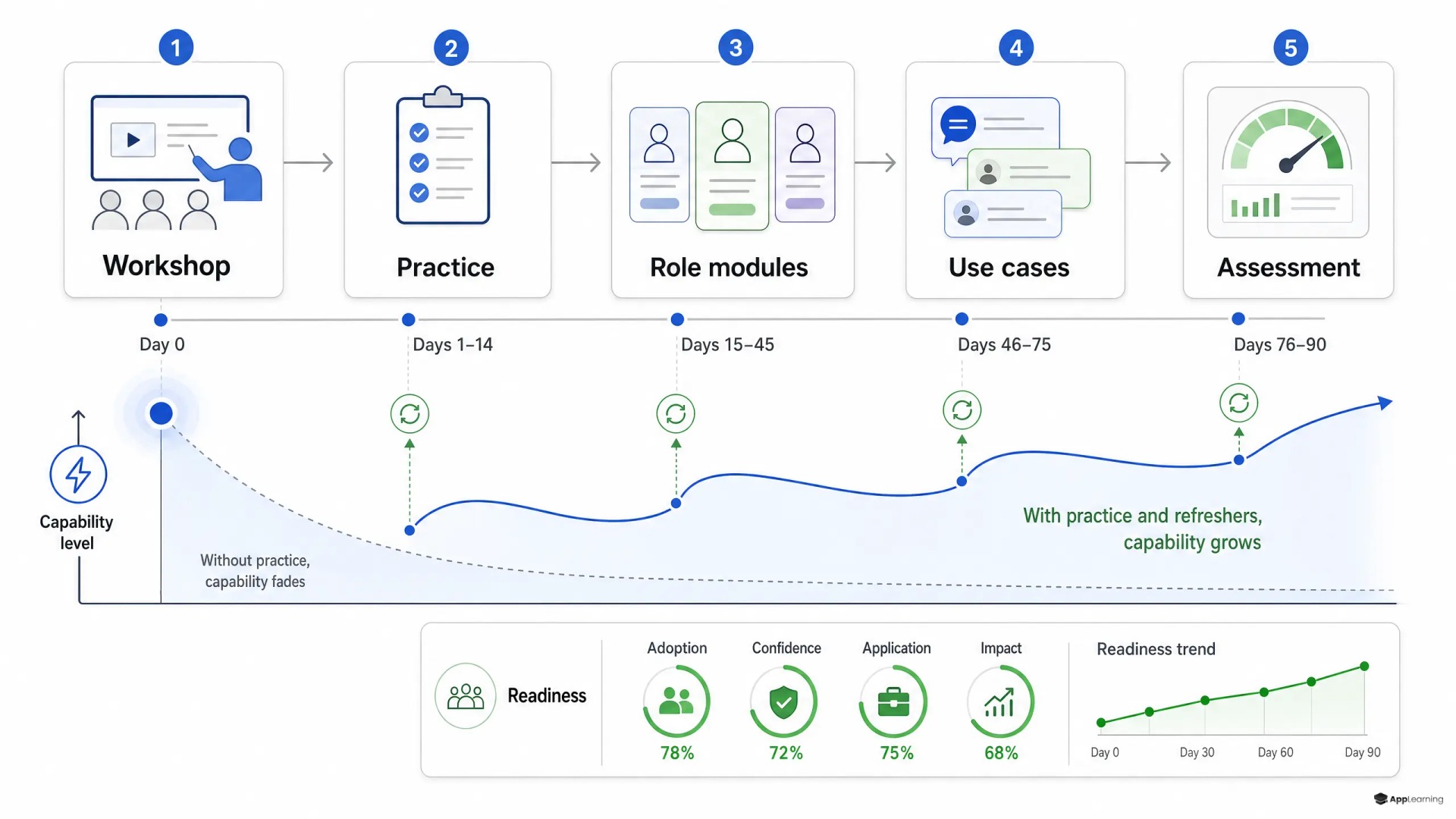
A good reinforcement system is smaller than the workshop but closer to the work. It should not ask every employee to become a prompt engineer. It should give each role a short loop that makes safe use easier than unsafe use.
- Role-based micro modules tied to recurring tasks
- Approved prompt patterns with clear data boundaries
- Scenario drills for common mistakes and edge cases
- Peer examples from teams doing similar work
- Refreshers when tools, policies, or use cases change
For an HR or L&D lead in finance or crypto, this means building modules around real operating moments. A compliance analyst may need practice summarizing regulatory updates without exposing client data. A customer operations lead may need scenarios for drafting responses that still require human review. A manager may need examples for evaluating AI-supported work without treating output as evidence.
For teams with European exposure, reinforcement also supports governance. The European Commission says the AI Act’s AI literacy obligation has applied since 2 February 2025, requiring providers and deployers to take measures for sufficient AI literacy among relevant staff. A single workshop is hard to defend as a lasting measure if roles, tools, and risks keep changing.
Good to know
How soon should reinforcement start after an AI workshop?
Within the first week. The goal is to convert workshop momentum into one small, role-specific workplace action before habits fade.
Does every role need different AI training?
Not completely, but every role needs different practice. Baseline AI literacy can be shared, while scenarios, prompts, risks, and success measures should reflect the work.
What should L&D measure beyond completion?
Measure confidence, approved tool use, applied use cases, quality review results, policy adherence, and manager-observed readiness.
The 30 60 90 day evidence loop
The measurement system should start after the event. Completion proves attendance. It does not prove application, confidence, quality, or control. Continuous AI upskilling needs a simple evidence loop.
- At 30 days, measure confidence, approved tool use, first applied scenarios, and blockers.
- At 60 days, review accepted use cases, peer examples, manager feedback, and quality issues.
- At 90 days, compare repeat use, rework reduction, cycle-time signals, and readiness by role.
Do not overclaim ROI. Measure whether people can use AI safely without constant supervision. In a regulated environment, a strong result may be that employees stopped pasting sensitive data into unsafe tools, used approved prompts, and escalated uncertain outputs earlier. That is business value.
Turn AI workshops into measurable workplace capability.
PlanFrom event to AI skills academy
The stronger model is an AI skills academy that starts where the jam, bootcamp, or rollout workshop ends. App-Learning can act as that reinforcement layer for finance and crypto companies: short role-based modules, scenario practice, use-case updates, peer examples, and readiness analytics that fit regulated environments.
This does not replace the workshop. It protects the investment. The live session creates energy, shared language, and a first experience of safe use. The academy turns that experience into habits, evidence, and accountable progress.
AI capability is not built in a day. A workshop creates the moment. Reinforcement creates the system. The companies that learn fastest will not be the ones with the biggest launch event. They will be the ones that make practice visible, role-specific, measurable, and close to the work.