

Key takeaways
- Agentic AI creates new operational risk in finance.
- Human oversight fails when teams do not know what to look for.
- Kill switches require escalation logic, training and scenario practice.
- AI governance learning should be measurable and role-specific.
On 30 June 2026, Bank of England Deputy Governor Sarah Breeden warned that AI is reshaping finance at speed, with agentic systems moving into cyber risk, markets and payments. The concern is not only that AI agents in finance may make poor decisions. It is that they may act, chain tools and transmit risk faster than normal human governance can absorb.
Autonomy turns model risk into operating risk
Traditional model risk assumes a system produces an output and a person or process decides what happens next. Agentic AI changes that sequence. The model may interpret a goal, call tools, initiate a payment, adjust a trading instruction, query internal systems or trigger another automated process. That turns AI risk from a question of output quality into a question of delegated authority.
This is why agentic AI governance cannot sit only inside model validation, legal review or architecture boards. The risk appears in the workflow. It appears at the point where an employee accepts an agent recommendation, where a product owner raises an autonomy limit, where a trader sees unusual order behaviour, or where compliance reviews an incident after the agent has already acted.
The kill switch is a workflow, not a button
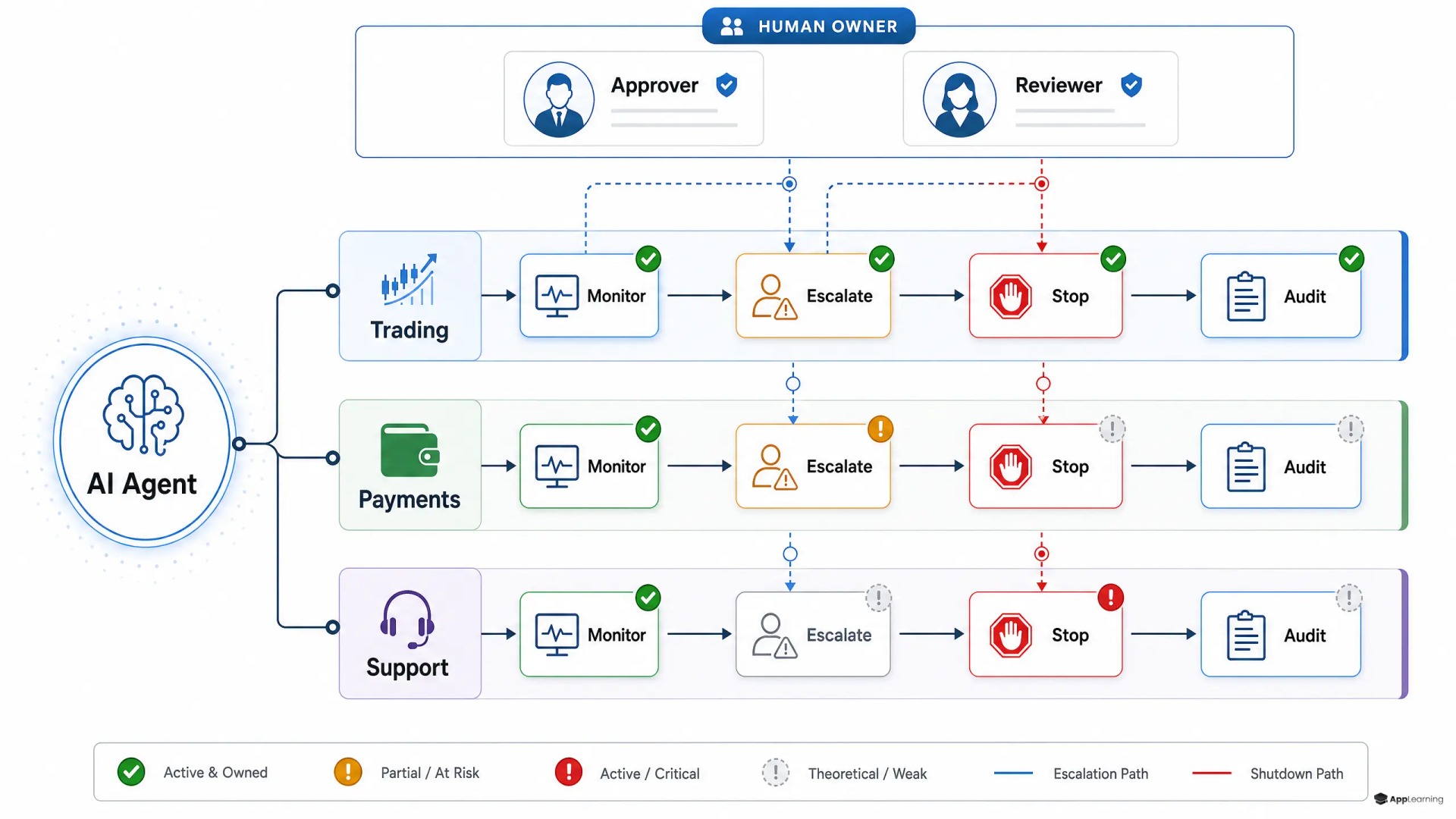
A technical AI kill switch sounds reassuring because it suggests a clear stop command. In live banking operations, the stop command is only one part of the safeguard. Bank of England AI Consortium members noted that agentic AI may compress decision-making latency in ways that challenge kill switches and circuit breakers, and they raised the example of a kill switch that stops a system but also disrupts payments.
The Financial Stability Board has moved in the same direction. Its June 2026 consultation on responsible AI adoption proposes organisation-wide governance across the AI lifecycle, including senior management attention to strategy, technology adoption and risk management. For banks, that means the control is not complete until people know how to use it under pressure.
Oversight fails without stop criteria
Human oversight is weak when the human does not know what counts as abnormal. A dashboard, approval queue or incident channel does not help if the operator cannot distinguish normal model variance from a breach of mandate. Kill-switch literacy means teams can answer four operational questions before autonomy increases.
- When should the agent be stopped immediately.
- When should the agent be constrained but kept running.
- When should the case move to risk, compliance, technology or senior management.
- What evidence must be preserved for audit, remediation and regulator review.
This is also becoming a workforce obligation, not only a technical preference. The European Commission says Article 4 of the EU AI Act requires providers and deployers to ensure a sufficient level of AI literacy for staff and others dealing with AI systems, taking account of their role, context and system risk. In a bank, responsible AI training therefore has to be tied to real decision rights.
Good to know
What does kill-switch literacy mean in finance AI?
Kill-switch literacy means employees know when an AI agent should be stopped, constrained, escalated or audited, and what evidence must be preserved after intervention.
Is human oversight enough for AI agents in finance?
No. Human oversight only works when people understand the agent’s mandate, risk limits, escalation paths and abnormal behaviour patterns.
Who needs role-based AI governance learning in a bank?
Trading, payments, product, risk, compliance, audit, operations and technology teams all need tailored learning because each function sees different agentic AI risks.
How should banks measure responsible AI training?
Banks should measure scenario performance, escalation accuracy, policy understanding, response time, audit evidence quality and readiness by role or workflow.
Readiness follows the banking role
A single enterprise AI course will not prepare a bank for agentic workflows. The learning path must match the failure mode of each function. A trader needs to recognise correlated agent behaviour, unexplained order patterns and market stress signals. A payments product team needs to understand value limits, consent, authentication, exception handling and customer harm. Risk teams need escalation thresholds, scenario analysis and concentration-risk views. Compliance and audit teams need traceability, evidence standards and a clear line from policy to observed behaviour.
This is where AI risk training becomes practical. Each role should practise realistic scenarios before the system reaches higher-impact workflows: an agent tries to split a payment to avoid a limit, a trading assistant keeps acting after market conditions shift, a customer-service agent exposes regulated information, or a product team raises an autonomy threshold without updating controls.
Build AI governance readiness before autonomy scales.
TalkReadiness must be measured before autonomy rises
At App-Learning, we see this as a capability system. Banks need short learning journeys, role-specific simulations, decision drills, knowledge checks and dashboards that show readiness by team, workflow and risk tier. The goal is not to make everyone an AI engineer. The goal is to make the right people competent at the moments where agentic AI can create harm.
Agentic AI will not wait for perfect policy architecture. It will enter through pilots, vendor tools, internal automation, product experiments and shadow workflows. The banks that manage it well will treat kill switches as operating practices, not technical artefacts. They will train the people around the switch before the agent has enough authority to make the switch matter.