

Key takeaways
- Start agentic AI training with actions, tools, data flows and affected people.
- Generic AI policy training is not enough for autonomous workflows.
- Oversight drills must teach when to approve, pause, escalate or document.
- Action-inventory learning creates stronger evidence for governance, audit and compliance teams.
AI agents change the training problem because they do not only answer questions. They can call tools, retrieve records, compare documents, update cases, draft customer responses and trigger workflows. In banking, that moves AI from advice support into operational execution. The employee no longer needs to know only whether an answer is plausible. The employee needs to know what the agent can do next.
Agents turn policy into operational risk
A 2026 paper by Luca Nannini and co-authors on AI agents under EU law argues that the foundational compliance task for high-risk agentic systems is an exhaustive inventory of external actions, data flows, connected systems and affected persons. That is also the foundation of AI agent training. If employees cannot describe the action chain, they cannot provide meaningful oversight.
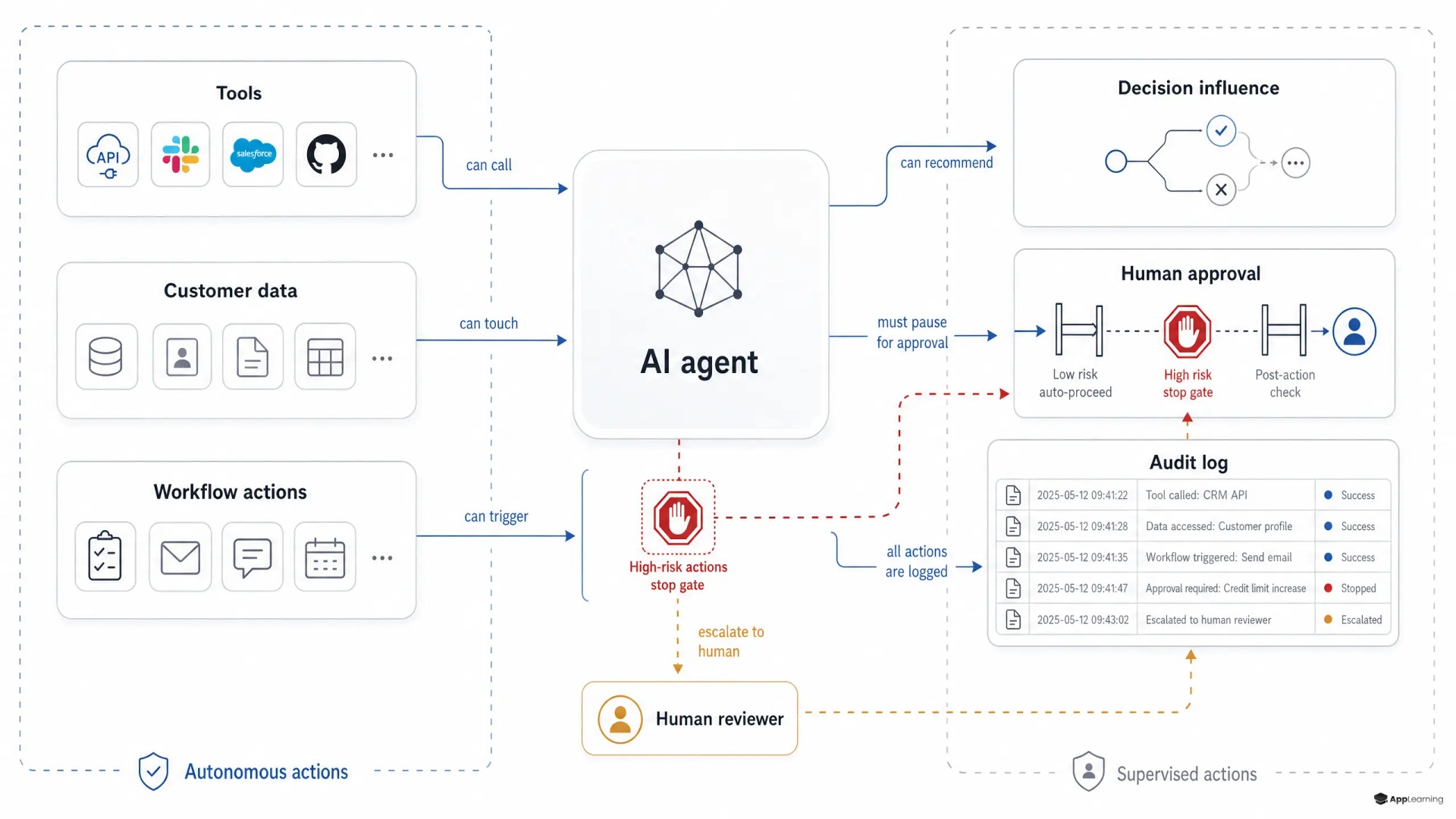
For a Chief Innovation Officer at a bank, the implication is direct. AI compliance training cannot stop at principles, prohibited prompts and acceptable-use rules. It must answer concrete questions for each role. Which systems can this agent access. Which data can it read or write. Which decisions can it influence. Which handoffs require a human. Which events create an audit trail. Without that map, agentic AI governance remains a document, not a working control.
The inventory becomes the learning object
An AI action inventory is not only a register for legal, risk and architecture teams. It is the raw material for role-based learning. The same inventory can define microlearning paths for relationship managers, operations analysts, compliance reviewers, IT owners and supervisors. Each group sees the part of the agent’s action space that affects their work.
- Actions such as read, write, recommend, submit, notify, block or escalate.
- Tools and systems the agent can call, including CRM, ticketing, KYC, payments or document platforms.
- Data classes the agent can touch, such as customer data, transaction data, complaints, risk flags or internal policy content.
- Decision influence, including whether the agent drafts, ranks, recommends, routes or executes.
- Human controls, including approval rights, pause conditions, escalation routes and documentation duties.
- Evidence requirements, including logs, completion records, scenario scores and supervisor sign-offs.
This turns governance into something employees can practice. A policy says the agent must not make an unauthorised decision. A learning scenario shows a borderline case where the agent has correct data, weak confidence and a time-sensitive customer impact. The employee must choose whether to approve, pause, escalate or document.
Awareness is not oversight
In Europe, this is not optional hygiene. The European Commission explains that Article 4 of the EU AI Act requires providers and deployers to ensure a sufficient level of AI literacy, taking into account staff knowledge, the context of use and the people affected by the system. The same guidance makes clear that AI literacy should be adapted to role, risk and system context.
That distinction matters. Generic AI awareness helps employees understand hallucination, bias and confidentiality. Operational oversight needs more. The AI Act’s obligations for deployers of high-risk systems connect human oversight with competence, training and authority. In practice, an employee must know not only that oversight exists, but when they have the mandate to interrupt the agent.
Good to know
Who should own the AI action inventory in a bank?
Ownership should sit across innovation, risk, compliance, IT, business operations and learning. One team can coordinate it, but no single function sees the full action chain alone.
Is action-inventory training only needed for high-risk AI systems?
No. High-risk systems need deeper control evidence, but any agent that calls tools, touches data or changes workflows should be mapped before employees use it.
How often should AI agent training be updated?
Training should update when the agent gains a new tool, reaches a new data source, changes its workflow role or affects a new group of customers or employees.
How is this different from normal AI compliance training?
Normal training explains rules and risks. Action-inventory training teaches employees how a specific agent behaves in their workflow and what they must do when boundaries are reached.
Finance teams need four practiced moves
The FCA’s 2026 review of AI in retail financial services names agentic finance as a live strategic shift and highlights related risks around consumer journeys, market power, fraud and cyber exposure. For AI agents in finance, the training target is therefore not abstract confidence in AI. It is disciplined intervention at the right point in the workflow.
- Approve when the action is inside the inventory, the data source is allowed and the risk threshold is clear.
- Pause when the agent reaches outside its mapped permissions, shows low confidence or touches a sensitive customer outcome.
- Escalate when the workflow affects regulated advice, complaints, credit, financial crime, vulnerable customers or model behaviour outside the approved design.
- Document when the human decision changes the agent path, overrides a recommendation or accepts a material risk.
These moves should be trained as drills, not explained as slides. Employees need short scenarios with agent traces, system permissions, customer context and competing pressures. The learning record should show more than completion. It should show that the employee can recognise the trigger and take the correct control action.
Build audit-ready AI agent training before rollout.
PlanReadiness evidence belongs in the rollout
App-Learning can help banks turn agentic AI governance into practical microlearning. The work starts with action mapping and data-flow awareness. It then becomes role-based oversight drills, escalation triggers and audit-ready readiness evidence. Each module ties one agent action to one role, one risk and one expected human response.
This makes adoption faster because employees are not asked to trust a black box. They learn the boundaries of the system before the system enters daily work. It also gives compliance, risk and transformation leaders a shared view of readiness. Dashboards can show who understands which agent, which control, which workflow and which escalation path.
AI agents will not fail only because the model gives a bad answer. They will fail when no one understands the action chain well enough to stop it, correct it or explain it. A bank is ready for agentic AI when its people can see the agent’s tools, data, permissions and consequences before they rely on its output. The AI action inventory is where governance becomes behaviour.