

Key takeaways
- AI upskilling is now a workforce readiness issue, not a side project.
- Completion data does not prove safe or useful AI capability.
- Employees need credible signals that show what they can do with AI.
- Proof-based learning combines assessments, applied tasks, confidence checks, and credentials.
- Finance and crypto teams need measurable AI training that respects compliance constraints.
AI skills have moved into daily work
AI upskilling is no longer a specialist track for data teams. It is becoming part of everyday work. Skills England reported in June 2026 that around 44% of workplaces use AI every day, while adoption remains uneven and often limited in impact because skills gaps hold back effective use in practice across employers.
For finance and crypto companies, this shift lands in a harder operating environment. Employees are not only writing faster or summarising documents. They are handling sensitive data, customer trust, audit trails, fraud risk, product explanations, internal controls, and regulatory language. Workforce AI readiness means people know where AI helps, where it fails, and when human judgement must stop automation from becoming risk.
That is why content access is not enough. Coursera CTO Mustafa Furniturewala made the same point in June 2026 when he argued that the education challenge is not more information, but helping people translate information into real-world skills.
It’s not possible to put the people who require learning in front of a chatbot and expect them to learn.
Completion data hides the proof gap
Most learning systems still measure the easiest thing to capture. A learner opened a module. A course was marked complete. A quiz was passed once. The dashboard looks clean, but the signal is weak.
Completion does not show whether a risk analyst can challenge a hallucinated market claim. It does not show whether a support employee can use a prompt without exposing customer data. It does not show whether a product manager can explain why an AI-generated recommendation should be rejected. This is the proof gap. The company has training activity, but not AI upskilling evidence.
The OECD’s 2026 work on skills in the AI age points toward the same structural need. It calls for flexible, modular, online training pathways and stronger recognition of prior learning as part of lifelong upskilling systems. In corporate terms, that means learning needs evidence layers, not just content layers.
Evidence sits close to the work
Useful AI capability assessment should look like the work employees actually perform. The Skills England PRIMES framework puts this in operational language through practical, reachable, integrated, modular, expandable, and sustainable AI training, with role-based pathways and confidence-building as recurring design patterns in employer guidance.
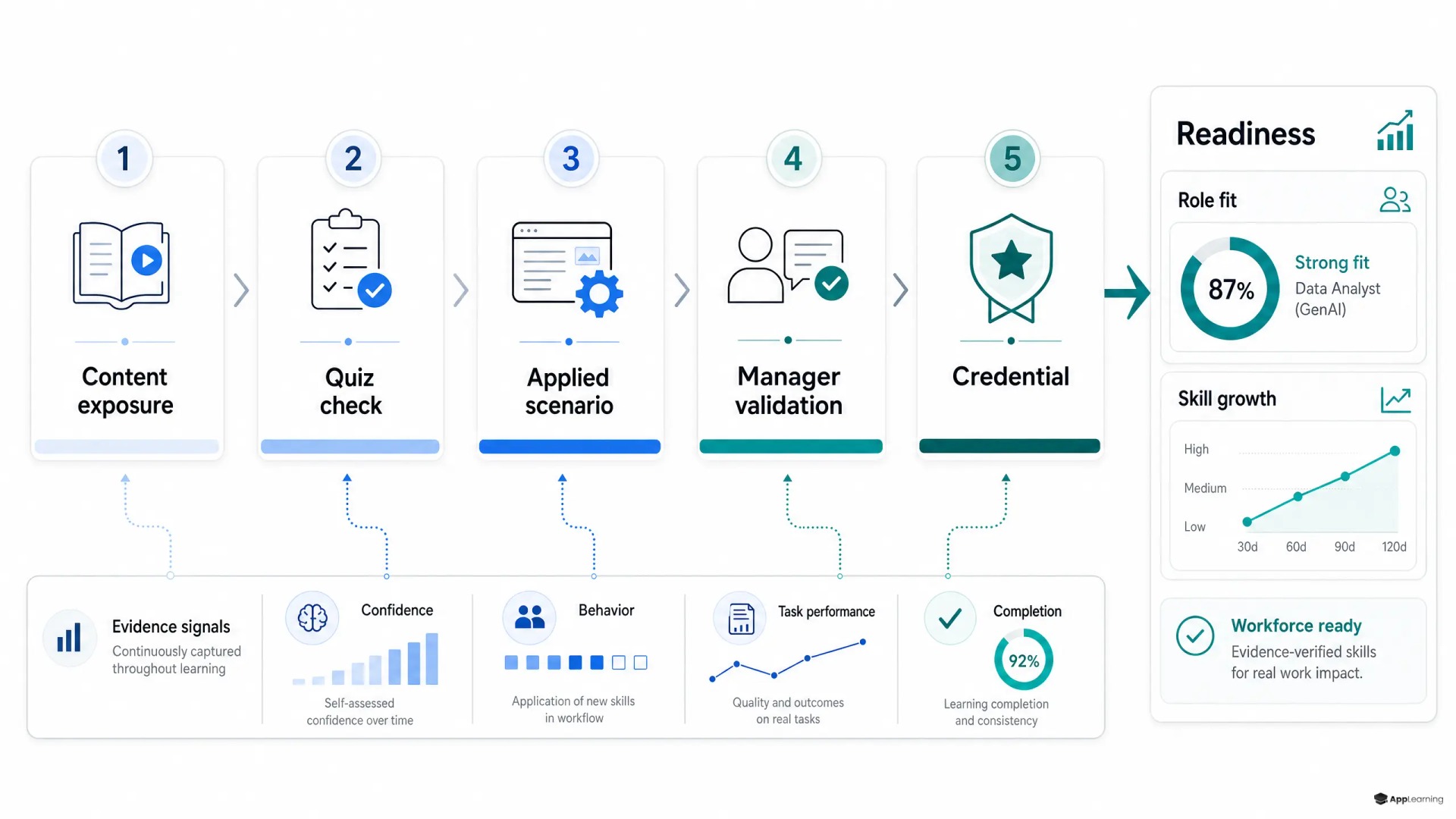
A proof-based AI learning journey should capture several forms of evidence, because no single metric is enough.
- Scenario performance against realistic cases and edge cases
- Applied tasks using approved tools, datasets, and policies
- Short quizzes that test judgement, not memory alone
- Confidence checks before and after practice
- Peer review where quality criteria are visible
- Manager validation for role-critical behaviours
- Behaviour signals such as repeated practice, revision, and safe tool use
- Credentials tied to evidence, not attendance
In regulated teams, this evidence does more than improve learning analytics. It creates a practical control layer. Managers can see who is ready for which AI-supported workflow. Compliance teams can see whether policy concepts turned into safe behaviour. Employees can see what they have proven and what still needs work.
Credentials need substance behind them
Employees want AI skills credentials because AI capability is becoming part of career mobility. But a badge without evidence is just a new version of course completion. It may look modern, yet it still fails when a manager asks what the employee can actually do.
Research on freelance knowledge workers shows the same problem in a sharper form. A 2026 CHIWORK paper found that freelancers use generative AI to structure learning and acquire new skills, but many of those skills become “invisible competencies” because workers lack credible ways to signal or validate them. The same pattern appears inside companies when internal talent systems cannot distinguish between exposure, confidence, and demonstrated capability.
A useful credential should therefore carry a trail. It should connect to the role, the assessed skill, the scenario, the rubric, the result, and the date. For HR and L&D leaders, this turns AI skills credentials into workforce planning data. For employees, it turns learning effort into something visible and usable.
Good to know
What makes AI upskilling evidence different from completion tracking?
Completion tracking shows that an employee finished a learning activity. AI upskilling evidence shows whether the employee can apply AI safely and effectively in a role-specific situation.
Which AI skills should finance and crypto companies assess first?
Start with the highest-risk and highest-frequency behaviours: data handling, prompt quality, output review, escalation judgement, customer communication, fraud or risk analysis, and policy-safe tool use.
Do AI skills credentials replace manager validation?
No. The strongest credentials combine platform evidence with manager validation, especially for regulated workflows where judgement, context, and accountability matter.
How can L&D modernize AI training without weakening compliance?
Use approved scenarios, controlled tools, clear rubrics, auditable learning records, and role-based permissions so innovation and compliance are designed into the same learning journey.
Proof-based journeys change the learning system
Measurable AI training starts with the job, not the content catalogue. The design question is simple. What must this role be able to do with AI without creating unacceptable risk?
From there, the learning journey becomes a sequence of evidence gates. A finance onboarding team might learn approved AI use cases, practise with compliant customer scenarios, complete a judgement-based assessment, submit a reviewed task, record confidence, and earn a role-specific credential. A crypto operations team might practise transaction monitoring explanations, escalation summaries, and policy-safe prompt patterns. The learning experience stays engaging, but the measurement stays concrete.
This is where App-Learning’s approach fits best. The platform logic is not to add another passive library to an already fragmented stack. It is to help teams build adaptive, role-based journeys that capture proof as people learn. Content, gamified practice, analytics, assessment, and credentials work as one system instead of separate reporting silos.
Build measurable AI learning your managers can trust.
PlanThe useful metric is readiness
AI upskilling should not be judged by hours consumed. It should be judged by readiness gained. In finance and crypto, that means employees can use AI with judgement, explain their choices, protect sensitive information, and work inside the rules of the business.
The next phase of L&D will belong to teams that can show capability, not just distribute content. Completion may still matter as an activity signal. It should not be mistaken for competence. The stronger system is clear: define the role, train the skill, test the behaviour, capture the evidence, issue the credential, and keep improving the journey as the work changes.