

Key takeaways
- Micro-credentials are evidence units, not mini diplomas.
- Employers need readable skill signals they can actually use.
- Assessment quality determines whether a credential means anything.
- Structured learning paths increase the value of each credential.
The term micro-credential creates confusion because it sounds like a smaller version of a degree. For employers, that framing is not useful. The real distinction is not size but signal quality. As the OECD notes, the market varies widely in format, provider type, and quality standards, which is exactly why many hiring and academy teams struggle to tell which credentials carry real decision value.
That is the practical lens employers need. A micro-credential only matters if it helps someone make a better decision: who is ready for a role, who can progress to the next learning step, who has actually demonstrated a capability, and which training investments are producing evidence rather than completion theater.
Micro-credentials are evidence units, not mini diplomas
The most useful official definitions already move in this direction. The European Commission’s approach to micro-credentials treats them as credentials built around documented learning outcomes, transparent description elements, and principles for design and issuance. UNESCO makes a similar point from a system perspective: the value is not simply that learning is shorter, but that smaller learning units can be recognized, quality assured, and connected into broader learning ecosystems.
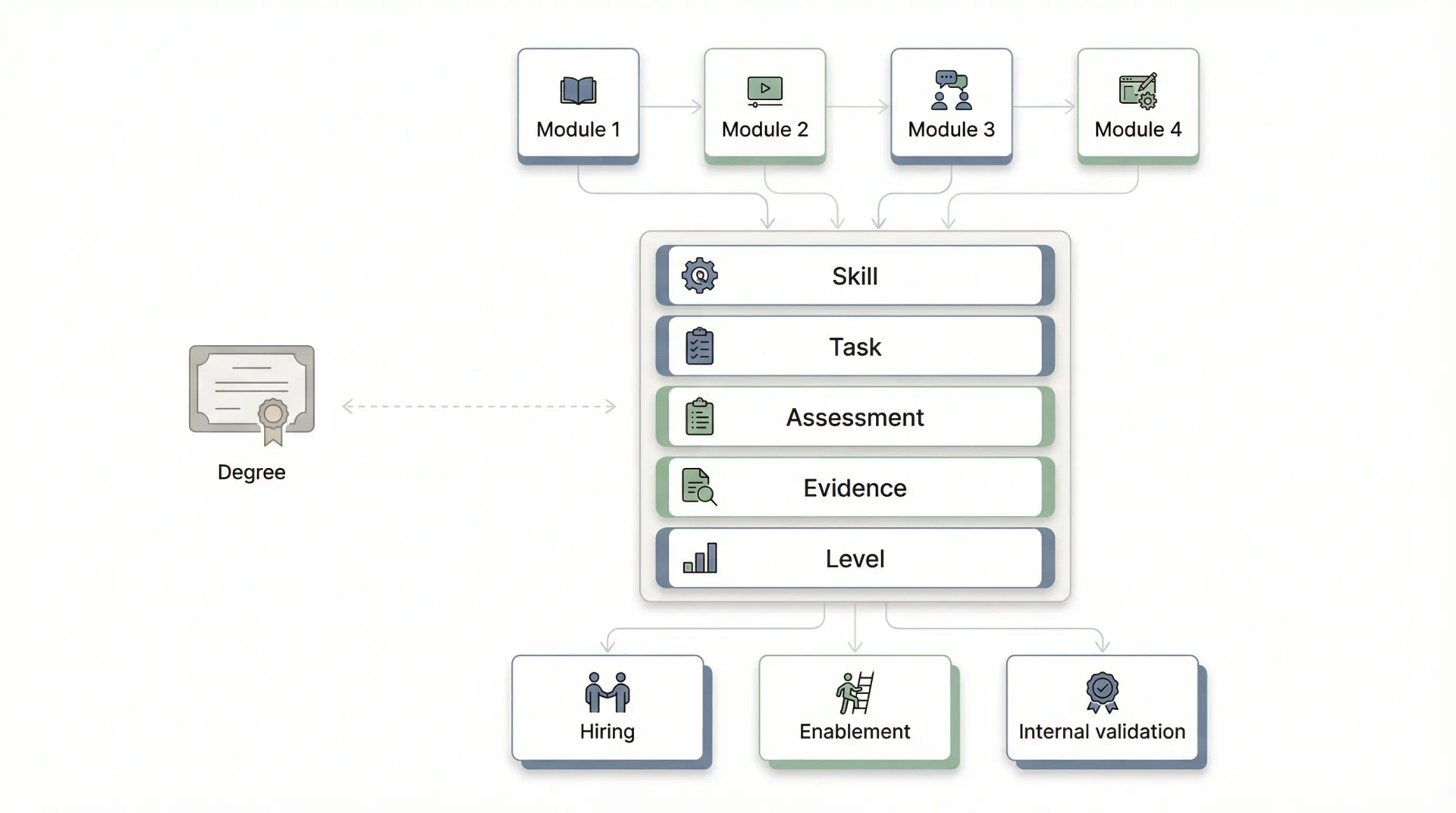
For employers, that means a micro-credential should be read as a bounded claim. It should tell you what the learner was expected to do, what standard they were measured against, who issued the claim, and what evidence sits underneath it. If those pieces are missing, the badge or certificate is mostly a design asset, not a capability signal.
Employer value starts with readability
Broad qualifications still matter, but they are often too static for fast-moving roles, internal mobility, and targeted upskilling. Employers need signals that are easier to interpret at the level where decisions actually happen: a manager staffing a project, a sales enablement lead certifying product readiness, or an academy owner validating that a learner can perform a specific task. That is why the EU recommendation explicitly links micro-credentials to lifelong learning and employability.
A readable micro-credential reduces ambiguity in three ways. It narrows the claim to a specific capability. It shortens the distance between learning and verification. And it creates a common object that learning teams, managers, and recruiters can discuss without translating broad academic language into job language every time.
- For hiring, it can support screening when a role depends on specific demonstrated skills rather than generic qualification labels.
- For internal enablement, it can mark readiness gates inside onboarding, product training, compliance, or manager development.
- For workforce planning, it can make skill progression visible across pathways instead of hiding progress inside course completion logs.
Credibility lives or dies in the assessment layer
This is where many micro-credential strategies fail. Employers do not need more certificates. They need claims they can trust. The OECD has been clear that expansion alone does not solve the quality problem, and its later work argues that trust depends on quality assurance, transparency, and better evidence on outcomes. A micro-credential earned for watching content is fundamentally different from one earned through observed performance, scored practice, or validated work output.
In operational terms, four elements drive credibility:
- Clear learning outcomes tied to a real capability
- Assessment criteria that are explicit and defensible
- Issuer trust, including who designed and quality-checked the credential
- Portable metadata or evidence that lets another party verify the claim
That last point matters more than many teams expect. According to 1EdTech’s Open Badges standard, a digital credential can carry metadata about the achievement, issuer, recipient, and supporting evidence, and can also be digitally signed as a verifiable credential. That turns a static image into something closer to a machine-readable proof object. For employers, this is the difference between a PDF that says “completed” and a record that can actually be inspected and validated.
Workplace use cases reward structure, not volume
The best employer use cases are not built around issuing lots of badges. They are built around specific decision points. A credential has value when it marks a threshold that matters inside the business.
In practice, that usually means using micro-credentials in a pathway rather than as isolated rewards. UNESCO’s framing is helpful here: small learning units become more valuable when they are connected into a broader ecosystem instead of left as fragmented one-off experiences.
- Onboarding: certify role readiness for concrete tasks, systems, or customer interactions
- Frontline and partner enablement: validate product knowledge plus applied execution
- Leadership development: evidence completion of practice-based milestones, not just attendance
- Internal mobility: show that an employee has met the capability threshold for a new role family
- External academies: offer customers or partners a more credible proof of skill than simple course completion
This is also where platform design matters. If content, assessment, evidence capture, and certificate logic live in separate systems, the credential becomes brittle and hard to trust. If they are linked, the organization can make a more defensible claim: this learner completed this sequence, passed this assessment model, and earned this credential under defined rules. That is the more credible skill proof system employers actually need, and it is where App-Learning can connect modular learning journeys to assessment and issuance logic rather than treating certificates as an afterthought.
See how App-Learning can turn modular learning into credible skill proof.
Book a demoTransparency turns credentials into usable infrastructure
The deeper shift is infrastructural. A micro-credential becomes more useful when it is described in consistent, searchable, interoperable ways. Credential Engine’s transparency model is built around publishing structured information about credentials, skills, costs, outcomes, and quality signals so different stakeholders can make better decisions. That same logic applies inside employers: if a credential is not readable by people and systems, it is hard to use in hiring, progression, or talent intelligence.
This is why the future of micro-credentials is not about issuing more of them. It is about making them legible. Employers do not need miniature diplomas cluttering the signal environment. They need evidence units that connect learning outcomes, assessment, verification, and business decisions. Once that connection is made, micro-credentials stop being marketing wrappers around content and start functioning as real proof of capability.
Good to know
Are micro-credentials replacing degrees or professional qualifications?
No. They work best as narrower proofs of specific capability. In many cases they complement broader qualifications by making recent, role-relevant skills easier to interpret.
What makes a micro-credential credible to an employer?
A clear skill claim, defensible assessment, trusted issuer, and verifiable evidence. Without those elements, it is usually just proof of participation.
Where do micro-credentials create the most value inside a company?
Usually at decision points such as onboarding, role readiness, partner enablement, compliance, internal mobility, and academy pathways where managers need a visible threshold of demonstrated capability.