

Key takeaways
- Completion is a weak proxy for AI readiness.
- AI literacy develops in observable stages, not one-off events.
- Regulated teams need evidence of judgment, not just participation.
- Learning platforms should track confidence, evaluation and escalation behavior.
Completion hides the real risk
Completion tells L&D that an employee opened a course, clicked through the content and maybe passed a recall quiz. It does not show whether they can use AI safely in a KYC review, customer complaint, suspicious transaction triage, code review or product policy check. In finance and crypto, mistakes do not stay in the classroom. They enter regulated workflows, customer communications and audit trails.
The European Commission’s AI literacy guidance makes the standard role- and context-specific. Staff need sufficient skills, knowledge and understanding for the AI systems they deal with, the setting in which those systems are used and the people affected by them. That is not a one-size awareness module. It is a capability requirement.
A completion metric cannot answer the operating question a compliance lead will eventually ask. Can this person recognize when AI output is wrong, risky, unverifiable, biased, out of policy or outside their authority?
AI literacy develops as a sequence
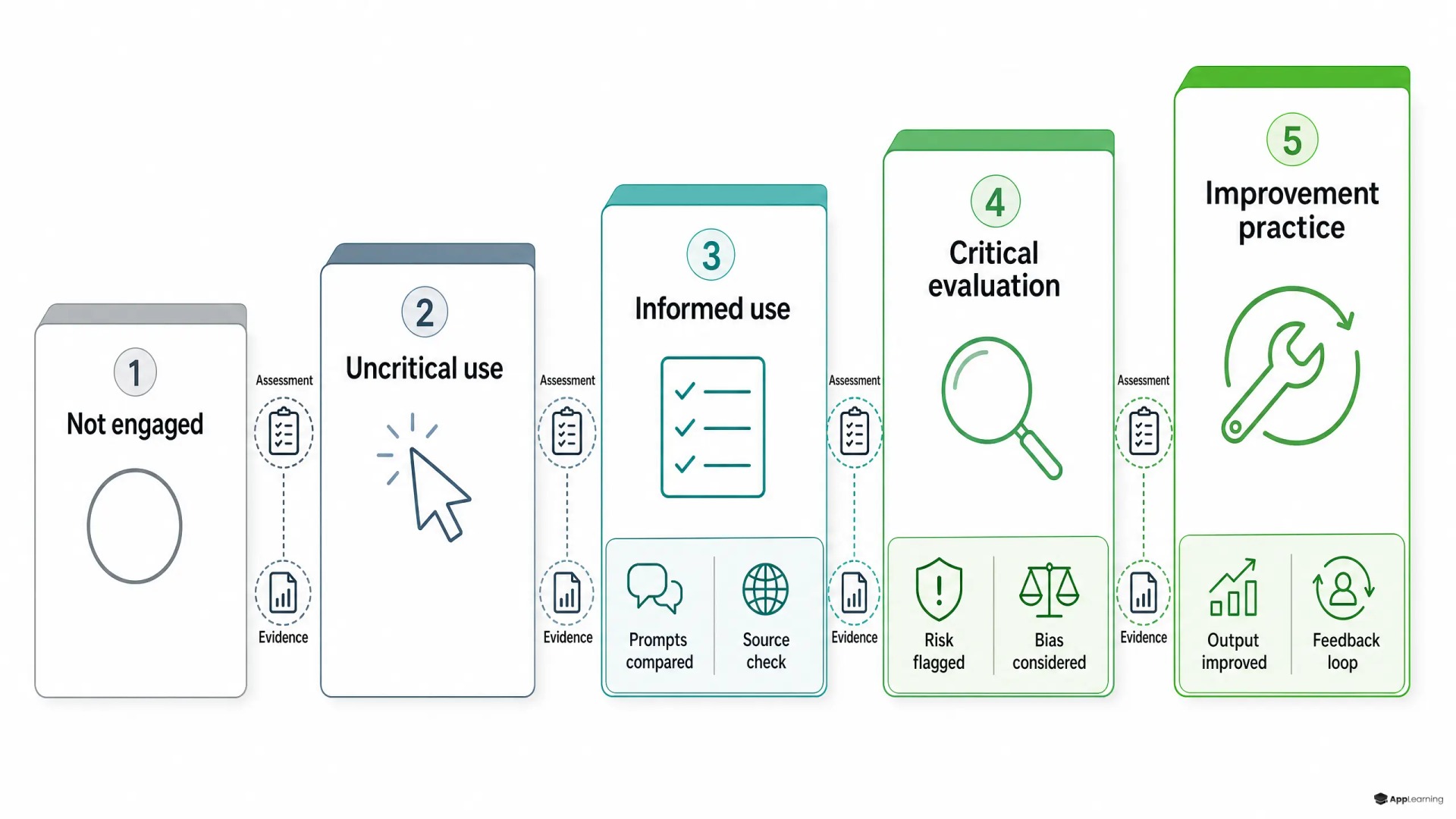
The useful shift is from course completion to AI skills progression. A 2026 AI Literacy Continuum paper describes five stages: not yet engaged, uncritical use, informed use, critical evaluation and improvement. Although the paper is written for higher education, the model fits enterprise learning because it names the behavior change companies actually need to see.
- Not engaged means the employee avoids AI or lacks safe access.
- Uncritical use means they accept output without verification.
- Informed use means they understand limits and verify basic claims.
- Critical evaluation means they assess assumptions, evidence, bias and consequences.
- Improvement means they redesign prompts, workflows or controls after failure.
In enterprise AI readiness training, Stage 2 may be enough for occasional productivity use. Stage 3 should be the baseline for risk, compliance, finance, legal, customer operations, product and engineering. Stage 4 belongs to workflow owners, AI champions and teams shaping how AI is embedded in the business.
Observable competence leaves a trail
Measurable AI training should look at behavior. Did the learner verify sources, compare an AI answer with policy, flag uncertainty, decide not to use AI, escalate the case or improve the workflow after a failure? Those traces are stronger than a pass mark because they show judgment in context.
- Confidence before and after scenarios
- Verification steps taken before accepting output
- Correct rejection of plausible but unsafe answers
- Escalation choices under time pressure
- Disclosure and documentation behavior
- Recurring error patterns by use case
- Improvement suggestions from frontline teams
This matches current workforce signals. PwC’s 2026 analysis of job ads found that AI-exposed roles are placing more weight on judgment, leadership and other human-intensive capabilities. The learning implication is clear: AI workforce readiness cannot be measured as tool familiarity alone.
Assessments must test judgment under constraint
An AI literacy assessment should be scenario-based. A short quiz can test vocabulary, policy terms and basic risks. It cannot prove that an employee will slow down when an AI answer is fluent but incomplete. The better pattern is blended: knowledge checks, simulations, artifact reviews and role-specific scenarios with messy inputs.
- An analyst receives an AI-generated KYC summary with missing source evidence.
- A support agent gets an AI draft that weakens a required regulatory disclosure.
- A developer asks AI to modify monitoring code, but the test result conflicts with the suggestion.
- A manager uses AI for performance feedback and includes sensitive employee information.
Each task should score the answer and the reasoning behind it. What did the employee check? What did they ignore? When did they escalate? How did they document the decision? In regulated environments, this creates evidence of judgment, not just evidence of participation.
Good to know
Is completion still useful for AI training?
Yes. Completion remains useful as a basic control record, especially in regulated environments. It should not be treated as proof of AI capability. Pair it with scenario results, confidence shifts, escalation behavior and role-based progression data.
How often should AI literacy be reassessed?
Reassessment should follow risk and change. High-impact roles should be tested more often, especially when new AI tools, policies, models or workflows are introduced. Lower-risk users may only need periodic refreshers and targeted checks.
Can progression tracking work with an existing LMS?
Often, yes. The key is whether the learning stack can capture more than completion. If it can record scenario choices, quiz patterns, role data and analytics over time, it can support a progression model.
What should regulated teams measure first?
Start with the behaviors that reduce operational risk: verification, correct rejection of unsafe output, escalation, disclosure and documentation. These are easier to observe than broad claims of confidence or productivity.
Readiness should be visible by role and team
For App-Learning, this changes platform design. The quiz, scenario and analytics layer should produce progression evidence, not just badges. A useful dashboard shows where teams sit on the continuum by role, use case and risk exposure.
- Completion status for control coverage
- Stage distribution by team and role
- Risky overconfidence hotspots
- Scenario pass rates by failure type
- Escalation accuracy and speed
- Improvement actions submitted after training
This makes AI workforce readiness operational. Compliance sees evidence. L&D sees learning gaps. Business owners see which teams can use AI in workflow and where guardrails still need human support.
Map AI training to role-based progression.
PlanThe better metric is movement
AI literacy is not proven by finishing a module. It is proven when people move from uncritical use to informed use, then to critical evaluation and, where relevant, improvement-oriented practice. That movement can be designed, tested and reported. For finance and crypto companies, the goal is not more training activity. The goal is a workforce that knows when AI helps, when it fails, when to stop and when to escalate.