
Key takeaways
- The best employee training platform for a growing team depends on operating maturity, not feature count.
- Fast hiring usually needs reusable onboarding, compliance, product, and role-readiness paths before a heavy LMS rollout.
- Compare platform types by launch speed, admin load, content updates, and evidence.
- App-Learning fits scaleups that need a lean internal academy built from fragmented company knowledge.
If you are searching for the best employee training platforms for fast-growing teams, the real question is not which LMS has the longest feature list. It is which platform can make onboarding, compliance training, product knowledge, and role readiness repeatable before hiring speed turns internal knowledge into a bottleneck.
For most growing teams, the right choice is a platform that launches quickly, keeps admin light, supports reusable learning paths, and produces enough evidence for managers, People teams, and compliance without forcing a full enterprise L&D model too early.
The handover model breaks first
The first sign is not usually bad training feedback. It is manager overload. New hires ask the same product, pricing, process, risk, and tool questions every month. People teams chase completion manually. Compliance evidence lives in spreadsheets. Subject-matter experts become bottlenecks because they are the only reliable source of truth.
This is why platform selection should start with operating pressure, not feature volume. SHRM’s guidance on measuring onboarding success includes time-to-productivity, retention, performance measures, and new-hire feedback. A training platform for growing teams should make those signals easier to manage, not bury them under LMS administration.
Best employee training platforms for growing teams: what to compare first
Start with the platform category, not the vendor logo. Growing teams usually choose between five patterns; each handles a different training bottleneck and creates a different admin load.
- Classic LMS: best when your main need is assigning courses, tracking completion, certificates, and compliance records with predictable administration.
- Enterprise learning suite: best when you already need integrations, governance, skills data, analytics, and multi-audience control across employees, partners, or customers.
- Collaborative learning platform: best when internal experts must create and update training often, and content ownership is distributed across departments.
- Knowledge-base approach: best for findable information in early-stage teams, but it usually needs quizzes, paths, reminders, and reporting before it becomes employee training.
- Academy platform: best when a growing team needs a guided learner experience for onboarding, product knowledge, compliance refreshers, and role-readiness paths.
The public positioning of major vendors shows these different centers of gravity. TalentLMS emphasizes easy scaling and tailored training, LearnUpon centers managed learning across audiences, iSpring Learn combines LMS workflows with course creation, 360Learning leans into collaborative learning, and Docebo positions itself as an AI-powered learning platform for employees, customers, and partners.
How to choose a training platform for a growing team
Shortlist employee training platforms against the work they remove from People, managers, Compliance, and Operations. A long feature list is useful only if the team can launch it, maintain it, and trust the records it creates.
- Launch speed: Can the first onboarding or compliance academy go live in weeks, not quarters?
- Role-based structure: Can new hires in Fraud, Operations, Support, Business, and Product each get relevant paths?
- Admin effort: Can enrollments, reminders, reporting, and updates run without a full LMS team?
- Content updates: Can PDFs, slides, SOPs, call scripts, and product docs become short reusable modules?
- Evidence: Can completion, quiz results, certificates, and refresher status be exported when managers or auditors need proof?
- Learner experience: Does the format help people finish, remember, and apply the training during real work?
The academy layer suits the messy middle
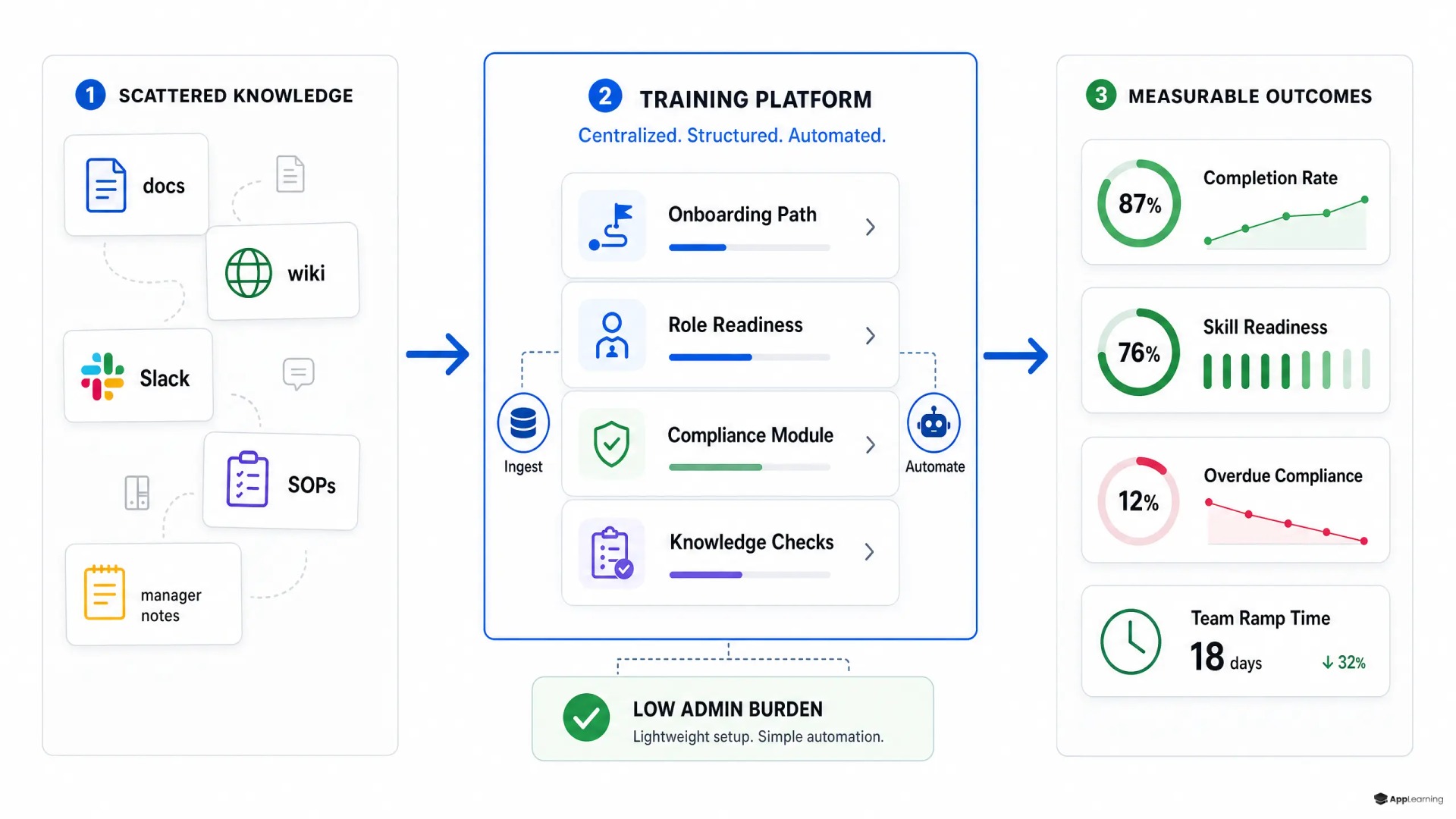
Many growing teams sit between two extremes. A knowledge base is too passive. A full enterprise LMS is too heavy. The academy layer fits that middle stage because it starts with the concrete learning journeys the business needs now: company onboarding, department onboarding, risk training, product understanding, process training, and refreshers.
This is where App-Learning’s academy model fits. It is built around branded microlearning academies, role-based learning paths, quizzes, certificates, analytics, and the conversion of existing documents into structured modules. That matters when the People team needs professionalization without hiring a large L&D production unit.
The point is not to replace every HR or talent system. It is to create a reliable learning layer that managers can trust and learners will actually use. Once that layer works, the company can expand from onboarding into upskilling, compliance refreshers, product changes, and leadership basics.
Good to know
What are employee training platforms?
Employee training platforms are systems that help companies create, deliver, manage, and measure employee learning. They can include LMS functionality, academy experiences, microlearning modules, quizzes, certificates, analytics, and role-based learning paths.
What is the best employee training platform for a growing team?
The best platform depends on maturity and bottleneck. A team under 100 people may need a knowledge base plus lightweight tracking; a 100-300 person scaleup with repeated hiring often needs an academy or lightweight LMS; a larger regulated company usually needs stronger reporting, governance, and integrations.
When should a scaleup move beyond documents and manager-led onboarding?
Move when onboarding quality depends too much on individual managers, when the same questions repeat every hiring cycle, when compliance records are hard to prove, or when new hires take too long to become productive.
How should a fintech evaluate training platforms?
A fintech should evaluate launch speed, role-based structure, admin effort, content update workflows, completion evidence, refresher training, quiz results, certificates, and the ability to support audit, risk, and regulatory documentation.
Onboarding, compliance, and readiness need different controls
Onboarding needs speed, clarity, and cultural consistency. Compliance needs version control, completion evidence, reminders, and audit-ready records. Role readiness needs practical checks: can the employee follow the workflow, handle the customer case, explain the product, apply the policy, or escalate the risk signal correctly.
In regulated fintech, this is not theoretical. DORA’s article on learning and evolving states that financial entities must develop ICT security awareness programmes and digital operational resilience training as compulsory modules in staff training schemes. Even when a company is not directly in scope, this sets a useful bar: training must be current, targeted, and provable.
- Use onboarding paths for company basics, culture, tools, security, and first-week tasks.
- Use department academies for fraud workflows, support quality, operations procedures, and commercial playbooks.
- Use compliance modules for mandatory policies, role-specific obligations, and periodic refreshers.
- Use quizzes and scenario checks where correctness matters more than attendance.
- Use analytics to find weak spots before they become manager escalations or control failures.
A practical employee training platform shortlist
Do not ask for the best platform in the abstract. Ask which category matches your next stage of operating maturity and where the team is losing time today.
- If the team has fewer than 100 employees and no recurring compliance burden, start with a clean knowledge base plus lightweight tracking.
- If the team has 100 to 300 employees and repeated hiring, prioritize an academy or lightweight LMS with fast setup, reusable paths, and low admin effort.
- If the company has several regulated departments, choose a system with strong reporting, certificates, refresher logic, and clear ownership for content updates.
- If internal experts must create and improve material often, look closely at collaborative learning workflows.
- If the company already has many slides and courses, check authoring depth and migration effort before choosing.
A practical shortlist for growing teams might include TalentLMS for simple LMS scaling, 360Learning for collaborative content operations, LearnUpon or Docebo for more complex multi-audience learning, iSpring Learn for teams that need LMS plus authoring, and App-Learning for scaleups that need a lean internal academy built from fragmented company knowledge.
Build your academy before knowledge fragments further.
TalkStart with the next six months
The right training platform for growing teams is the one that stabilizes the next six months of hiring and change. It should make onboarding repeatable, make compliance visible, make role readiness measurable, and make updates less painful. Growing teams do not need learning theatre. They need a system that turns knowledge into capability before scale turns every gap into an operating risk.