
Key takeaways
- AI upskilling is becoming an executive accountability issue in financial services.
- Three-year plans require repeatable learning operations, not campaign-based training.
- Certificates and role analytics turn training activity into reportable evidence.
- Protected learning time raises the value of concise, mobile-first programs.
A compact turns skills into governance
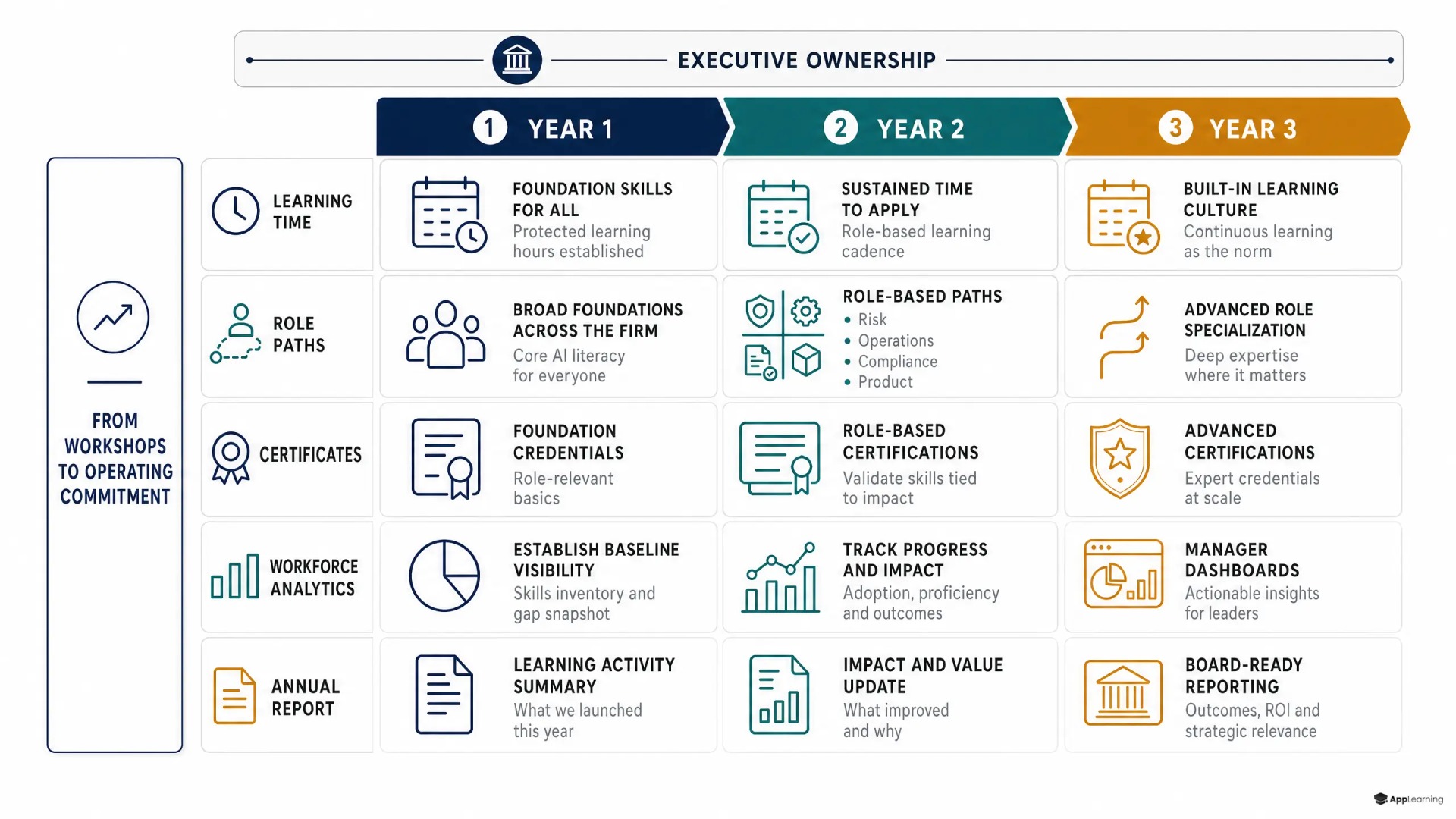
The shift is not that banks need more AI courses. That was already clear. The shift is that financial services AI training is being pulled into the management system of the firm. Published on 14 July 2026, the Financial Services Skills Compact asks signatories to upskill their UK workforce in AI and other critical skills over a rolling three-year period, assign a senior executive to the skills gap, and publish annual progress updates.
That changes the operating brief for HR and L&D. Bank AI upskilling can no longer sit as a voluntary workshop series run when budget and attention allow. It now has to survive executive scrutiny, workforce segmentation, data quality checks, and public reporting cycles.
Executive ownership breaks the workshop model
A senior executive cannot govern a folder of slide decks. They need a plan that connects business risk, role change, training design, and evidence. The Compact also asks firms to provide the Financial Services Skills Commission with methodology for submitted data and to report progress annually on firm webpages. That makes AI skills governance a practical discipline, not an internal slogan.
For L&D teams, the consequence is simple. The question moves from “who attended the AI session” to “which parts of the workforce have gained which capability, against which target, in which reporting period.” Completion alone is too thin. Learning hours alone are too blunt. A regulated firm needs proof that the training was intentional, relevant, and traceable.
Role paths beat generic AI awareness
Generic AI awareness has a place at the start. It does not carry a three-year skills plan. Credit analysts, relationship managers, compliance officers, product owners, operations teams, and executives face different AI decisions. They need different practice cases, risk language, and standards of evidence.
The Compact defines upskilling as completion of at least one curated or recommended learning item, such as a professional qualification, course, certificate, module, badge, or high-quality digital learning, with clear evidence of engagement and completion. It also says mandatory training does not count toward the upskilling definition. That distinction matters. Financial firms cannot relabel compliance learning as capability building and call the work done.
- Executives need AI strategy, accountability, and risk trade-off modules.
- Client-facing teams need responsible use cases, disclosure boundaries, and escalation rules.
- Operations teams need process redesign, data quality, and human review skills.
- Risk and compliance teams need model governance, audit trails, and control design.
- Product and technology teams need safe experimentation, monitoring, and adoption playbooks.
Good to know
What does the Financial Services Skills Compact change for L&D teams?
It moves AI upskilling from a discretionary learning initiative into a governed workforce commitment with executive ownership, three-year planning, and annual reporting.
Why are certificates important for bank AI upskilling?
Certificates create structured evidence that a learner completed a defined module, path, or assessment. They make progress easier to report and compare across roles.
Does mandatory compliance training count as AI upskilling under the Compact?
The Compact separates upskilling from mandatory training. Firms need curated learning in AI or other selected critical skills, not a relabelled compliance course.
How can finance firms make AI training measurable?
They should define role groups, set target populations, track unique learners, issue certificates, and connect progress data to annual workforce reporting.
Reporting needs evidence not impressions
The first reporting deadline creates a data problem before it creates a content problem. Firms signing at launch must report by 30 November 2026, including selected critical skills, workforce size, and the number and percentage of the current UK workforce upskilled over the preceding 12 months, with 24- and 36-month data where available. The Compact measures unique learners, not course volume.
That forces a cleaner measurement stack. A reporting-ready academy needs role groups, target populations, versioned content, certificates, learner evidence, timestamps, and dashboards that can be trusted. It also needs rules for what counts. A five-minute video may create awareness. It may not create meaningful capability. Protected learning time makes that trade-off visible because every hour now competes with operational work.
Build an AI academy your leadership can measure.
PlanThe academy layer becomes infrastructure
This is where the academy layer matters. App-Learning can sit between executive intent and workforce evidence with role-based learning paths, certificates, multilingual delivery, mobile-first modules, live progress data, and content that can be updated without waiting for a full LMS rebuild. The point is not to replace governance. It is to make governance executable.
The same logic applies beyond the UK and beyond banking. Fintech and crypto firms already live with fast product cycles, regulatory scrutiny, and fragmented learning stacks. As AI adoption accelerates, they will need measurable AI training that proves more than enthusiasm. The UK framework gives them a useful signal. Skills programs will be judged less by launch energy and more by repeatability.
The Financial Conduct Authority has also framed AI as a force that could reshape retail financial services by 2030, including firm operations, consumer journeys, competition, fraud, cyber risk, and market concentration. Its Mills Review announcement points to a wider direction of travel. AI capability is becoming part of how financial firms manage conduct, resilience, and customer outcomes.
Finance leaders should treat the Financial Services Skills Compact as an operating preview. The durable advantage will not come from giving everyone the same prompt engineering webinar. It will come from building a measurable academy that maps skills to roles, protects time, certifies progress, and gives executives enough evidence to stand behind the plan each year.