

Key takeaways
- Topic selection should combine novelty, decision relevance, and conceptual transfer.
- New modules should reuse mental models established in earlier learning.
- Shared foundations reduce duplicated content across markets.
- Regional product differences belong in modular branches, not disconnected courses.
Feature lists do not teach judgment
Product education roadmaps often start with the release backlog. A new account flow, Bitcoin feature, fee model, risk screen, or portfolio tool appears, so the team creates a module. That feels current, but it is a weak product education curriculum. Novelty is not the same as learning value. The real failure point is often a missing chain of concepts.
The BIS notes that digital finance can expand access to payments, credit, savings, and insurance while also creating vulnerabilities such as scams, overindebtedness, and unsuitable investment products. For fintech teams, education is not content decoration. It is part of the product operating model.
Topic choice needs harder filters
A better roadmap uses four filters before a topic becomes a module:
- Novelty: learners have not seen the mechanic before.
- Decision relevance: misunderstanding changes user, employee, or advisor behavior.
- Prerequisite gap: the topic depends on concepts learners may not have.
- Transfer potential: the module can reuse a mental model from earlier learning.
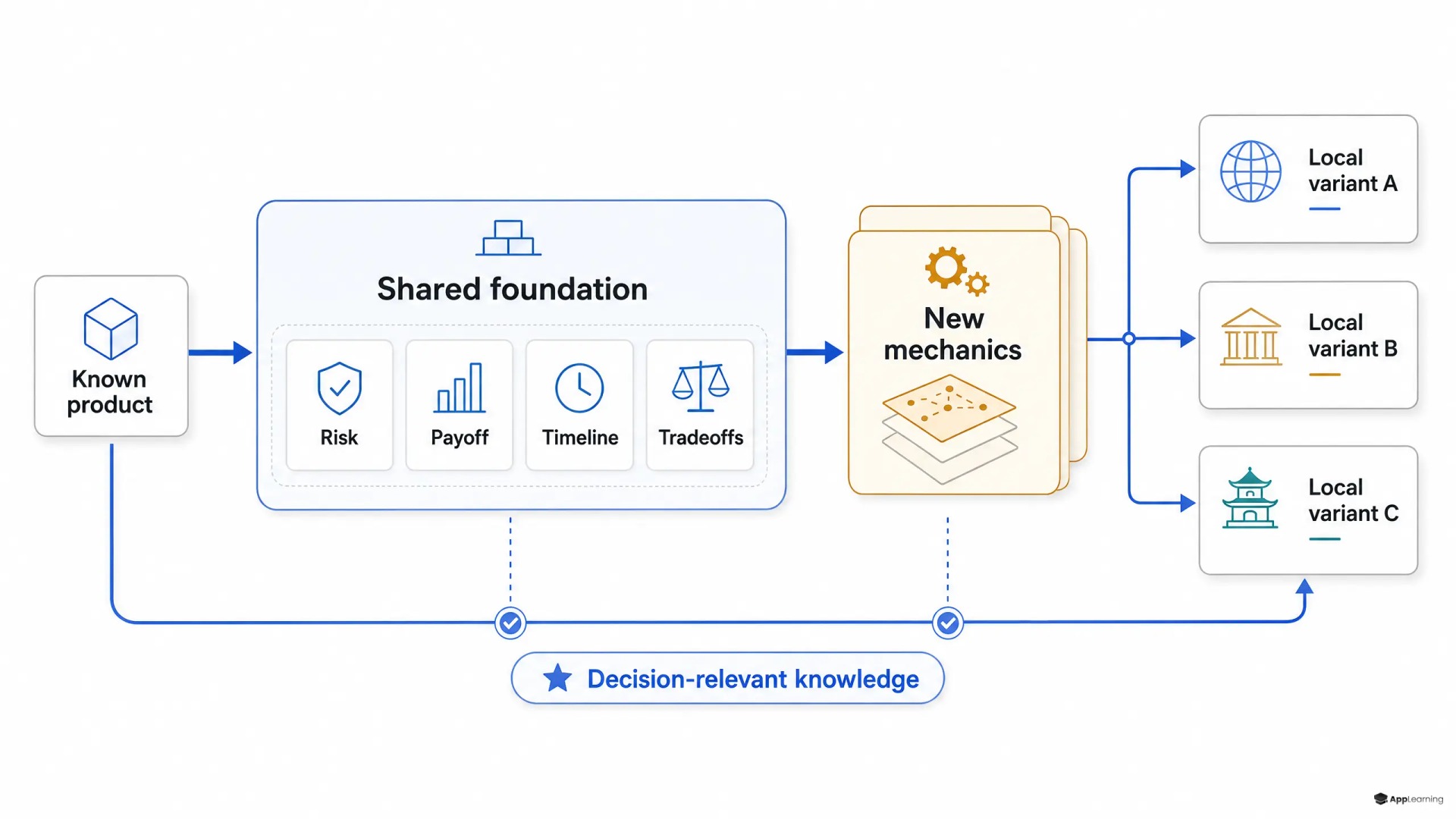
In one anonymized course-planning discussion, a complex financial-product topic made the roadmap for three reasons. Employees were unlikely to understand the mechanics, the topic reused concepts from an earlier module, and business relevance was rising. The product also differed by market. The answer was not isolated country courses. It was a specialist module, plus a broader foundation chapter that could serve multiple regions.
Prerequisites turn complexity into sequence
A prerequisite learning map makes the hidden sequence visible. It shows what the learner must already understand before a new product mechanic makes sense. Research on cognitive load theory treats working memory limits as a central constraint in instructional design, and a 2025 review of prior knowledge in learning highlights mechanisms such as encoding, chunking, comprehension, cognitive load, and transfer.
This has practical consequences. Do not start with the advanced feature. Start with the decision the learner must make. Then map the concepts behind that decision. If the learner needs to understand volatility, collateral, settlement, reward mechanics, risk tiers, or liquidity first, those ideas belong upstream. Otherwise the course explains the interface while leaving the product logic unclear.
Good to know
How is a prerequisite learning map different from a topic list?
A topic list names what to teach. A prerequisite map shows the order in which concepts must be understood before a learner can use a product mechanic with confidence.
Does this work for customer education and internal teams?
Yes. The same structure can guide in-app onboarding, advanced user education, support reduction, sales enablement, and fintech employee education.
Where should regional product differences sit?
They should sit in localized branches after the shared foundation, so each market gets relevant detail without duplicating the whole curriculum.
One core can carry many markets
Financial products rarely localize cleanly through translation alone. Market rules, product availability, tax language, risk warnings, eligibility, and examples change. The EU/OECD-INFE framework was designed to support financial literacy programmes and educational materials across Member States, which is a useful pattern for localized product education. Keep the competence layer stable. Localize the product branch.
- The shared core explains the base concept, vocabulary, user decision, and risk logic.
- The market branch explains local rules, screenshots, examples, disclaimers, and product availability.
- The assessment checks both layers without forcing every learner through irrelevant detail.
Build the map before the modules.
MapApp-Learning turns the map into reusable paths
App-Learning structures modular product training as content architecture, not as a pile of courses. The work starts with the product portfolio, user journeys, support issues, and adoption goals. Then the team maps shared foundations, prerequisite concepts, localized branches, quiz logic, and analytics. The same system can support customer onboarding, advanced feature adoption, partner education, and fintech employee education.
For a Product Lead, the benefit is focus. The core team does not need to rebuild explanations for every market or every release. The learning system can ask better questions. Has the learner mastered the foundation before seeing the advanced module. Is confusion caused by the product mechanic, the regional rule, or missing prior knowledge. Which branch should appear next.
A product-education roadmap should show dependency, risk, reuse, and local variation. If it only lists features, it will keep creating content faster than learners can absorb it. If it becomes a prerequisite map, education becomes a product asset: easier to maintain, easier to localize, and much closer to the decisions that drive activation, retention, and confidence.