

Key takeaways
- Financial access and financial capability are different outcomes.
- Benefit onboarding needs decision practice, not only terms and conditions.
- Short gamified paths can explain contribution, risk, and long-term behavior.
- Completion and knowledge data show where users remain uncertain.
The account is not the experience
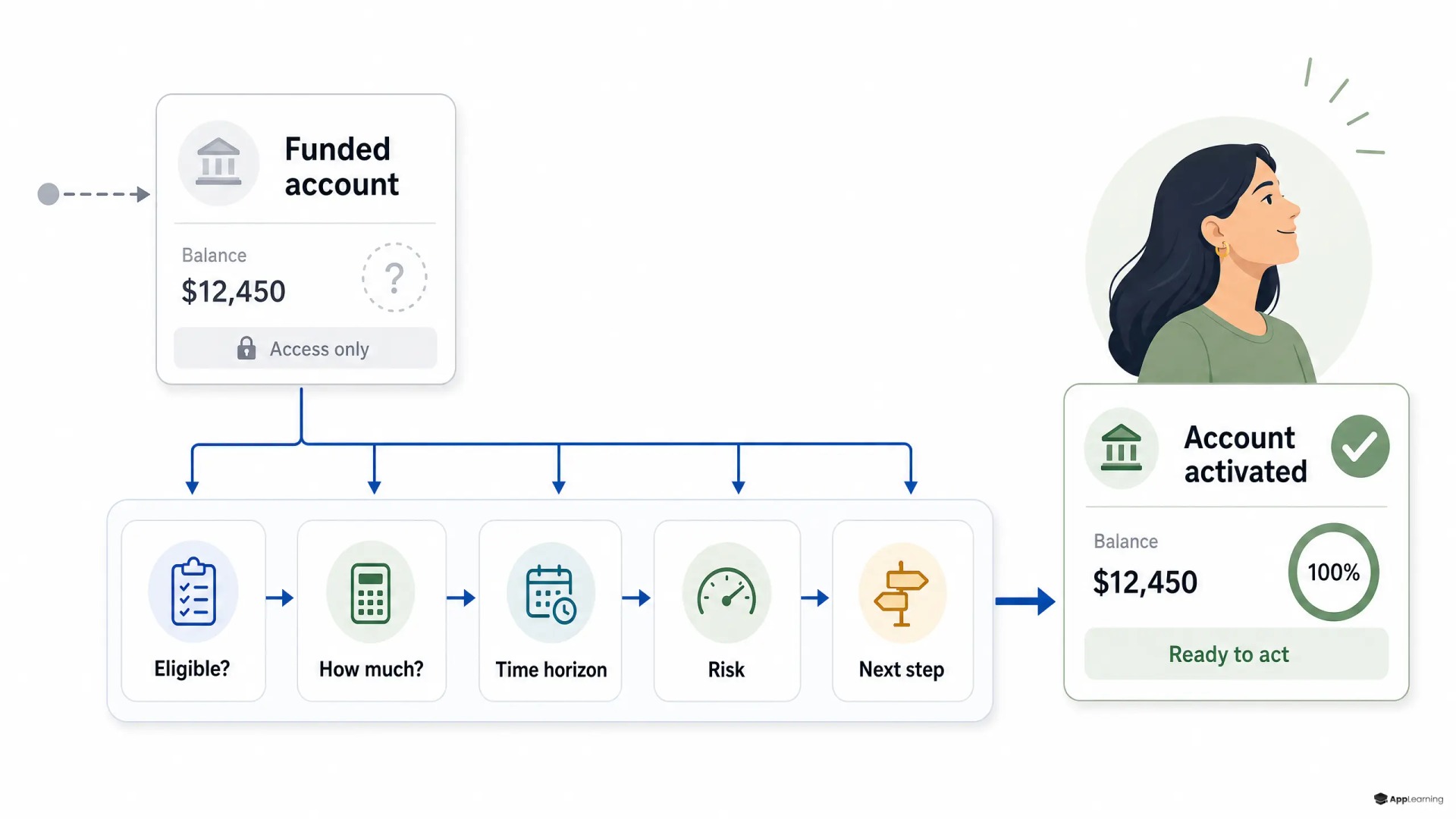
A funded account solves one problem: access. It does not solve eligibility confusion, contribution choice, risk understanding, tax questions, or the simple uncertainty of what to do next. That is the activation problem behind many new financial benefits.
New funded accounts show the pattern. When federal child investment accounts began accepting contributions on July 4, 2026, Treasury said they could receive money from parents, family members, employers, and other eligible contributors. Reuters reported that Goldman Sachs and Morgan Stanley announced $1,000 matches for eligible employees’ children. The access event was clear. The user journey was not.
For HR and L&D teams in finance, banking, and crypto, this is not a communications detail. It is an operating risk. If an employee cannot tell whether they are eligible, what happens after enrollment, or how time horizon changes risk, the benefit becomes a support burden. Financial benefits education should sit inside activation, not after it.
Literacy data exposes the gap
The capability gap is measurable. The TIAA Institute–GFLEC index found that risk was the weakest knowledge area, with only 36% of risk-related questions answered correctly in 2026. That matters for investment benefit activation because risk, compounding, inflation, and time horizon are the exact concepts users need when a savings or investment benefit opens.
The same research introduced the P-Fin 8 Index as a short measure of financial literacy. Employers and fintechs should treat that as a design signal. If knowledge can be measured in minutes, benefit onboarding can test confidence before users make choices and after they complete a learning path.
Onboarding contains the real curriculum
The best learning moment is not a quarterly webinar. It is the point where a person must decide. The OECD’s workplace handbook supports financial education delivered at the right moment, or just in time, because timing changes relevance. For fintech onboarding and employee financial wellness, this means education should appear beside the action, not buried in a PDF.
- Who is eligible and what documents are needed
- What the employer, provider, or state funds
- What the user can choose, change, or pause
- How risk, time horizon, fees, and tax treatment interact
- Which next step completes activation
Good to know
How is this different from a benefits communication campaign?
A communication campaign explains that the benefit exists. An education layer helps users understand eligibility, practice decisions, confirm knowledge, and complete the next step.
Where should financial benefits education sit in the employee journey?
It should sit inside onboarding and activation flows, close to the point where the employee or customer must make a choice.
Can this work in a regulated finance or crypto environment?
Yes, if the learning system uses approved content, version control, clear disclaimers, completion evidence, and analytics that support oversight without turning education into advice.
What should HR and L&D measure beyond completion?
Measure confidence change, repeated errors, scenario choices, drop-off points, reminder response, certificate issuance, and topic-level uncertainty across cohorts.
Game mechanics must serve decisions
Gamification helps when it reduces hesitation. A 2023 meta-analysis of gamification in education found positive effects on learning outcomes, motivation, and engagement, but financial learning is not a public scoreboard problem. Points, streaks, and badges should mark progress through real decisions. They should not reward speed, overconfidence, or trading behavior.
- Use scenarios for contribution trade-offs
- Use checkpoints for risk and eligibility
- Use reminders for incomplete activation
- Use certificates for completion and audit evidence
This is where savings account education and investment learning diverge from normal product tutorials. The learner is not only learning where to click. They are building enough judgment to avoid avoidable mistakes, ask better questions, and know when guidance becomes regulated advice.
Build financial benefits education your users can complete.
BuildActivation becomes visible through learning data
App-Learning can turn a new benefit into a short, personalized onboarding academy. The academy can segment users by eligibility, role, country, product type, and confidence level. It can combine approved content blocks, decision scenarios, reminders, certificates, and dashboards without turning the experience into advice.
- Completion by eligible population
- Drop-off by step or topic
- Confidence before and after training
- Questions missed by cohort
- Certificates for compliance records
For HR and L&D leads, the value is visibility. For providers, it is lower friction and cleaner activation. For users, it is a benefit that explains itself at the moment it becomes usable. The learning layer also makes updates easier when rules, contribution limits, or product terms change, because content is modular and trackable.
Funding is the opening move. Understanding is the operational system that makes the benefit work. The next generation of financial benefits will be judged less by the announcement and more by whether people can take the next safe step with confidence.