

Key takeaways
- Distributed sales teams need training built for real field conditions.
- Mobile access improves completion, reuse, and speed to readiness.
- Low-friction lesson design matters as much as content quality.
- Offline support is a baseline requirement, not a premium feature.
- Training metrics must connect to activation and sales readiness.
Desktop training assumes the wrong field
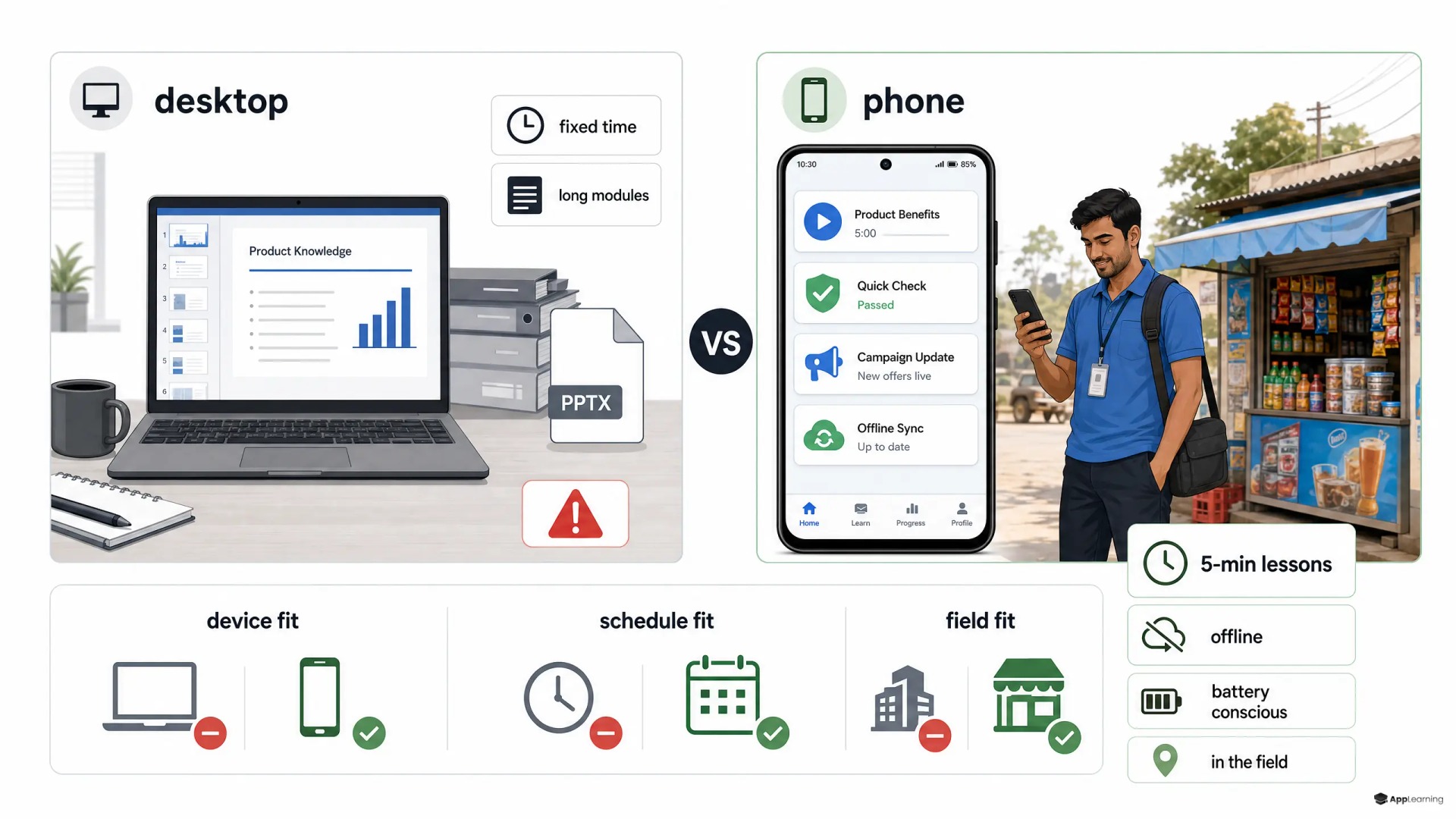
Desktop and classroom training break because they assume a stable environment. A scheduled session. A shared language level. A manager nearby. A screen large enough for dense slides. A connection that does not drop during the quiz.
Distributed sales agents work in a different system. They move between kiosks, shops, customers, transport routes, and payment points. Many are independent or semi-independent. Some sell for a few weeks, then leave. New promotions, tariff rules, stock processes, and compliance steps keep changing. If training sits in a portal that feels separate from work, the agent will treat it as optional admin.
That is the real case for mobile training for sales agents. It is not a preference for small screens. It is a fit between the training format and the operating model.
The phone is the operating environment
For a field sales business, the agent’s phone is not only a device. It is the workplace. It carries WhatsApp, payment tools, customer messages, stock photos, route tasks, CRM forms, and personal apps. Training has to compete for storage, battery, attention, and data.
Google’s Build for Billions guidance names the same constraints product teams see in the field: slow or expensive connectivity, less capable device memory and processors, and limited charging during the day. A heavy learning app may fail before content quality matters. If the install is too large, the media is mandatory, or the app resets after a signal drop, the business has not created training. It has created abandonment.
Connectivity is a product constraint
Low connectivity changes the shape of learning. It is not enough to make a course “mobile responsive”. A responsive desktop course can still be too heavy, too long, and too dependent on live data.
The World Bank’s guidance for low-bandwidth skills training points to practical patterns that also apply to field agent mobile learning: downloadable content, low-cost access models, compressed lessons, and bite-sized design. For sales agents, that means core onboarding, product cards, tariff explanations, objection handling, and readiness checks should load even when the signal is poor.
Offline is not an edge case. It is the base case. The app should read locally first, queue progress, and sync later. The agent should not need to understand the difference between a timeout, a failed request, and a partial sync. The next useful action should still be visible.
Readiness improves when waiting disappears
Mobile sales training works because it removes waits from the activation path. The agent can learn the registration step before asking support. They can check the current promotion before speaking to a customer. They can review the payment flow before the first transaction. They can pass a short certification before selling a new product.
Comparable evidence from frontline health systems supports this direction with the right caveat. The WHO recommends mobile delivery of training and educational content for health workers when it complements, rather than replaces, in-service training. Sales operations should read that carefully. Mobile learning is strongest when it is tied to the job, backed by supervision, and focused on the next action.
Good to know
Should sales agents use a separate learning app?
Usually not if they already work inside a field app. Embedded training reduces switching and keeps learning close to sales tasks, CRM status, rewards, and product access.
How short should mobile sales training lessons be?
Most lessons should take two to five minutes. The better rule is one field action per module, followed by a clear next step or readiness check.
Can readiness checks work without stable internet?
Yes. Questions, attempts, pass status, and unlock logic can be stored locally and synced when the agent reconnects.
Which training metric matters most for field agents?
The most useful metric is time from signup to first successful sale, supported by onboarding completion, readiness pass rate, and support dependency.
Small design choices carry the load
The lesson design matters as much as the learning strategy. A mobile-first format should reduce friction at every step.
- One concept per module.
- Two to five minutes for most field lessons.
- Text-first content with optional audio or image support.
- No mandatory video for critical onboarding steps.
- Plain language, local examples, and multilingual delivery.
- A readiness check linked to the next sales permission or task.
This is where many LMS rollouts fail. They move the same content to a smaller screen. Good mobile training rebuilds the content around field decisions. What does the agent need to do next. What could they get wrong. What must be remembered. What evidence does the business need before the agent sells.
App-Learning connects training to field operations
At App-Learning, the mobile-first approach is operational. Training should sit close to onboarding, CRM, support, rewards, and performance data because agents do not experience those systems separately. A lesson about stock ordering should point to the ordering step. A campaign update should change the pitch card and readiness check. A certification result should be visible to supervisors and, where needed, connected to product access.
The App-Learning team has written about designing mobile training for sales agents off grid because the weakest device and weakest region are the real design review. If training only works on headquarters Wi-Fi, it is not field training.
- Cache the first-sale path.
- Publish campaign updates as small content bundles.
- Track completion and failed attempts offline.
- Use AI-supported workflows to simplify new product information fast.
- Sync progress into the systems operations teams already use.
Build training that works where agents sell.
TalkThe right metrics tie learning to activation
Mobile training should not be judged only by course completion. Completion matters, but it is not the business outcome. A CEO or COO needs to know whether training shortens the path from signup to first successful sale and reduces avoidable support load.
- Signup to first completed onboarding step.
- Onboarding start to first successful sale.
- Readiness pass rate by product and region.
- Campaign update reach within 24 or 48 hours.
- Support tickets per new agent before first sale.
- Sales quality errors after certification.
- Inactive agents blocked by missing readiness steps.
The winning system is smaller, faster, clearer, and closer to the sale. Mobile training works for distributed sales agents because it respects the reality of the field. It treats learning as part of the operating system for activation, not as a library agents are expected to visit when the day is already full.