
Key takeaways
- AI fluency does not replace workplace judgment.
- Soft skills onboarding must use realistic practice, not handbook reading.
- Communication, escalation and verification need structured repetition.
- Regulated teams need evidence that new hires can apply judgment.
The entry level job is getting seniorised
The graduate AI-skills debate is not only a hiring story. It is an onboarding story. AI-native graduates can produce drafts, summaries, spreadsheet checks and research outlines faster than previous cohorts. That speed is useful. It also removes some of the slow practice that used to build workplace habits.
In PwC’s 2026 AI Jobs Barometer, the strongest signal is not that junior work disappears everywhere. It is that some entry-level roles are being rewritten around judgment, stakeholder management and leadership. PwC describes growth in seniorised entry-level roles while other entry-level roles shrink, which creates a gap between graduate confidence and workplace readiness.
That gap should not be blamed on graduates. Universities, employers and AI vendors have all pushed output speed. The missing layer is practice under constraints. A new hire may know how to prompt a model. They may still struggle to challenge a confident answer, write a careful client response, ask for help early or explain uncertainty to a manager.
AI fluency can hide weak work habits
The risk is not that AI makes people incapable. The risk is that AI hides weak routines behind polished output. A paragraph can sound professional before the person understands the client context. A risk summary can look complete before sources are checked. A recommendation can sound decisive before edge cases are considered.
The demand side is already moving. NACE’s 2026 early-career update found that more employers are asking for AI skills in job descriptions and that more employers want early-career talent who can use AI at work. But AI use is only one part of readiness. The work still depends on communication, resilience, critical thinking and professional judgment.
A useful onboarding system therefore has to separate three things that are often mixed together: tool training, policy training and judgment training. Tool training teaches the interface. Policy training teaches the rule. Judgment training teaches when the rule is unclear, when the tool is wrong and when the person must escalate.
Regulated teams cannot onboard by policy alone
Finance and crypto teams feel this more sharply because mistakes do not stay inside a document. A poor assumption can affect a client reply, a transaction review, a risk note or an internal control. The question is not only whether the new hire completed AI onboarding. The question is whether they can show the method behind the answer.
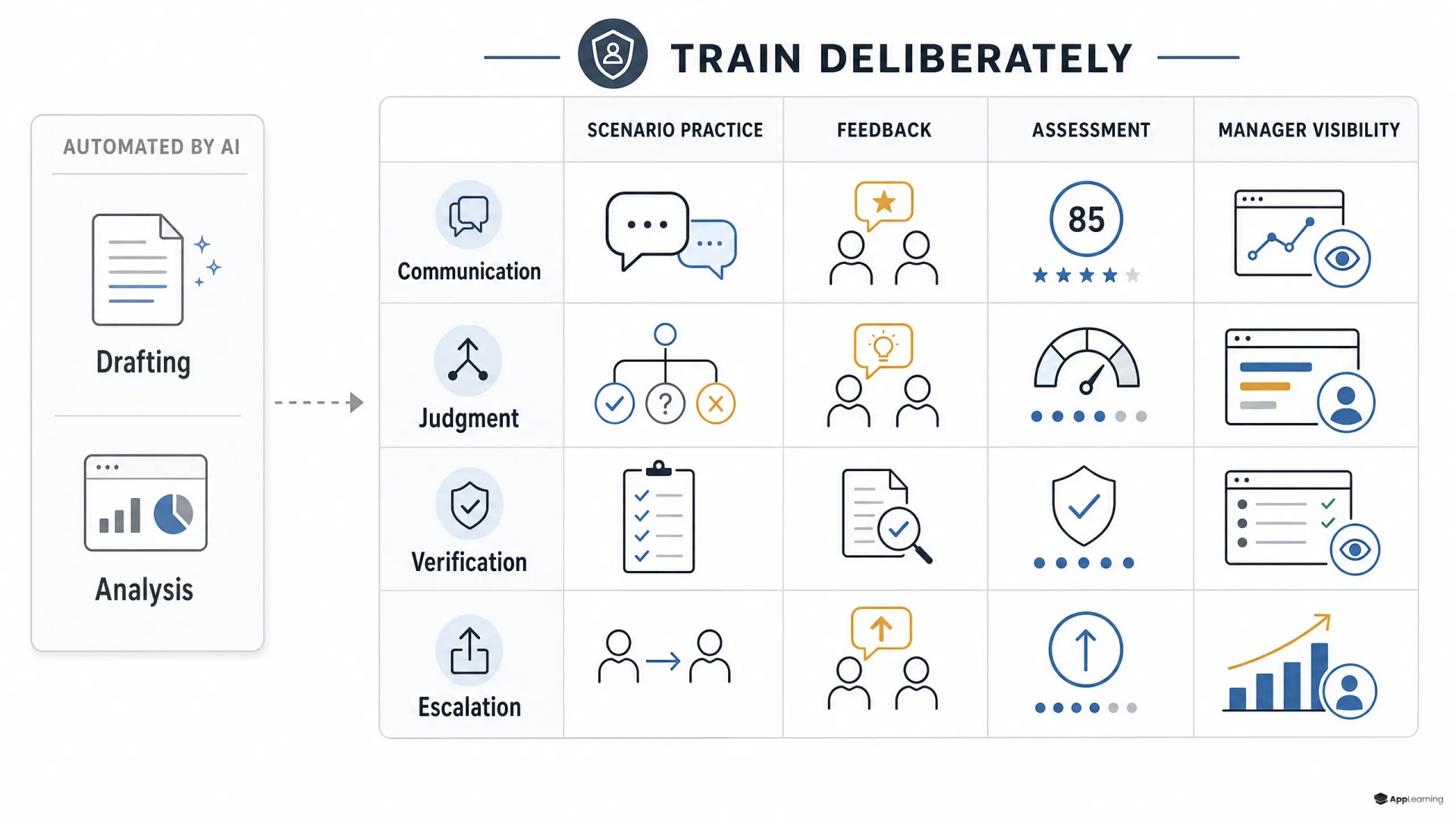
This is where soft skills onboarding becomes operational. Communication is not a personality trait. It is the ability to write with the right level of certainty. Escalation is not nervousness. It is knowing which signal crosses the threshold. Verification is not academic caution. It is the habit of checking claims before they enter regulated work.
Practice belongs inside the onboarding system
An employee onboarding platform should do more than host policies and collect completion data. It should create realistic practice loops. App-Learning’s work with regulated teams usually starts here: convert the moments that create risk into short scenarios that a new hire can repeat, fail safely and improve.
- Client response practice with tone, accuracy and approval boundaries.
- Risk escalation scenarios with incomplete facts and time pressure.
- Source verification tasks that require checking AI output against approved material.
- Team handoff exercises where context, assumptions and open risks must be explicit.
These modules should allow AI use, because banning the tool during onboarding teaches the wrong lesson. The point is to see whether the new hire can use AI without outsourcing accountability. A good scenario asks for the prompt, the draft, the checked sources, the final answer and the reason for escalation or non-escalation.
Good to know
Should onboarding restrict AI use for new hires?
Usually no. New hires should practise with the tools they will use at work, but under clear rules for disclosure, verification, data handling and manager review.
What is the difference between AI onboarding and soft skills onboarding?
AI onboarding teaches tool use, policy and acceptable boundaries. Soft skills onboarding trains the human behaviors that make AI use safe and useful, including judgment, communication, escalation and collaboration.
How can L&D measure judgment without making it superficial?
Use scenario evidence. Track decisions, explanations, source checks, escalation choices, revisions and manager feedback instead of relying only on course completions.
Why is this urgent for finance and crypto teams?
Because regulated work needs traceable reasoning. A confident AI-assisted answer can still create risk if the new hire cannot explain the source, assumption, approval path or escalation decision.
Readiness needs evidence, not completions
Completions show exposure. They do not show readiness. For workforce readiness training, the useful evidence is behavioral: how a person handles ambiguity, how fast they ask for help, how they correct an AI mistake and how clearly they explain a decision.
- Quizzes test policy thresholds and prohibited actions.
- Role plays test tone, listening and escalation under pressure.
- Verification tasks test source quality and evidence discipline.
- Manager dashboards show attempts, outcomes, coaching notes and readiness signals.
The dashboard matters because L&D cannot manage this through anecdotes. Managers need to see which new hires can work independently, which need coaching and which risks repeat across a cohort. That makes soft skills onboarding measurable without reducing human judgment to a vanity score.
Build onboarding that proves readiness.
DiscussA better first ninety days
The next version of AI onboarding will not be a short policy module on acceptable use. It will be a practice system for human work in AI-supported environments. New hires need to learn how to communicate clearly, verify claims, escalate early and collaborate without hiding behind machine-polished output.
AI-heavy juniors are not the problem. Unstructured onboarding is the problem. If companies automate the basic tasks that used to teach judgment, they have to replace that learning path deliberately. The best teams will not wait for soft skills to appear with experience. They will design the experience.