
Key takeaways
- Digital euro readiness includes user readiness and workforce readiness.
- Merchant and support education should start during the development phase.
- Privacy, funding, offline use and recourse need role-specific explanations.
- Learning analytics can reveal confusion before pilot issues scale.
The pilot has entered the operating layer
On 14 July 2026, the ECB announced that 36 payment service providers from across the euro area had been selected for the digital euro pilot. The pilot will test technical functionality, operational processes and user experience, with a 12-month operational phase due to start in the second half of 2027. This moves the digital euro from policy design into operating practice.
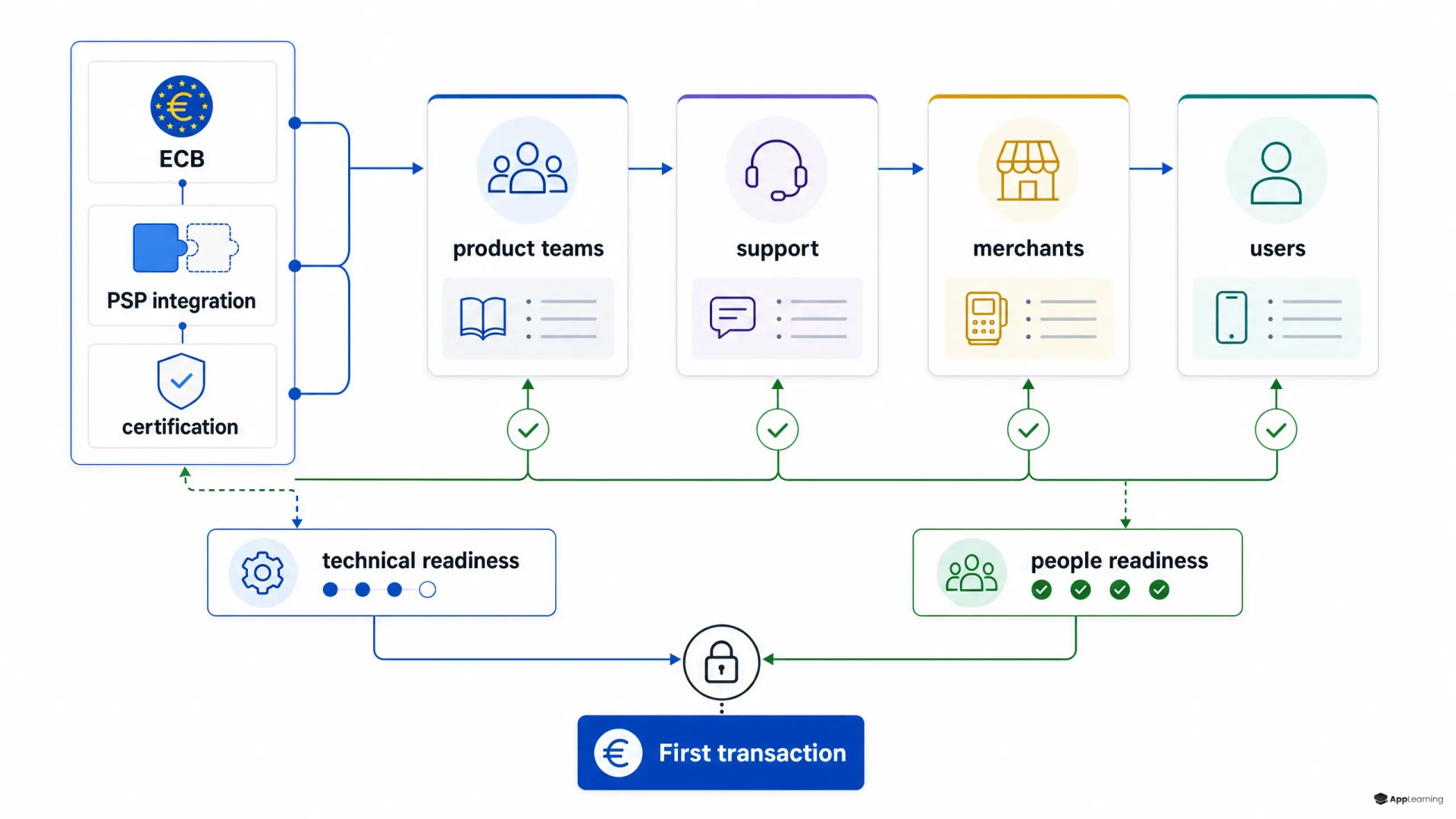
For PSP leaders, the immediate work looks technical. Connect to the digital euro service platform. Build or adapt interfaces. Prepare for user testing and certification. But the first real-life transaction will not fail only because an API breaks. It can also fail because a merchant cannot explain the flow, a support agent cannot triage a funding issue, or a user does not understand what makes the beta digital euro different from a normal wallet balance.
Integration will not explain the payment
The latest digital euro scheme rulebook documentation includes version 0.91 and annexes covering testing, certification, user journeys, minimum UX requirements, end-to-end process flows, front-end requirements and dispute management. That is the right base for implementation. It is not a substitute for digital euro education. A rulebook defines what must happen. A learning system prepares people to make it happen under pressure.
Technical readiness creates the service. Education creates a usable service. The gap sits in the middle, where staff and users translate a new payment concept into decisions at checkout, in support queues and inside product flows.
- What is the beta digital euro and what is it not
- How funding and defunding affect the user’s bank account
- When online and offline use feel different
- How refunds, failed payments and recourse should be explained
- Which claims staff and merchants must avoid
Four groups need different operating knowledge
The ECB’s pilot FAQ says the development phase starts in the third quarter of 2026 after PSP participation agreements, and includes payment service development, DESP onboarding and integration, user testing, back-end certification and onboarding of end users. That makes digital euro pilot onboarding part of the development phase, not a launch task at the end.
A single explainer deck will not work. PSP training has to split by role because each audience carries a different risk.
- Product and growth teams need the proposition boundaries, user journeys, activation points and language rules.
- Support teams need diagnostic scripts, escalation paths, refund scenarios and incident language.
- Merchants need acceptance flows, checkout prompts, SoftPOS handling and customer-facing explanations.
- End users need plain guidance on public digital money, privacy, funding, offline use and what to do when something fails.
Pilot learning needs scenarios, not manuals
The pilot will validate four use cases: online person-to-person payments using an alias or DEAN, offline P2P payments via NFC, online person-to-business payments at a mobile point of sale via NFC, and online P2B payments in e-commerce or m-commerce. The ECB also clarifies that refunds sit inside existing P2B flows rather than as a separate use case. Each flow creates a different learning burden.
A pilot-ready journey should therefore teach through scenarios, not policy text. The core modules should cover:
- Digital euro, beta digital euro, bank money and crypto distinctions
- Account setup, alias use and DEAN basics
- Funding, defunding, holding limits and automatic flows
- Privacy and data boundaries in user language
- Offline P2P via NFC and its limits
- Merchant acceptance, refunds and failed payment handling
- Support routing, escalation and incident capture
- Terms, consent, fees and communication constraints
- Feedback prompts after key actions
Good to know
Who needs digital euro education inside a PSP pilot team?
Product, engineering, support, compliance, merchant-facing teams and lifecycle owners need a shared base, then role-specific training that reflects their operational responsibilities.
When should digital euro pilot onboarding start?
It should start during the development phase because the ECB says that phase includes integration, user testing, certification and end-user onboarding after PSP participation agreements are signed.
What should CBDC customer education explain first?
Start with the mental model: the digital euro would be central bank money in digital form, not crypto and not a normal bank deposit.
How can learning analytics help the pilot?
They show which concepts create confusion, which support scenarios repeat, and where content needs repair before wider rollout.
Feedback becomes better when learning is instrumented
The ECB expects pilot PSPs to enable payment services for end users and support feedback collection, while national central banks provide documentation, facilitate liquidity operations and collect feedback with PSP support. That means learning analytics can complement pilot evidence. If 40 percent of merchant staff fail the same refund scenario, or users replay the same privacy explainer before dropping off, that is operational data.
This is where an education layer earns its place beside integration. App-Learning can structure role-based onboarding, merchant micro-training, support simulations, user explainers and feedback analytics around the same flows product teams are building. For a fintech product or growth leader, this is familiar territory. Users do not activate because a feature exists. They activate when the product teaches the right mental model at the right moment.
Build pilot readiness before the first transaction.
TalkEducation is part of pilot risk control
The digital euro pilot will generate technical evidence. It should also generate evidence about comprehension, trust and operational behaviour. Without a structured digital euro education workstream, PSPs may learn too late that the biggest blockers are not in the infrastructure but in the handoffs between product, support, merchants and users. Digital euro user readiness is not soft work. It is the operating layer that turns a controlled pilot into reliable evidence for scale.