

Key takeaways
- Support volume often reveals an onboarding failure before it becomes a retention problem.
- Users raise repetitive tickets when the next action, reason, or consequence is unclear.
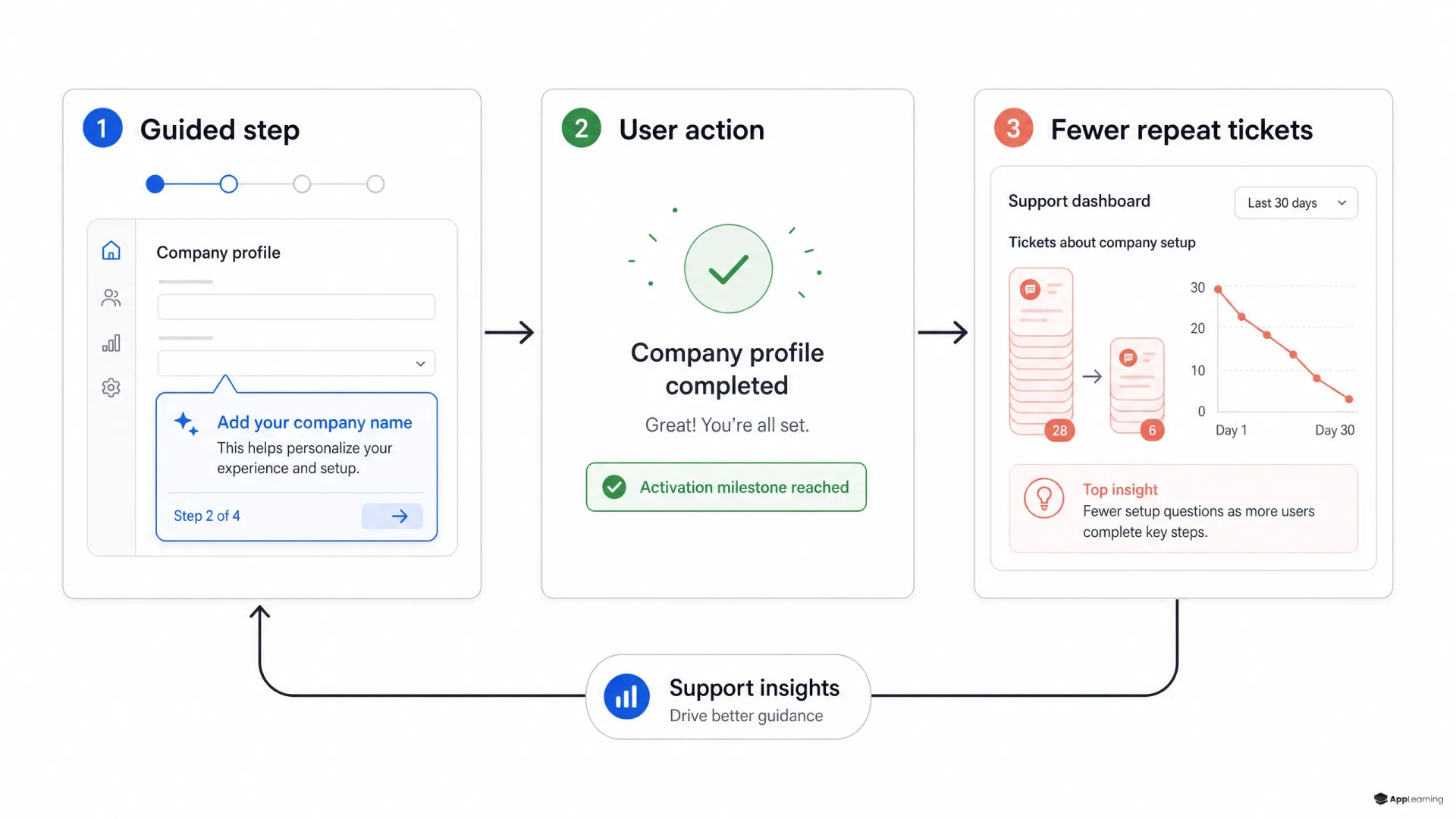
- Contextual education prevents confusion without forcing users through a long product tour.
- Better onboarding creates operational leverage across Product, Growth, CX, and Compliance.
Support demand starts before the ticket
A new user who asks how to verify an identity, connect an account, make a first deposit, or understand a fee is not always reporting a support problem. Often, they are reporting an onboarding gap. The product asked for an action before it created enough understanding to make that action feel safe and worthwhile.
That distinction matters in fintech. A confused user is not deciding whether to click another feature. They may be deciding whether to share data, move money, accept risk, or trust a provider. For UK-regulated firms, the FCA’s Consumer Duty makes the operational standard explicit: customers need clear, timely information that they can understand, alongside effective support.
Treat repetitive support contacts as journey evidence. “How do I?” signals an unclear task. “Why do you need this?” signals missing rationale. “What happens if I do this?” signals unaddressed risk or consequence. “Where can I find it?” signals poor orientation. These are not four versions of the same ticket. They point to different fixes in the onboarding system.
The explanation belongs at the decision point
A help center still has a role. It handles edge cases, policies, and deeper research. But it is weak when a user must leave a money-moving flow, search with the right terms, interpret an article, and return without losing their place. The W3C describes context-sensitive help as support tied to the function being performed so users can avoid mistakes without losing track of their task. That is a sound product principle, not only an accessibility requirement.
The strongest onboarding best practices use progressive disclosure. Show the smallest explanation that lets a user complete the next meaningful action. Do not front-load a product tour with every feature, policy, and financial concept. Explain APY before a savings decision, transfer finality before a crypto withdrawal, or verification requirements before a document upload.
- Explain why the product needs an action, not only what the user must do.
- Use plain language for fees, risk, timing, permissions, and irreversible outcomes.
- Place short guidance beside the decision, then offer a deeper path for users who need it.
- Use examples and lightweight knowledge checks where misunderstanding could cause harm or support demand.
- Keep human support easy to reach when self-service is not enough.
Ticket tags need a journey map
Most teams measure onboarding in Product and support in CX. That split hides the cost of confusion. Registration completion can improve while users still create tickets at verification, funding, account setup, or their first transaction. A funnel without support signals can make a brittle journey look healthy.
Connect the two systems through a shared event model. Tag tickets by journey stage, user intent, product concept, and severity. Then compare ticket rate, time to first value, and activation completion for users who saw a guidance module against comparable users who did not. The point is not to claim that every ticket can be deflected. It is to find recurring questions that a better product explanation can prevent.
Use three working views: a weekly list of the highest-volume onboarding intents, a journey map that shows drop-off and support contact at each decision point, and an experiment log that records the guidance shown, audience, activation outcome, and unintended effects. This gives Product, Growth, CX, and Compliance one operating picture instead of four separate reports.
Build guidance where your users hesitate.
PlanEducation becomes an operating asset
Good guidance does more than lower ticket volume. It reduces the repeat explanation work carried by support, gives Growth a clearer activation lever, and gives Compliance a reusable place to review sensitive language. The same approved explanation can appear in onboarding, lifecycle messages, support replies, and an AI-assisted help flow. That consistency matters when product concepts change quickly or differ by market.
This is where an embedded learning layer helps. App-Learning’s customer academy platform supports short learning paths, quizzes, progress tracking, and analytics for product and financial education. The practical value is not a separate course catalog. It is a reusable system for placing approved, measurable guidance into the moments where users hesitate.
The best onboarding does not try to turn every new user into an expert. It gives each user enough understanding to take the next safe, valuable step. When teams design for that moment, activation improves for the right reason: users can act with more confidence, while support can focus on the problems that truly need human help.
Good to know
Which support tickets should a fintech team address through onboarding first?
Start with high-volume, low-complexity questions that appear before first value. Prioritize unclear setup steps, unfamiliar product terms, verification rationale, fee explanations, and navigation failures.
Should contextual guidance replace the help center?
No. Contextual guidance should prevent predictable confusion during tasks. A help center should remain available for deeper research, policies, unusual cases, and users who prefer self-service search.
How can teams prove that guidance reduced support demand?
Measure ticket rate per active or newly activated user by journey stage. Compare cohorts exposed to a guidance module with similar cohorts that were not, then review activation, repeat contacts, and escalation quality together.