

Key takeaways
- Time to first sale is the cleanest early activation signal.
- Readiness friction often beats motivation as the cause of drop-off.
- An agent activation platform must connect onboarding, confidence, and action.
- Certification works when it gates field execution, not just course completion.
- Faster first-sale readiness protects recruitment spend and operating margin.
A new field agent who has signed up but not sold is not yet productive capacity. They are a cost center with potential. Many agent businesses miss this point because they track recruitment, app installs, and training completion before they track time to first sale.
First sale is the real activation line
Training completion is useful, but it is not the operating outcome. A seller can finish a module and still fail in the field because they do not know the tariff, cannot explain the bundle, have no stock, or are unsure how to handle the payment flow. Time to first sale cuts through that noise. It shows how quickly the business converts a recruited agent into a working distribution point.
For CEOs and COOs, this matters because every inactive recruit carries hidden cost. Recruiting spend, SIM allocation, starter materials, supervisor time, helpdesk calls, and incentives all sit ahead of revenue. If first sale takes too long, churn starts before the agent ever becomes useful.
The gap hides after signup
The failure point is rarely one big problem. It is a chain of small frictions between registration and execution. The agent is approved, but the next step is unclear. The product sheet is in a WhatsApp thread. The promotion changed yesterday. The agent has not ordered stock. The customer asks one hard question, and confidence drops.
- Registration is complete, but payment readiness is not.
- The agent knows the brand, but not the live offer.
- Training exists, but it is too long for low-end phones and weak data.
- Support answers questions, but only after the selling moment has passed.
- Managers see sales results, but not readiness gaps before those results appear.
In high-churn field networks, these gaps compound fast. A motivated agent can still stall if the system does not tell them what to do next, what to say, what to check, and when they are ready to sell.
Activation needs an operating flow
An agent activation platform should not behave like a traditional LMS. It should work like an execution layer between signup and the first field action. GSMA’s work on mobile money agent training is a useful benchmark because it treats training as operational infrastructure: curricula must stay current, agents need practical demos, certification matters, and training formats must adapt to different literacy and numeracy levels.
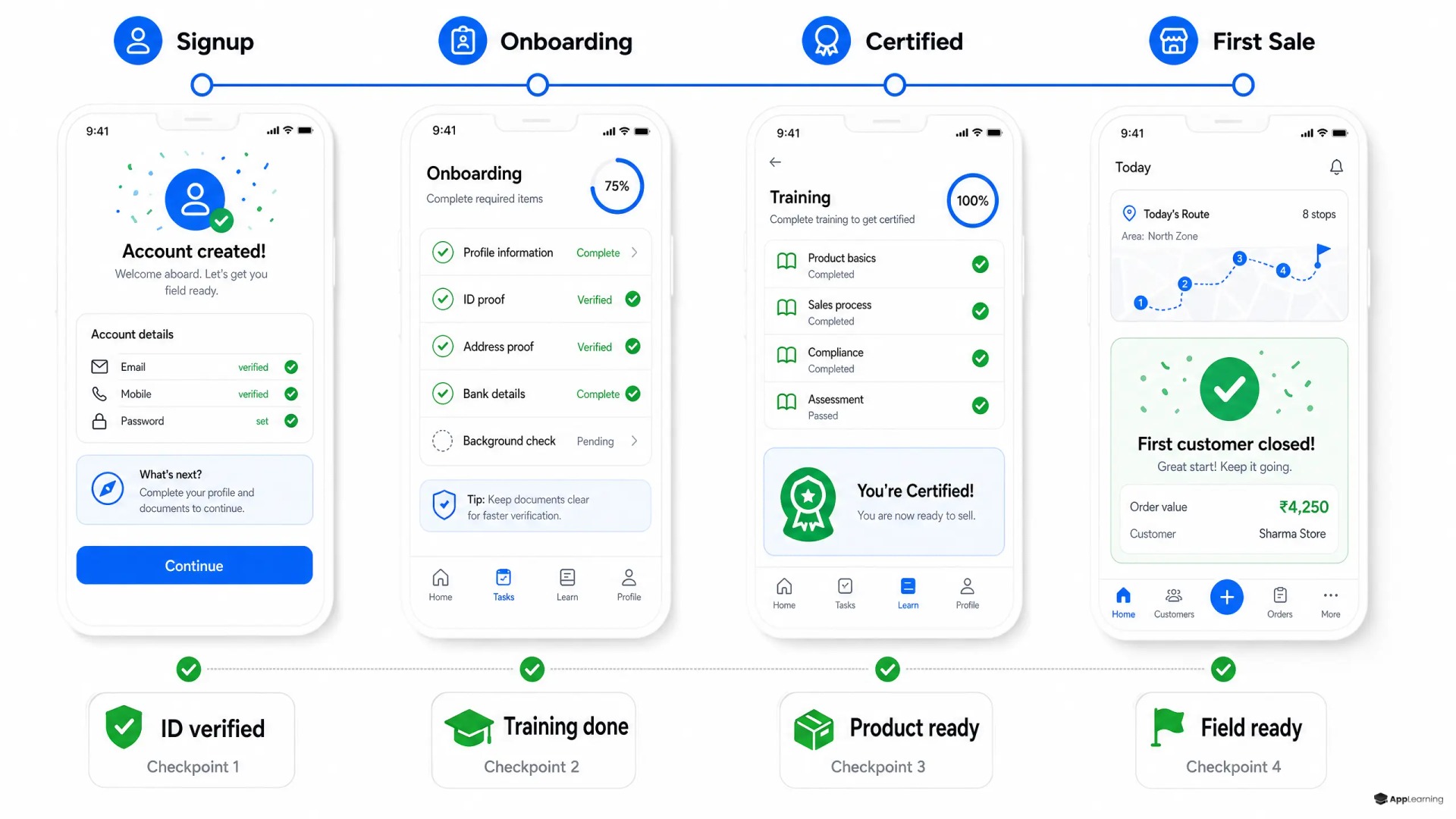
That logic applies directly to telecom, prepaid, and distributed retail sales. The agent onboarding platform must remove the next blocker, not just present information. It should guide the agent through setup, product basics, first offer, compliance rules, stock or wallet readiness, sales script, objection handling, and first transaction steps in one simple path.
Confidence beats content volume
Product confidence is not created by more content. It is created by short practice loops that prove the agent can act. A readiness check should ask whether the agent can explain the offer, choose the right bundle, follow the transaction flow, avoid compliance errors, and recover when the customer hesitates.
This is where certification becomes useful. It should not be a badge at the end of a course. It should be a gate before a new campaign, product, tariff, or compliance-sensitive activity goes live in the field. The same principle appears in GSMA’s mobile money certification guidance, which emphasizes training records, assessment records, performance monitoring, and evidence that agents have the tools needed for service delivery.
Good to know
Why is time to first sale more useful than training completion?
Training completion shows exposure. Time to first sale shows whether the agent became capable enough to act in the field.
What should an agent activation platform include before first sale?
It should include guided onboarding, setup steps, product knowledge, readiness checks, certification, campaign updates, and progress visibility for managers.
How is an agent activation platform different from an LMS?
An LMS usually manages courses. An activation platform connects learning to field execution, readiness gates, sales confidence, and early performance data.
Where should leaders look first when activation is slow?
Start with the gap between signup and first field action, then inspect setup friction, product confidence, stock or payment readiness, and support dependency.
A lighter layer for distributed teams
App-Learning supports this type of activation flow with short lessons, quizzes, certificates, role-based paths, gamified mechanics, dashboards, and API-based reporting. The platform is built for internal onboarding and partner education, with web and mobile support, as described in App-Learning’s overview of scalable learning academies. In an agent network, that means onboarding can sit closer to the field app, not in a separate system agents forget after signup.
The practical value is consistency. A new agent in a township, a rural shop, or an urban kiosk receives the same core guidance, adjusted by role, market, language, and campaign. Updates can be pushed when tariffs change. Managers can see who is ready, who is stuck, and where support demand will rise before the sales numbers show damage.
Build a clearer path from signup to first sale.
StartThe metrics that expose activation lag
Leaders should manage activation as a funnel, not as a training calendar. The goal is to find the step where readiness breaks and remove it.
- Signup to first login
- First login to onboarding completion
- Onboarding completion to readiness certification
- Certification to first stock or wallet readiness
- Readiness to first customer attempt
- First attempt to first successful sale
- First sale to second sale
- Support requests per activated agent
- Campaign update reach and comprehension
- Drop-off rate by region, supervisor, language, and device type
The strongest agent activation platform reduces time to first sale by making the path from signup to field execution visible, guided, and measurable. Recruitment fills the top of the funnel. Incentives create a reason to act. But readiness is what lets a new agent move with confidence when the first customer is in front of them. That is where activation is won or lost.