

Key takeaways
- In-house builds offer control, but control turns into maintenance after launch.
- White label wins when speed, brand consistency, localization, and analytics matter together.
- For Bitcoin products, education must reduce hesitation inside the user journey.
- Evaluate the operating system, not only the learner interface.
The build temptation is real
Product teams often want to build their own learning experience for good reasons. In Bitcoin fintech, education touches trust, risk, security, first purchase, recurring buys, wallets, and self-custody. A generic LMS feels too far from the product. A custom academy promises exact UI control, native analytics, and a tone that matches the brand.
That logic is sound at prototype stage. It breaks when education moves from a campaign to an operating capability. Then the question is not whether the frontend can be built. It is whether the team wants to run a learning product indefinitely.
The cost moves below the interface
After launch, the expensive work sits under the surface. A custom build needs admin tooling, learner states, permissions, quiz logic, certificates, progress tracking, content versioning, data exports, and support workflows. Communications of the ACM reported that maintenance and enhancement consume a major portion of software lifecycle cost, and learning systems are no exception.
- Who updates a lesson after a fee model changes
- Who checks translated quizzes before a market launch
- Who owns analytics events when activation drops
- Who fixes mobile rendering across devices
- Who maintains SSO, privacy controls, and exports
For a Bitcoin company, this matters because education content is never static. Regulation shifts. Security guidance changes. Product flows evolve. Beginner misconceptions repeat. If the academy depends on engineering for every small update, education becomes backlog debt.
White label only works when it owns operations
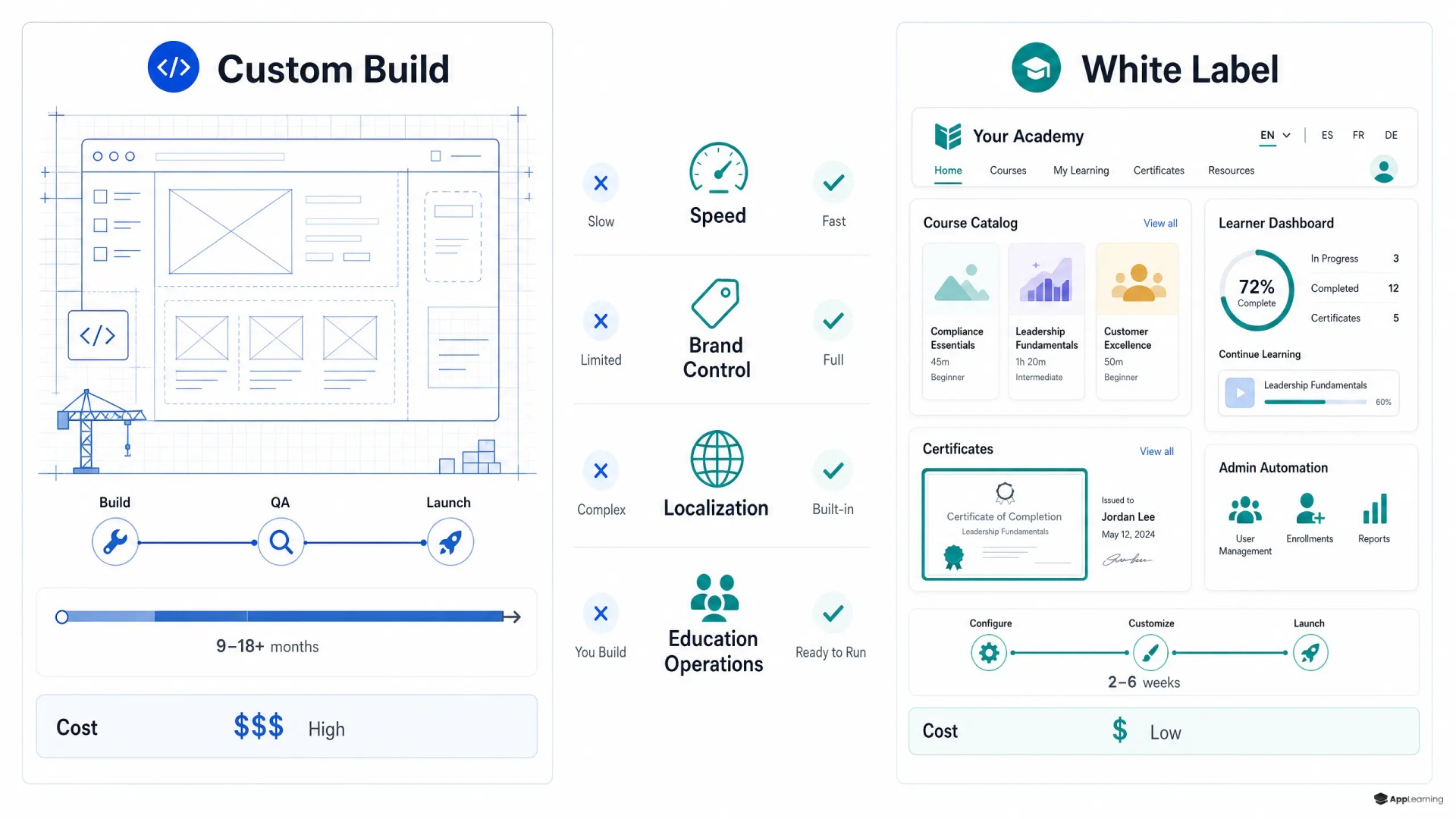
A white label learning platform should be more than a logo swap. The useful version gives brand control while removing the heavy operating layer. It should support embedded mobile and web journeys, modular lessons, quizzes, rewards, certificates, role or segment based paths, admin dashboards, and clean analytics.
Localization is a core test. The W3C defines localization as adapting a product, application, or content to the language, cultural, and market requirements of a target locale. That is wider than translation. It affects examples, risk wording, currencies, screenshots, support references, and review workflows.
- Brand domain, colors, tone, visuals, and certificates
- Deep links or embeds from onboarding and feature flows
- Short lessons with quizzes and gamified reinforcement
- Dashboards for progress, drop-off, answers, and completion
- Localization workflows that do not block engineering
- APIs, SSO, and exports where enterprise teams need them
The better choice appears when learning must scale
Build in-house when the learning product is the company’s core IP, when the pedagogy is unique, or when the roadmap must be fully owned by product engineering. That is a serious commitment. It needs a durable team, not a sprint.
Choose white label when education is a growth lever. For a product lead measured on activation, retention, support load, and trust, speed matters. The learning layer should help users move from uncertainty to action without pulling engineers away from the core Bitcoin product.
Good to know
When should we still build in-house?
Build when the learning product is core IP, requires unique pedagogy, and has a dedicated team to maintain it.
Can white label work inside a mobile Bitcoin app?
Yes, if it supports deep links, embeds, mobile layouts, SSO, and analytics tied to product events.
What should a pilot prove?
A pilot should prove completion, content update speed, localization workflow, learner data quality, and impact on activation.
A practical evaluation model
- Time to first launch. Count weeks to a real embedded academy, not a demo.
- Change cost. Measure how fast non-engineers can update content.
- Localization readiness. Test one full module in a second market.
- Data quality. Check whether analytics answer product questions, not vanity metrics.
- Product proximity. Trigger learning at moments of hesitation, not in a separate help center.
- Ownership. Decide who runs curriculum, review, QA, and reporting after launch.
Let’s map your branded Bitcoin academy.
TalkThe App-Learning fit
App-Learning fits teams that want branded Bitcoin education inside the user journey without building from scratch. The App-Learning product platform combines microlearning, LMS administration, quizzes, certificates, gamified mechanics, and readiness data in one operating layer.
The point is not only speed. It is controlled speed. In the Invity Academy case, App-Learning delivered an embedded React academy in eight weeks with English and Czech content, 19 lessons, 6 quizzes, original illustrations, certificates, and contextual product calls to action.
That is the real white label advantage. The brand stays in front. The product team keeps focus. Education becomes infrastructure for confidence, not a side project that waits for spare engineering capacity.