

Key takeaways
- Academies are customer and employee product surfaces, not passive content archives.
- Brand consistency shapes perceived trust, quality, and product coherence.
- A serious refresh updates learning components, not only logos and colors.
- AI-assisted assets work best inside strict design-system constraints.
The academy is part of the product surface
A branded academy is not a side library. It is part of the product experience. Users reach it during onboarding, feature discovery, compliance education, partner training, support deflection, and internal enablement. In fintech, that moment is sensitive. A user may be learning about custody, Bitcoin transfers, risk, fees, limits, or security. If the academy looks older than the app, the user feels a break in the system.
That break is not cosmetic. It tells the user that the learning layer may be less maintained than the product layer. The content may still be correct, but the surface suggests otherwise. Learning platform brand consistency protects the signal that the company is precise, current, and in control.
Brand drift starts after launch
Most academy drift starts with a reasonable implementation decision. The team launches a white-label platform, uploads the logo, sets colors, connects a domain, and moves on. That is treated as white label LMS branding. Then the main brand evolves. Typography changes. Buttons get new radius values. Navigation gets lighter. Icons move from filled to line style. Illustration rules change. Tone becomes clearer.
The academy does not change unless someone owns the design relationship. Lesson cards, quiz screens, progress widgets, certificates, modals, empty states, and navigation all keep the older visual language. Over time, the academy becomes a fossil of a past brand system.
Nielsen Norman Group’s consistency heuristic is useful here because it frames inconsistency as cognitive load. Users should not have to decide whether two surfaces from the same company mean the same thing, behave the same way, or deserve the same trust.
Visual inconsistency carries a trust cost
Trust does not fail only through outages, bad copy, or broken flows. It also erodes when surfaces disagree. A fintech user who enters the product through a modern mobile app and lands in an academy with older typography, dense cards, mismatched icons, and different navigation has to run a silent check. Is this still the same company. Is this content current. Is this safe to follow.
That moment competes with learning. Instead of understanding the product, the user is assessing the environment. For activation, that is expensive. Product education should reduce uncertainty. A stale academy adds uncertainty at the point where confidence should increase.
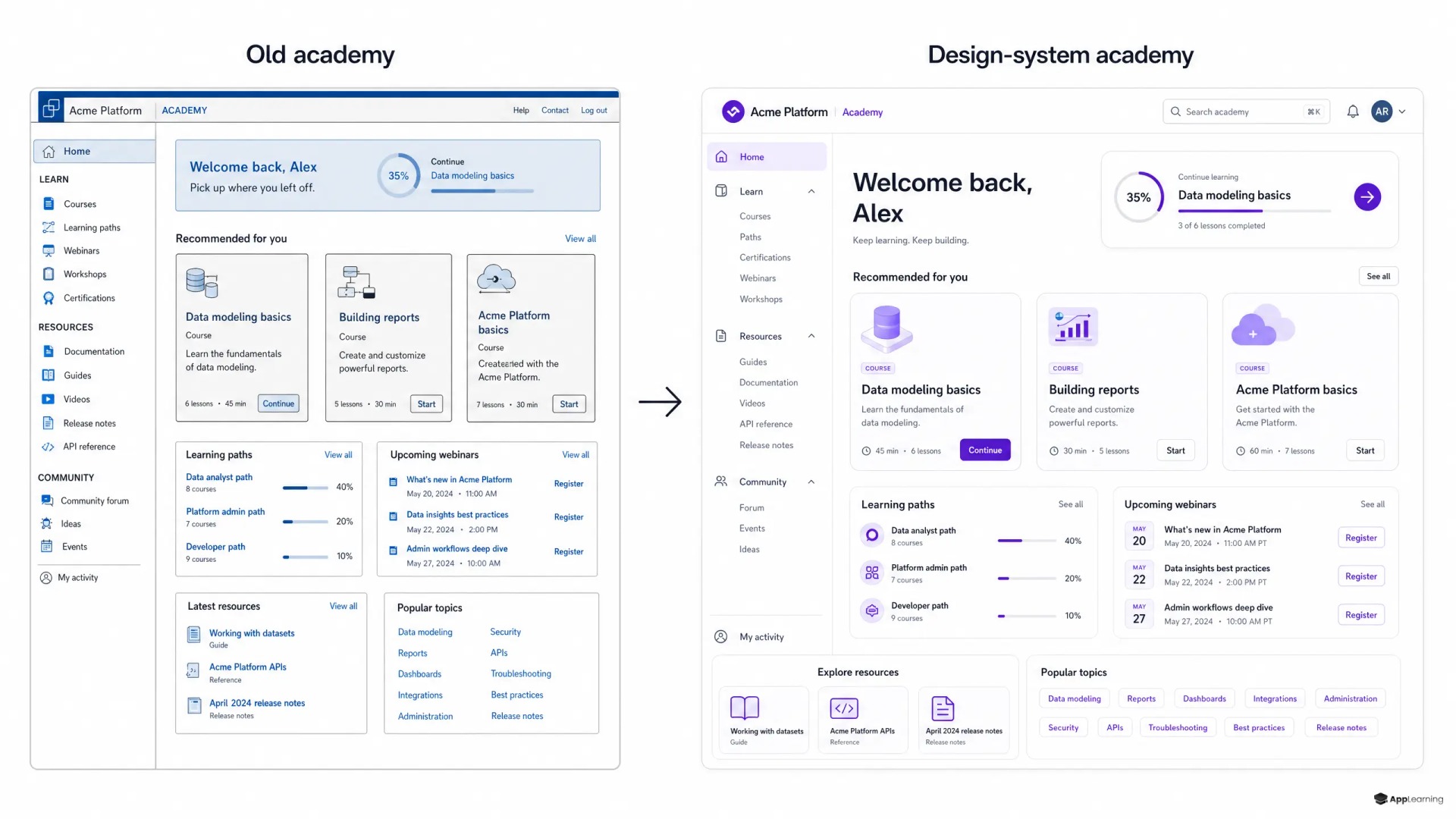
The refresh lives in components
An academy design refresh should start with an inventory, not a mood board. The goal is to map the LMS design system to the current product design system and identify every place where the academy creates a different experience. The WCAG 2.2 standard also makes accessibility part of the component conversation, especially around focus states, target sizes, contrast, and usable authentication patterns.
- Shell structure and navigation across desktop and mobile
- Typography scale, spacing, color tokens, and elevation rules
- Lesson cards, module pages, progress states, and completion screens
- Quiz components, answer feedback, hints, errors, and retry flows
- Iconography, thumbnails, illustrations, badges, and certificates
- Empty states, loading states, locked content, and upgrade prompts
- Multilingual layout behavior for longer labels and local examples
The practical test is simple. If a learner moves from the product into the academy, the academy should feel like the same product family. Not identical. Learning has different patterns than banking, trading, payments, or wallet flows. But it should share the same design grammar.
AI needs the design system
AI-assisted asset generation can help a branded academy design team move faster. It is useful for icon drafts, lesson thumbnails, scenario images, alt-text drafts, and localised visual variants. But without constraints, it produces visual noise. The academy gets ten icon styles, three illustration systems, and a set of assets that look impressive in isolation but weak inside the interface.
The NIST AI Risk Management Framework is a good reminder that trustworthy AI work depends on governance across the lifecycle. For academy production, that means approved prompts, token references, negative prompts, review rules, asset naming, accessibility checks, and human approval before anything reaches learners.
Maintenance beats another one-off skin
A stronger operating model treats the academy as a maintained product layer. Each brand update creates an academy diff. New typography triggers template review. New icon rules update the generation workflow. New mobile navigation triggers journey testing. New market launches trigger localisation QA. New product concepts trigger updated explanations, quizzes, and analytics checks.
This is where App-Learning’s role is different from a one-time LMS setup. We treat branded academy design as an ongoing system. The work covers layout, typography, iconography, navigation, learning components, mobile behavior, AI-assisted asset production, and content operations. The aim is not to decorate a learning platform. The aim is to keep education aligned with the product it supports.
Keep your academy aligned with the product.
AlignThe academy should not age separately
A brand refresh is incomplete if the academy still carries the old brand. The academy is where users build confidence, recover from confusion, learn advanced features, and decide whether the product is worth deeper use. If that surface feels neglected, the brand promise weakens. If it feels coherent, current, and useful, the academy becomes part of the product engine. It helps users understand value faster and trust the product longer.