
Key takeaways
- Enterprise learning use cases often share the same infrastructure needs.
- Modular content makes one academy useful across different teams.
- Web, in-app and white-label deployment serve different operating situations.
- AI conversion works only with review, structure and analytics.
Different requests hide one operating problem
At ten people, learning happens through calls, side-by-side work and repeated explanations. At fifty people, that model starts to fail. The same founder now hears five different requests: employee onboarding, customer onboarding, product education, compliance training and agent enablement. They sound like separate projects. They are usually the same problem in different clothes.
The real issue is knowledge transfer. CIPD’s induction guidance frames onboarding as helping new starters settle in and get the information they need to perform. In a scaling startup, that information is often spread across founders, managers, support leads, product docs and chat history. An enterprise academy turns that informal knowledge into a repeatable system.
The academy core is smaller than it looks
Most enterprise academy use cases share the same infrastructure. OECD work on training in enterprises shows how workplace learning depends on company decisions about formal and informal learning, not only on the availability of courses. The useful platform question is therefore not “Which course do we buy?” but “Can the system model how our people actually learn and prove it happened?”
- Modules hold workflows, product concepts and company decisions.
- Quizzes and checks turn passive reading into verified understanding.
- Certificates create evidence for compliance, partners and internal readiness.
- Analytics show completion, drop-off, weak topics and manager follow-up needs.
- Roles, permissions and branding separate internal and external experiences.
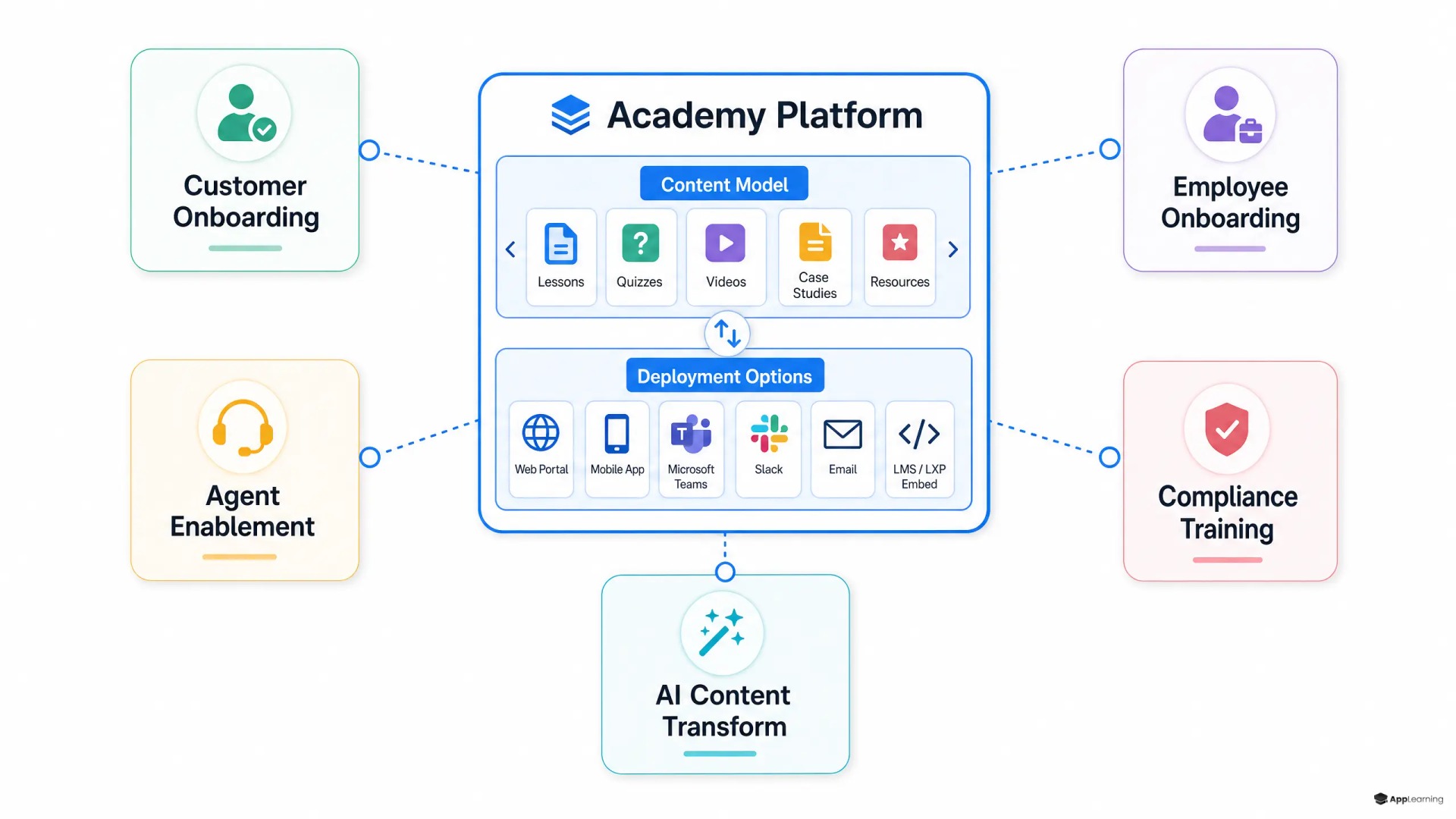
This is where a modular LMS matters. The content should not live as one fixed course. It should be built from reusable blocks that can appear in a new-hire path, a customer education platform, a support-agent certification or a compliance refresh without rebuilding the whole academy.
Deployment shapes the learning job
Deployment is not a cosmetic choice. A web academy works when learners need a clear destination for structured training. An in-app academy works when the learning moment should sit inside the product workflow. A white label academy platform matters when customers, partners or agents must experience training as part of the client’s own brand. Integrations matter when learning progress should connect to HR, CRM, support or product data.
Reporting also changes by use case. A founder wants to know whether new hires are productive faster. A customer success lead wants to know whether accounts understand the product. A compliance owner wants proof. ADL’s technical learning architecture guidance treats learner performance data as something captured across activities and stored for reporting. The same principle applies even when a startup needs a practical dashboard, not a standards-heavy stack.
Good to know
Can one academy platform support employees and customers?
Yes, if content, permissions, branding and analytics are separated. The same module logic can serve internal onboarding and external product education.
When does white-label deployment matter?
It matters when the academy is part of the customer, partner or agent experience and must match the client’s brand and trust expectations.
Does a startup need an L&D team to run this?
No, but it does need clear ownership. Managers and subject experts should review content while the platform handles structure, delivery and evidence.
Where should AI be used first?
Use AI first on existing material that is accurate but messy, such as docs, decks and recordings. Keep human review mandatory before publishing.
AI conversion needs editorial control
AI-assisted content transformation is useful when the company already has raw knowledge: slide decks, process docs, recordings, help articles, sales playbooks and compliance material. AI can help turn that material into modules, summaries, quiz drafts and learning paths. But speed is not the same as quality. UNESCO’s guidance for generative AI in education and research argues for human-centred use, which is the right operating stance here.
- Map each source to a clear learner group.
- Split long material into small learning units.
- Generate questions against real job decisions.
- Mark compliance-critical content for stricter review.
- Publish only after owner approval and version control.
- Use analytics to improve weak modules after launch.
The gain is speed with control. AI can reduce the first-draft burden. It should not decide what the company teaches, what is mandatory or what counts as proof of competence.
Map your academy before you buy more tools.
MapSeveral academies without several rebuilds
App-Learning is built around this separation between content, delivery and evidence. The same base can support a browser academy, an in-app academy, a branded academy and a reporting dashboard. Modules, checks, certificates, analytics, branding and review steps can be combined around the actual use case instead of forcing every client into one template.
- Start with employee enablement for new hires and managers.
- Convert the most repeated explanations into core modules.
- Add quizzes where misunderstanding creates cost or risk.
- Use certificates for compliance, customer readiness or agent qualification.
- Extend the same content model into customer and partner education.
A growing company does not need a bigger training machine. It needs a cleaner knowledge system. The academy should remove repeated explanations, reduce manager dependency and make learning visible without adding operational weight. When the platform is modular, one academy can hold many learning shapes and still stay simple enough for a startup team to run.