
Key takeaways
- SME employees want development, but time and budget block access.
- Skills gaps are concentrated in tech, AI, and job-performance capabilities.
- Growing teams need role-based learning plans, not larger course libraries.
- Training should prove faster readiness and better application at work.
The demand is already visible
The usual SME training story starts in the wrong place. It assumes people do not want to learn. The 2025 data points elsewhere. AICPA and CIMA reported that 67% of SME employees received no formal skills training beyond mandatory requirements in the previous 12 months, even though most wanted to build skills.
The employer side is just as clear. The same research found that 79% of SME employers had identified skills gaps in the past year. The main gaps were not vague. They sat in technology and IT, AI proficiency, and job-performance skills such as communication, project management, and problem solving.
For a founder running a 50-person company, that matters. The risk is not only that people lack skills. The risk is that each manager solves the problem alone, with different tools, different explanations, and different standards. That creates uneven onboarding, slow handovers, and preventable mistakes.
Generic training creates hidden waste
SME skills gap training fails when it is built around content volume. A course library looks efficient because the price per course is low. In practice, it pushes work back onto the employee and the manager. Someone still has to choose the right course, connect it to the job, create practice, answer questions, and check whether performance changed.
That model does not fit growing teams. People do not have spare hours to browse learning catalogs. Managers do not have time to become instructional designers. Founders do not have the budget to buy platforms that require an L&D department to operate.
A better SME upskilling strategy starts with a narrower question: which capability gap is slowing this role down right now. The answer should point to work, not topics.
Role maps beat course volume
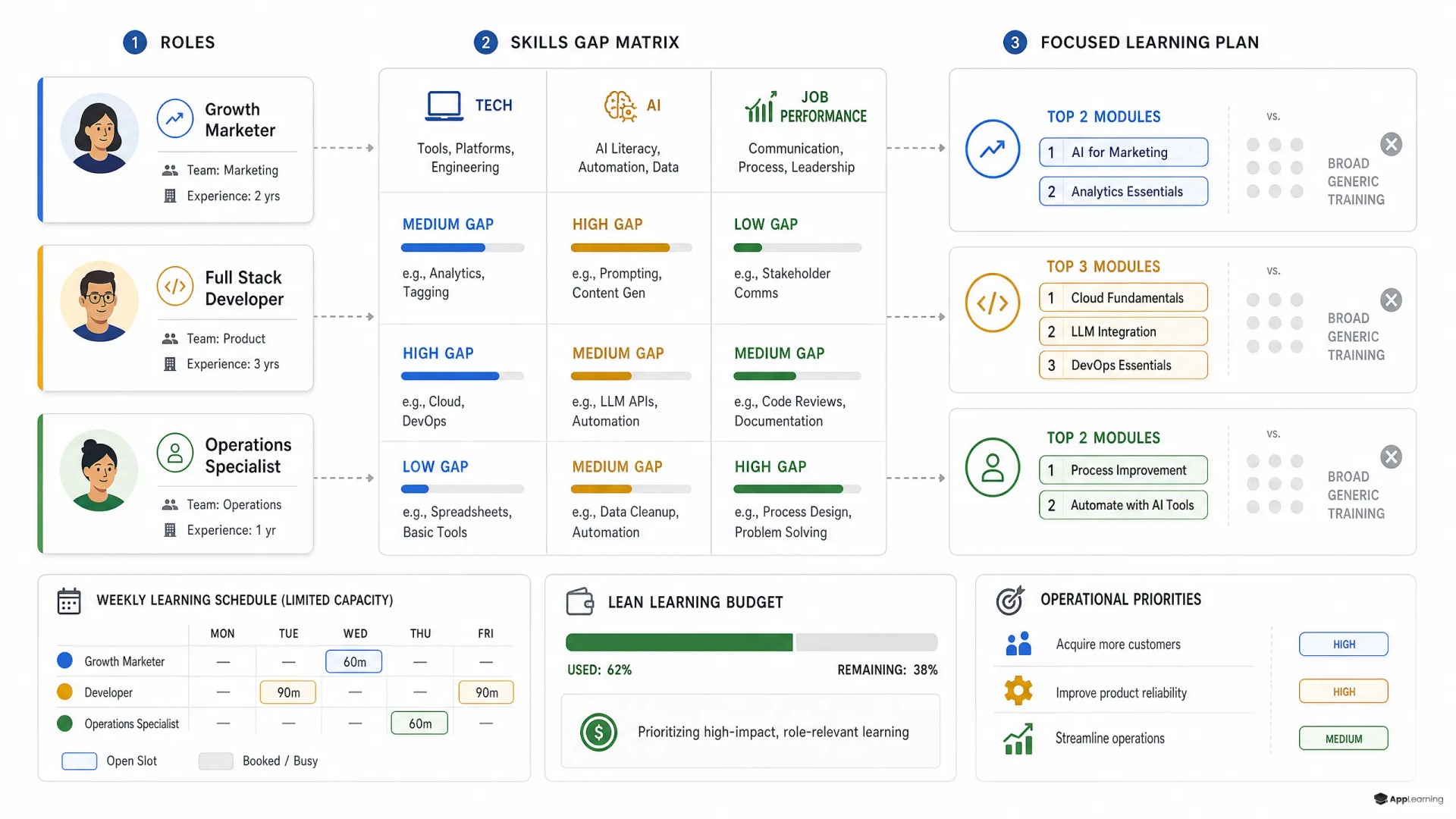
Role-based learning is practical because it reduces choice. It turns training from a menu into a path. For each key role, define the few capabilities that determine readiness. Then connect each capability to a task, a standard, and a proof point.
- For customer success, readiness may mean handling the first renewal risk call without escalation.
- For operations, readiness may mean running the weekly reporting process without rework.
- For sales, readiness may mean qualifying a lead against the current ICP and documenting next steps correctly.
- For team leads, readiness may mean giving feedback, assigning work, and escalating risks before deadlines move.
This is employee training for growing teams as an operating system. It does not start with every skill people might need one day. It starts with the next set of skills that remove friction from the business.
Small training systems fit SME reality
Training on a budget for SMEs works best when it accepts the real constraints. The OECD notes that SMEs often have less time and fewer resources to devote to training, with cost, information, and coordination barriers all limiting investment. The design response should be smaller, closer to the work, and easier to repeat.
- Use microlearning for one decision, one workflow, or one common mistake.
- Turn expert know-how into short internal lessons before it disappears into private Slack threads.
- Pair peer learning with real examples from recent projects, tickets, calls, or customer cases.
- Ask managers to reinforce one behavior in the next one-to-one or team review.
- Make practice visible through checklists, role plays, submissions, or reviewed work samples.
None of this requires a heavy LMS rollout. It does require discipline. A short lesson without a task is content. A short lesson with practice, feedback, and manager follow-up is capability building.
Good to know
How should an SME start a skills gap analysis?
Start with three to five roles that create the most operational drag. For each role, identify the tasks that take too long, create rework, or depend too much on one expert.
Is a course library enough for SME upskilling?
Usually not. A course library can support learning, but it does not define priorities, create practice, or prove that people can apply the skill in the job.
What is the best low-cost training format for growing teams?
Use short lessons tied to real tasks, peer examples, and manager reinforcement. The format matters less than the connection between learning, practice, and performance.
What should founders measure first?
Measure readiness. Track how quickly new or upskilled employees complete key tasks independently, with acceptable quality and less manager intervention.
A lightweight academy removes coordination work
A platform helps when it standardizes the repeatable parts of learning without adding administration. For a growing startup, the useful unit is not a massive course catalog. It is a lightweight academy that keeps role paths, onboarding knowledge, practice tasks, and progress signals in one place.
This is where a tool such as App-Learning fits the SME problem. The point is not to make training look more formal. The point is to make critical knowledge easier to capture, assign, update, and measure. Founders get less dependency on individual managers. New hires get clearer paths. Teams get a common version of how the work should be done.
Build a lightweight academy your team can actually use.
StartReadiness is the metric
Course completion is a weak signal on its own. It proves access, not application. SMEs should measure whether training makes people productive faster and reduces avoidable support from managers.
- Time until a new hire completes the first key task independently
- Number of manager escalations during the first 30 or 60 days
- Quality checks passed without rework
- Observed use of the new workflow, tool, or AI practice
- Manager confidence that the person can perform the role standard
The strongest training systems in SMEs are not the biggest. They are the most connected to work. They protect time, focus money, and turn internal knowledge into repeatable capability. For growing companies, closing the skills gap is not a content procurement exercise. It is an operating decision about which roles must become ready faster, which workflows must improve now, and which learning habits the company can sustain as it scales.