

Key takeaways
- Awareness is not the same as readiness.
- Training should connect knowledge to the next operational step.
- Scenario questions help learners practice escalation and decision-making.
- Key resources must be easy to find at the moment of need.
Awareness is a weak finish line
Many training modules end too early. They explain the rule, confirm the learner has seen it, and record the completion. That may satisfy a reporting need. It does not prove the learner can act when the situation appears in real work.
In finance and crypto, this gap is sharper because regulation keeps moving from general intent to operational proof. DORA became applicable on 17 January 2025, and MiCA applies from 30 December 2024, with stablecoin-related titles applying earlier. The practical burden is not only knowledge. Teams must operate controls, escalate issues, document evidence, and respond under pressure.
The next action belongs inside the module
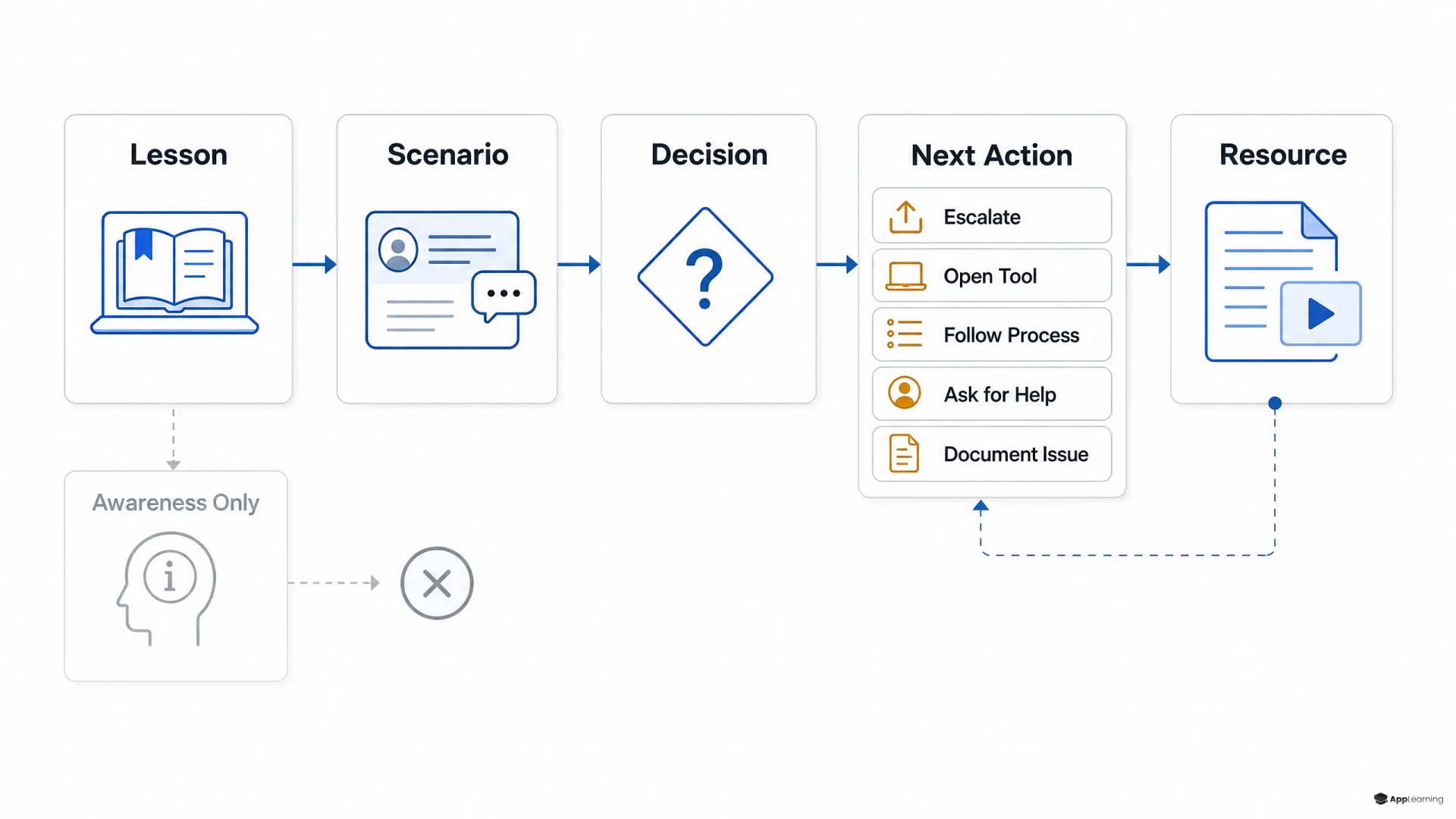
Useful training describes what to do after recognition. NIST SP 800-50 Rev. 1 frames cybersecurity and privacy learning as a lifecycle that should encourage behavior change and use metrics for improvement. That aligns with a simple design rule for compliance training and product training: every module should end with an operational verb.
- Escalate a suspected breach to the named channel.
- Open the case management or monitoring tool.
- Follow the correct KYC, AML, or incident checklist.
- Ask the right internal expert before proceeding.
- Document the issue with the required evidence.
- Pause an action until a control step is complete.
A clear next action has three parts: a trigger, a destination, and an owner. The trigger tells the learner when to act. The destination tells them where to go. The owner tells them who holds the decision. If a module cannot name those three things, it is not ready to publish.
Scenarios make judgment visible
People often know a policy in the abstract and fail at the boundary case. Scenario-based training closes that gap by making the learner choose under realistic conditions. The Association for Talent Development recommends scenario-based approaches for tasks that involve decision making and critical thinking. In an AML module, that could mean a client who refuses source-of-funds evidence. In a product-risk module, it could mean a feature request that creates a reporting obligation.
The point is not to catch people out. It is to expose risk before work is live. A good scenario shows wrong confidence, slow escalation, unclear ownership, or confusion between similar processes. That gives L&D and compliance teams a stronger signal than completion alone.
Good to know
Does every training module need a next action?
Yes, if the module is meant to change operational behavior. Pure announcements may only need awareness, but compliance, onboarding, product, and risk training should point to the next step.
What makes a scenario question useful?
It should use a realistic trigger, plausible wrong answers, consequence-based feedback, and a link to the process the learner would use at work.
How can L&D measure readiness beyond completions?
Track scenario decisions, repeated errors, resource use, confidence gaps, manager follow-up, and whether learners know where to escalate.
Where should internal resources sit in an LMS module?
Place them beside the decision point, not only at the end. The learner should be able to open the right tool, policy, checklist, or escalation channel immediately.
Resources belong at the point of need
A policy link at the end of a course is a library gesture. Useful LMS design places resources beside the decision. If a question asks learners to identify a market-abuse red flag, the relevant policy, escalation inbox, and case template should be one click away.
The National Academies’ learning research emphasizes transfer and use of learning, which is the same operational logic applied to employee readiness. Learning content should sit close to the environment where it will be used. In an internal training LMS, that means job aids inside modules, not hidden in a document repository that nobody searches during a live case.
Build training that ends in action.
TalkReadiness becomes a design constraint
At App-Learning, we use a compact pattern: explain the concept, test judgment with a scenario, route the role to the next step, and measure follow-up. In one compliance-oriented academy design, short lessons were paired with scenario checks and a practical next-step resource. The module did not stop at “be aware.” It showed how to act when the signal appeared.
Role-specific paths matter. A relationship manager, operations analyst, and product owner may need the same policy knowledge, but not the same next action. The relationship manager may need to pause a client interaction. Operations may need to enrich a case. Product may need to involve legal before release. One generic module cannot carry all of that cleanly.
Action-oriented training changes the measurement conversation. Completion remains necessary, especially in regulated environments. But it should sit beside better indicators: scenario accuracy, repeated wrong-answer patterns, resource opens, confidence gaps, and manager follow-up. Those signals show where the system is ready and where it is only documented.
The standard for training should be plain. If a learner finishes and only remembers the topic, the module has created awareness. If the learner finishes and knows the next action, the right resource, and the point of escalation, the module has created usable readiness. That is the difference between training content and a learning system that supports work.