

Key takeaways
- Learning outcomes and conversion goals need separate design and measurement paths.
- Conflicts of interest should be visible in workflows, ownership, and disclosures.
- Sources, reviews, and versions turn educational integrity into an auditable system.
- Neutral education can improve activation without becoming disguised product promotion.
Learning and selling now share the same screen
Fintech education often sits inside the activation journey. A user learns what yield, custody, leverage, repayment or volatility means, then sees a route into the product. That can reduce confusion and support better decisions. It also creates a financial education conflict of interest when the learning flow quietly narrows the answer to the provider’s commercial offer.
The risk does not require bad intent. It appears when the success metric for an education module is only conversion, when risks receive less space than benefits, or when alternatives disappear from the lesson. Users may still complete the flow, but customer education trust falls when they later see that education was a sales funnel with softer language.
A voluntary code sets a firmer direction
The European Commission’s July 2026 initiative is developing a voluntary code of conduct for private and not-for-profit financial-literacy providers. On August 9, 2026, the code is still in development, with adoption expected in the first quarter of 2027. Its stated direction is clear: transparent objectives, accurate and unbiased content, and safeguards against conflicts of interest.
Initiatives have transparent objectives, offer accurate and unbiased content, and include safeguards to mitigate conflicts of interest.
This is not yet a new binding compliance rule. It is a strong signal about the standard providers will increasingly be expected to meet. For fintechs, fintech education compliance should not be treated as a final legal check on a finished lesson. It should shape the product system that creates, approves, releases and measures learning content.
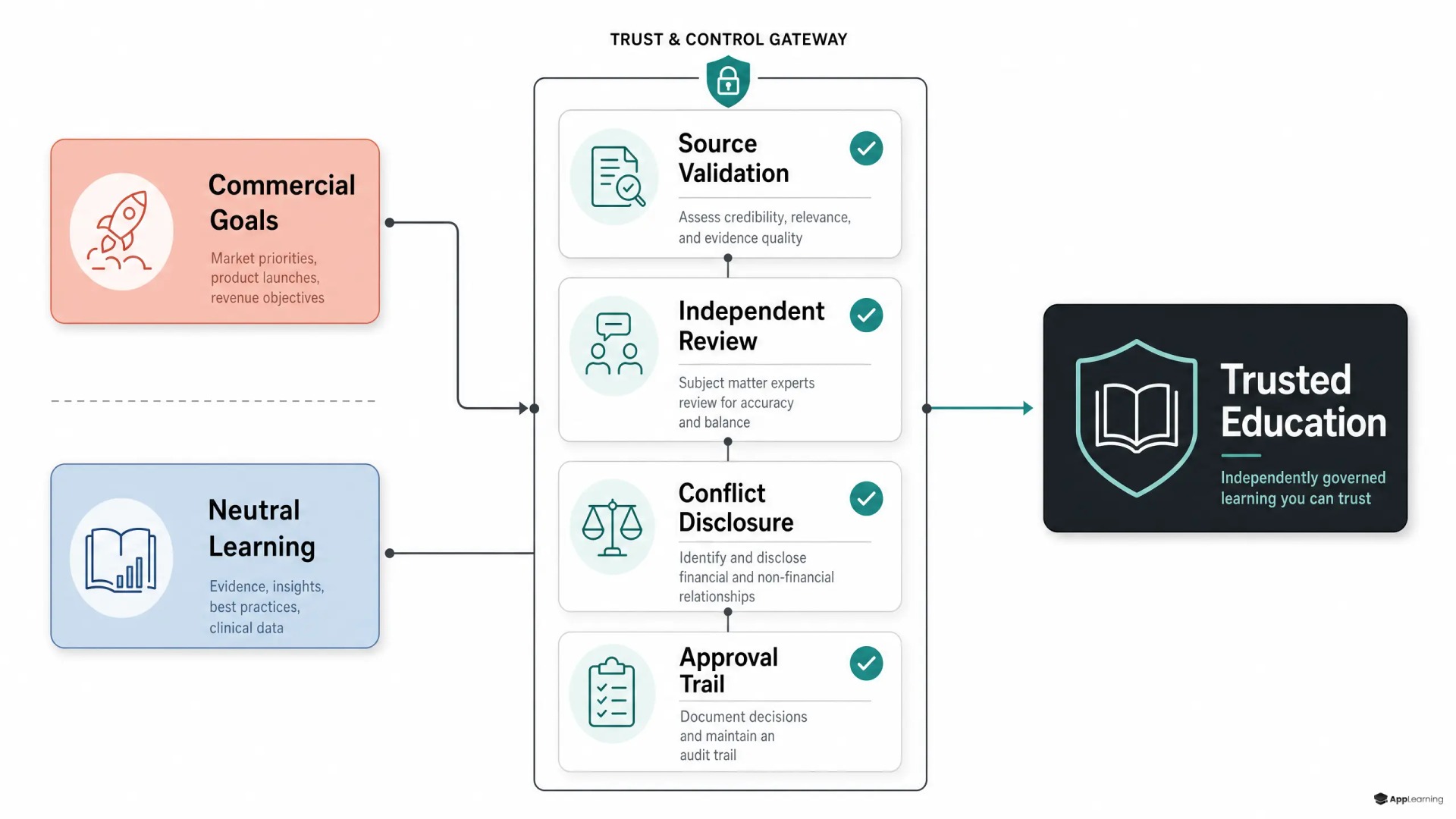
Guardrails belong in the content operating system
Financial literacy governance works when the evidence of integrity is built into the workflow. A module should have a defined learner outcome, not a vague brief to “drive feature adoption.” The EU and OECD financial competence framework for adults offers a useful reference point because it focuses on the capabilities people need to make sound personal-finance decisions.
- Set a learning objective that names the capability a user should gain, such as comparing risk, cost, liquidity or repayment outcomes.
- Classify each screen as neutral education, product information or promotion, then apply different approval rules to each.
- Attach structured source fields to claims, including source owner, jurisdiction, publication date and review date.
- Assign accountable roles for authoring, product accuracy, compliance review and final release approval.
- Maintain version history, conflict disclosures and a record of material changes so teams can explain what users saw and why.
This structure also prevents a common failure: using education as a substitute for regulated information. Where a journey covers an investment product, the EU PRIIPs framework requires clear key information documents, including risks, costs and complaint routes. Educational content can improve comprehension, but it cannot replace the required product disclosure.
Good to know
Is the EU financial-literacy code of conduct already in force?
No. The Commission’s July 2026 announcement describes a voluntary code that is being developed through stakeholder roundtables and is expected in the first quarter of 2027.
What should a fintech disclose in educational content?
Disclose the provider behind the content, the purpose of the module, any product relationship, and material limitations. The disclosure should appear where the user makes sense of the content, not only in terms and conditions.
Can neutral education still improve activation?
Yes. Neutral education can reduce uncertainty, prepare users for complex actions and direct them to the right next step. Activation should follow demonstrated understanding, not replace it as the only outcome.
Who should approve financial education modules?
Use clear role ownership. Content specialists should own learning design, product experts should validate product facts, compliance or legal reviewers should assess regulated claims and disclosures, and one accountable release owner should approve publication.
Commercial value survives a cleaner boundary
Neutrality does not mean removing commercial value. It means sequencing it properly. Teach the concept before the offer. Explain trade-offs before the call to action. Let users test their understanding before they commit money or enable a complex feature. This produces a better activation path because users reach the product with a clearer mental model, rather than with a short-lived response to persuasive copy.
- Teach the category through risks, constraints, terms and realistic alternatives.
- Present the provider’s product in a clearly labelled product-information or promotional layer.
- Use knowledge checks to identify gaps, then guide users to the next suitable learning step or product action.
- Measure understanding, confidence, support deflection and sustained feature use alongside activation.
Build education users can trust and teams can govern.
ConnectGoverned education can scale inside the product
App-Learning can serve as the governed layer between financial expertise, compliance and the in-app experience. Structured sources, role-based approvals, version control and multilingual content workflows make unbiased financial education easier to maintain across markets. Knowledge checks and learning analytics then show where users misunderstand a concept, where a journey creates friction and which content needs revision.
The important design choice is separation with continuity. Learning should feel native to the product journey, but its objectives, evidence and approval path must remain visible and distinct from sales messaging. That is how a fintech turns financial literacy from a conversion tactic into a durable trust system.