

Key takeaways
- Digital adoption platforms guide tasks but do not always build understanding.
- Complex Bitcoin onboarding needs explanation before users are ready to act.
- Trust grows through staged education, not just better UI prompts.
- Measure task completion and customer understanding as separate signals.
The boundary of interface guidance
A digital adoption platform is useful when the user already understands the job and only needs help completing it. A prompt can point to the right button, explain a required field, or keep a multi-step flow moving. That removes interface friction.
But many onboarding failures are not navigation failures. A new Bitcoin customer may know how to tap “Buy,” yet still hesitate because they do not understand custody, volatility, transaction finality, identity checks, or what happens if they lose access. The European Supervisory Authorities’ consumer warning makes the point plainly: crypto-asset features and risks can be difficult to understand, while consumer protection may be limited depending on the asset and provider.
Guiding the next click is helpful. It is not the same as helping a customer make sense of the decision behind that click.
Overlays cannot supply the missing mental model
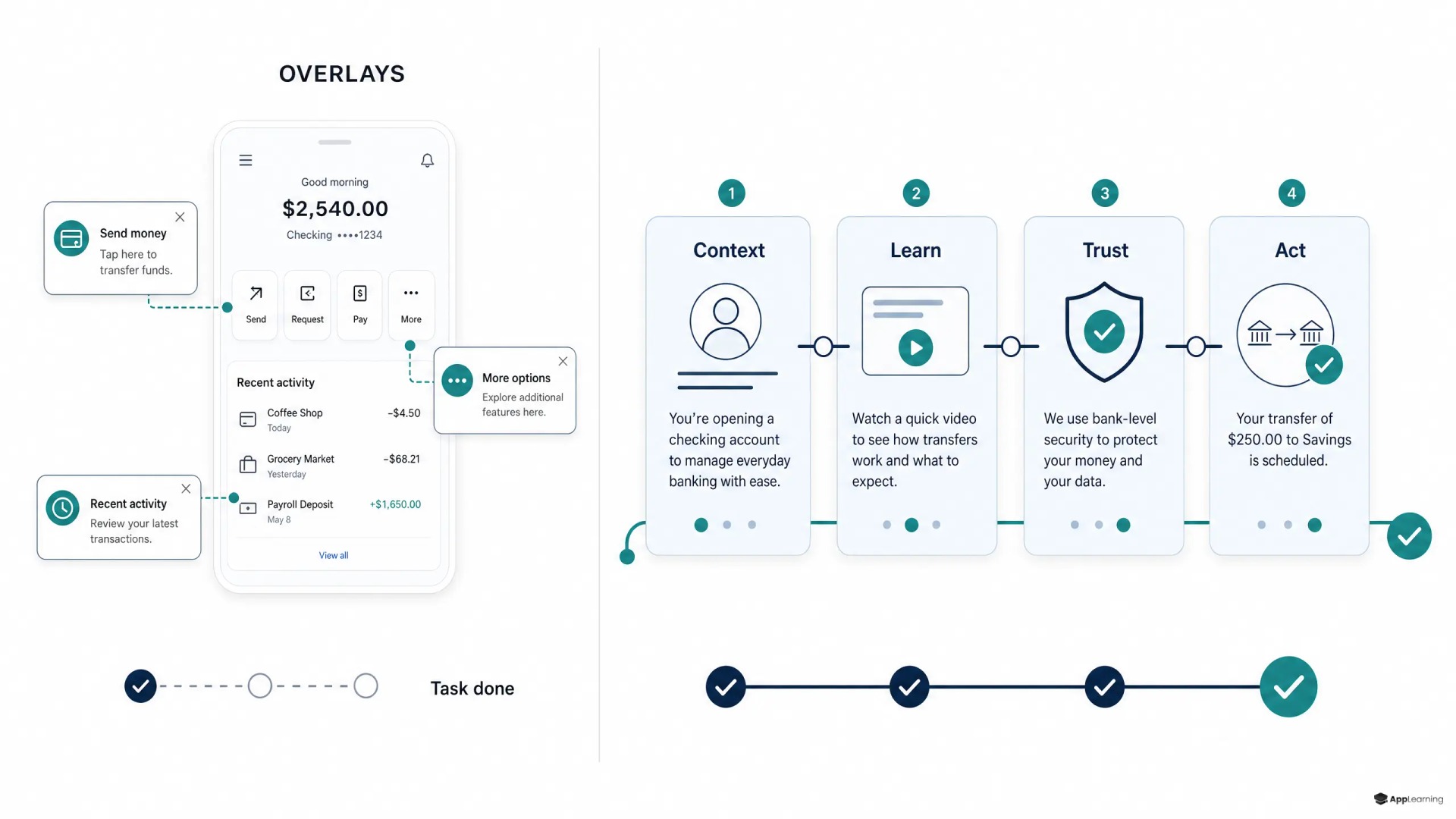
Walkthroughs work best when the product is familiar and the path is clear. They struggle when users must form a mental model before a task has meaning. An overlay can show where a wallet setting lives. It cannot, by itself, explain the trade-off between custodial convenience and self-custody responsibility in a way a first-time customer can retain and apply later.
This matters because Bitcoin onboarding carries consequences beyond a single screen. The CFPB’s analysis of crypto-asset complaints identifies fraud, theft, hacks, frozen accounts, and problems accessing assets as recurring customer issues. A product team should not try to hide those stakes behind a frictionless tour. It should explain the relevant choices clearly, at the moment customers need to make them.
- Task guidance answers where to click and what to enter.
- Customer education answers what the action means and why it matters.
- Trust-building answers what can go wrong and how the customer stays in control.
Confidence needs to be built in stages
For unfamiliar or regulated products, education should be part of the journey rather than a help-centre destination. The customer needs a small amount of context before an action, practical guidance while completing it, and reinforcement after it.
A strong sequence might explain why verification is required before asking for documents. It might clarify the difference between a one-time purchase and a recurring buy before presenting a savings plan. It might introduce backup and recovery concepts before a user enables wallet features. Each lesson should prepare the next decision, not overload the user with a course at registration.
This is also where lightweight interaction helps. A short scenario, confidence check, or quiz can reveal whether a customer understands a concept. The goal is not to turn onboarding into a game for its own sake. It is to surface uncertainty before it becomes abandonment, a support ticket, or an action the customer later regrets.
Activation is larger than completed onboarding
A customer who passes KYC and completes a first purchase is not automatically activated. In a Bitcoin product, durable activation often means that the customer understands the product well enough to return, use the relevant features, and make decisions without fear-driven hesitation.
That changes how teams design and measure onboarding. Product analytics should track completion and time to task, but they should also track knowledge signals, repeated help requests, confidence checkpoints, and adoption of the next meaningful feature. A clean funnel can still conceal a weak understanding layer.
The practical design principle is simple: remove accidental friction from the interface, but preserve the moments of reflection that a consequential decision deserves.
Good to know
When is a digital adoption platform enough for onboarding?
It is often enough when users understand the product and only need help finding controls, completing fields, or following a known workflow.
What should education cover in Bitcoin onboarding?
Start with the concepts required for the next decision, such as verification, risk, custody, security, purchases, and recovery. Keep each lesson tied to a real product moment.
Should customer education replace compliance disclosures?
No. Education can make concepts clearer, but it should complement required disclosures, suitability processes, and risk communication rather than replace them.
Diagnosing the real onboarding failure
Before adding more tours, teams should separate guidance problems from understanding problems. The distinction prevents a common mistake: treating every drop-off as a UI issue and responding with more prompts.
- Treat it as a guidance problem when customers cannot find controls, misunderstand field labels, or lose their place in a process.
- Treat it as an understanding problem when customers ask basic concept questions, stop before a high-stakes choice, or avoid features after initial setup.
- Treat it as both when customers need a clearer path and enough context to trust that path.
- Instrument both layers with task data, learning progress, confidence checks, and support-contact themes.
The answer may include a digital adoption platform. It may also require better product copy, revised risk communication, or structured education. The point is to match the intervention to the actual barrier.
Build onboarding that turns Bitcoin complexity into customer confidence.
TalkA broader education layer for Bitcoin products
App-Learning fits where a team needs more than interface prompts. It provides an embedded customer education layer that can combine modular Bitcoin learning, contextual triggers, branded mobile-first experiences, quizzes, progress signals, and localized content. A digital adoption platform can still handle interface guidance; the education layer supplies the context that makes those guided actions meaningful.
This model also gives product, growth, and compliance teams a clearer operating boundary. Product teams can focus on the core experience. Education can be maintained as a reusable system that supports new features, new markets, and different levels of customer knowledge without rebuilding the same explanations each time.
The goal is not to make a consequential Bitcoin decision feel effortless. It is to make it intelligible. When customers understand the product, the risks, and the next step, onboarding becomes a route to informed confidence rather than a sequence of clicks.