

Key takeaways
- LMS tools can serve external audiences, but many operating models begin with internal training.
- Customer education platforms optimize learning around activation, trust, and continued product use.
- Brand, login friction, product context, and lifecycle data determine the better fit.
- App-Learning fits fintech teams that need customer education to support activation and retention.
The learner changes the platform decision
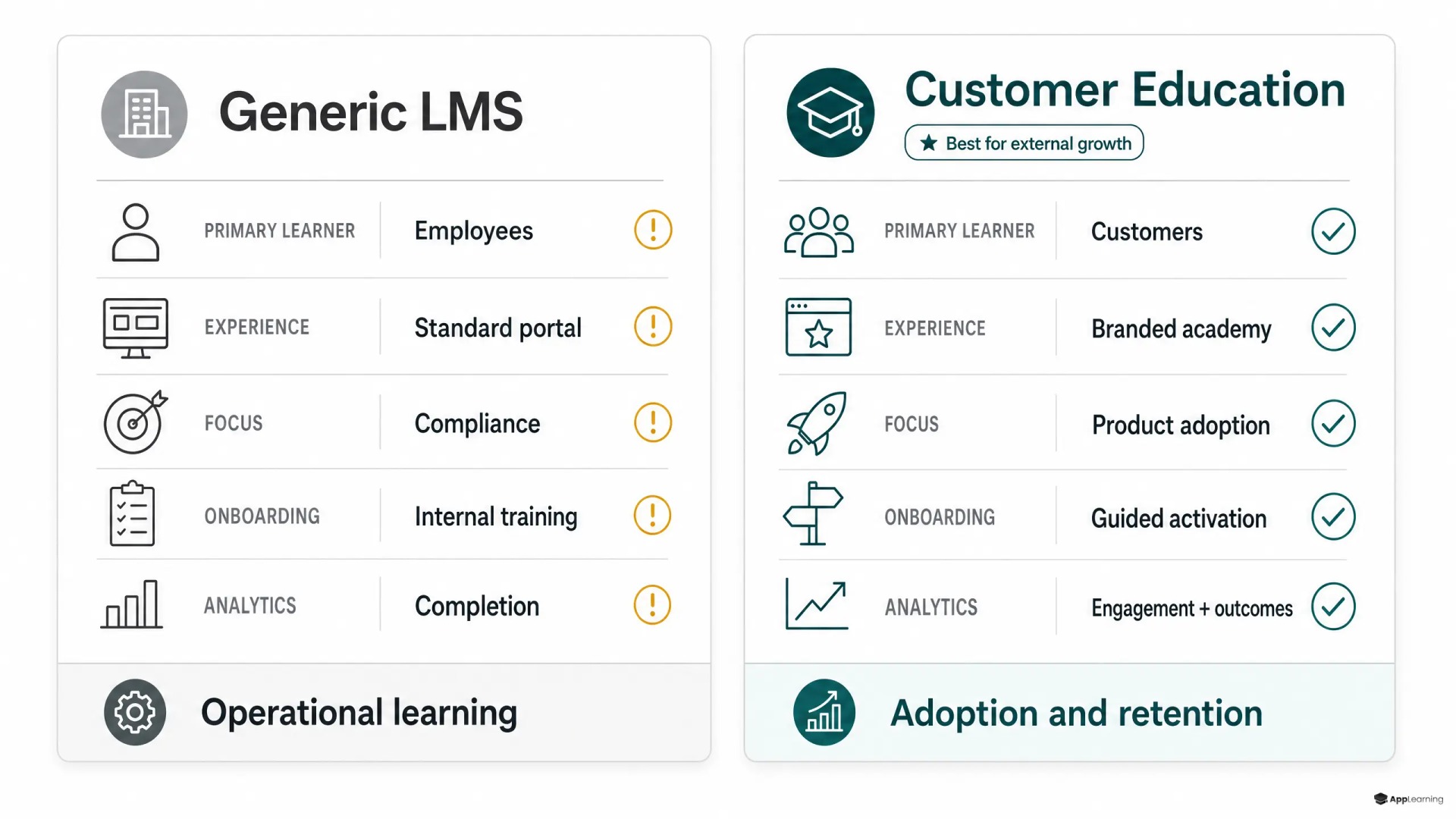
The customer education platform vs LMS debate is often framed as a feature comparison. That is too shallow. Both systems can host courses, assign learning paths, issue certificates, and report completion. The real decision starts with the learner and the operating goal. Employees are part of a managed workforce. Customers are voluntary learners who may leave before they understand why the product matters.
An LMS is a learning management system: a system for organizing, delivering, administering, and measuring training. It is not limited to employee learning. For example, Docebo’s platform documentation describes internal training alongside customer, partner, and reseller learning, while LearnUpon’s API documentation similarly covers employees, partners, and customers. The category boundary is therefore not absolute. The difference lies in what the platform and team optimize first.
Internal training runs on management structures
A conventional LMS often starts from internal training assumptions. Learners have company identities. Managers can assign courses. Compliance deadlines create urgency. HRIS groups, departments, roles, and completion reports shape the system. This makes an LMS a strong choice for employee onboarding, recurring compliance, internal product knowledge, and regulated role readiness.
Customer learning works under different conditions. A fintech user may arrive through onboarding, an email, a support article, or a prompt after abandoning a deposit flow. They do not care about a course catalog. They need a clear answer at the moment confusion blocks progress: what this feature does, what risks apply, and what to do next.
That is why customer education software must act more like part of the product journey than a separate training portal. It needs low-friction access, useful content for distinct user states, and a clear connection between learning activity and product behaviour. Skilljar’s customer onboarding guidance makes the same practical point: complex products and large customer bases need scalable, self-paced education to support adoption and ongoing use.
External learning needs a product-grade experience
In an LMS vs customer education platform comparison, external learner experience carries more weight than it does for internal training. Customers judge the academy against your app, website, and support experience. A generic login, dated interface, or detached content library can signal that learning is an afterthought. In fintech, that gap also weakens trust when users are trying to understand money movement, security, custody, risk, or account limits.
The platform should therefore support a branded environment, single sign-on or deep links, role-based paths, mobile access, and fast content updates. LearnUpon Anywhere illustrates the principle through embedded courses and SSO, which remove the additional login step between a digital product and the learning experience.
Adoption analytics must go beyond completion
Completion is useful, but it is not the outcome. A customer may finish a lesson on bank transfers and still fail to make a first deposit. A strong customer education platform connects learning data with the product and lifecycle stack, so Product, Growth, CX, and Content can test whether education improves time to first value, feature activation, support deflection, or retention.
Skilljar’s implementation guidance recommends tying training to activation and usage, time to value, adoption depth, retention, and support efficiency rather than reporting completions alone. That is the right measurement model for fintech education. Treat each learning path as a product intervention with a target behaviour, not as content published for its own sake.
Good to know
Can an LMS be used for customer education?
Yes. Many LMS platforms support customer and partner training. The key question is whether its learner experience, integrations, branding, and analytics suit an external adoption use case rather than an internal training operation.
What is the main difference between a customer education platform and an LMS?
The main difference is the operating focus. An LMS often emphasizes administration, assignment, compliance, and workforce reporting. A customer education platform emphasizes external access, product understanding, lifecycle engagement, and adoption outcomes.
When should a fintech company use customer education software?
Use it when product complexity, trust requirements, or onboarding friction prevent users from reaching value. Start with the moments that block activation, such as identity verification, first funding, wallet setup, security, or feature discovery.
How should teams measure customer education impact?
Track learning progress alongside product behaviour. Useful measures include time to first value, successful completion of a target action, feature adoption, repeat usage, relevant support contacts, and retention by trained versus untrained cohorts.
Where App-Learning fits
App-Learning fits the branded academy model when customer education must support activation, trust, and retention in a complex product. Its academy platform supports external customer education alongside internal learning, with branded academies, role-based paths, microlearning modules, quizzes, certificates, analytics, single sign-on, deep links, and embeds.
The operational advantage is not simply having more learning features. It is being able to turn product releases, compliance updates, support patterns, and lifecycle moments into short, reviewable learning modules. A user who has not completed KYC needs a different path from a user exploring a wallet, a card, or an investment product. The academy should make those distinctions easy to publish, measure, and improve.
Build a branded academy around the product moments that matter most.
Talk to usA practical choice framework
Choose a general LMS when the primary job is governed internal training. Choose a customer education platform when the primary job is helping external users reach value and stay engaged with the product.
- Choose an LMS when employee onboarding, compliance evidence, manager oversight, and workforce reporting lead the requirements.
- Choose a customer education platform when customers, partners, or community members are the main learners and product adoption is the business outcome.
- Prioritize branded access and product-adjacent delivery when trust and friction affect customer engagement.
- Require integrations or exportable data when you need to compare learning progress with activation, feature use, support demand, or retention.
- Start with one high-friction product moment, then expand the academy only after the learning path proves useful.
The best platform is not the one with the longest feature list. It is the one that matches the behaviour you need to change. For a fintech team, education becomes a growth lever when it helps users understand the product before uncertainty turns into abandonment, and when the team can prove that learning moved a meaningful product outcome.