

Key takeaways
- Completion records are necessary but rarely prove usable understanding.
- Role-based scenarios create stronger evidence than one-size-fits-all courses.
- Version control and reassignment workflows matter when obligations change.
- A compliance LMS should connect learning data to audit and remediation processes.
- App-Learning suits regulated teams that need understandable, measurable compliance education.
The system behind the completion record
The compliance training software vs LMS decision is often framed as a feature comparison. That misses the operating problem. Both systems can host courses, assign learners, send reminders, and report completion. A general LMS is built to manage learning across many subjects. Compliance training software is built to run a control: identify who needs to know what, deliver the right version, assess whether they can apply it, and retain evidence for review.
A compliance LMS can be enough when risk is low, content changes slowly, and a completion record is the only required output. Regulated finance and crypto teams face a harder standard. They need learning records that map to roles, policies, risks, versions, assessment outcomes, and remediation.
Completion is an administrative event
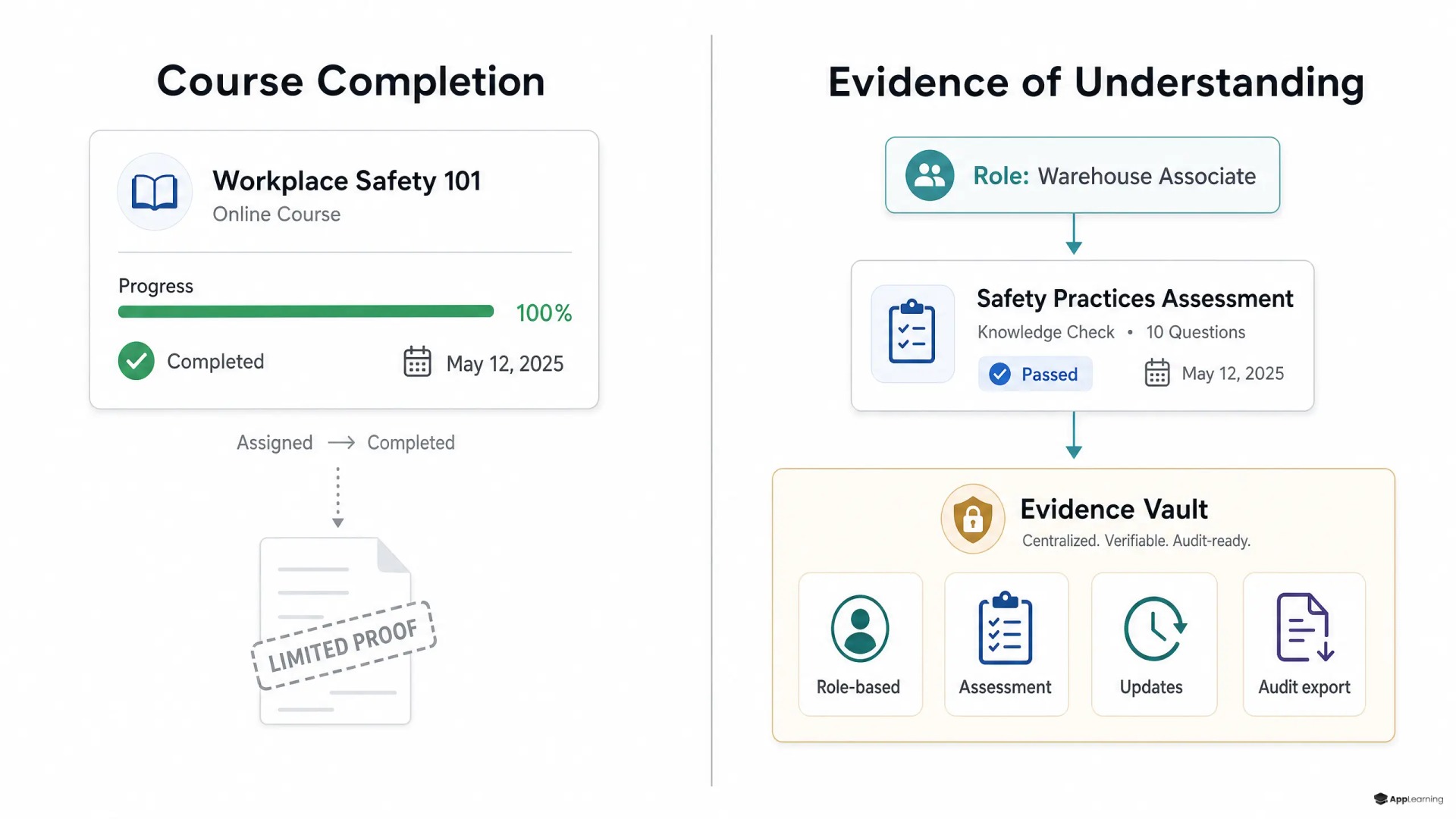
A completed module proves that a person reached the end of an assigned learning path. It does not, by itself, show that they understood a control, recognised an escalation trigger, or can make the right decision under pressure. That distinction matters when training is part of the organisation’s risk-management system rather than an annual HR task.
Under Article 13(6) of DORA, financial entities must make ICT security awareness and digital operational-resilience training compulsory, cover employees and senior management, and match complexity to each person’s remit. The requirement points beyond blanket completion. A generic phishing lesson may suit the whole workforce; an incident commander, a developer with privileged access, and a customer-facing adviser need different practice and different evidence.
Evidence has to match the risk
Stronger evidence starts with an explicit claim. What must this role be able to do after training? The answer may be to spot suspicious activity, protect client information, escalate an ICT incident, apply a suitability rule, or explain a crypto-asset risk without misleading a customer. The assessment should test that decision in a realistic context.
- Assignment evidence showing who was required to complete which learning path
- Version evidence showing the policy or rule set used at the time
- Assessment evidence showing attempts, scores, decision points, and pass thresholds
- Remediation evidence showing how failed or overdue learners were handled
- Reporting evidence that can be filtered by role, entity, location, manager, and control owner
This does not mean every policy needs a long exam. It means the depth of the learning and the evidence should be proportionate to the risk. In payments, the EBA security-measures guidelines call for staff training aligned to duties and responsibilities, plus targeted training for key roles. A single course and a single completion field cannot express that distinction well.
Role relevance turns policy into judgment
Most compliance content begins as policy text. Employees experience it as a series of decisions made in real workflows. The job of a compliance training platform is to close that gap. It should place the learner in situations they recognise, ask them to choose an action, explain the consequence, and record whether they can apply the required rule.
For a bank, that may mean separating frontline conduct scenarios from operational-resilience tasks and management accountability. For a crypto-asset service provider, it may mean teaching staff how volatility, custody, fraud, conflicts, and cyber risk change the information they provide to clients. ESMA’s MiCA knowledge-and-competence guidelines reinforce this focus by setting criteria for assessing the relevant staff’s knowledge and competence.
This is where App-Learning has a practical role. Short, interactive learning sequences can turn dense obligations into role-specific decisions without reducing the seriousness of the subject. The useful unit is not a policy summary. It is a repeatable decision exercise connected to a real risk.
Good to know
Can an LMS be used for compliance training?
Yes. An LMS can manage mandatory assignments, course delivery, reminders, and completion reporting. It becomes insufficient when regulated teams need role-based evidence, controlled updates, assessment depth, remediation workflows, and audit-ready reporting that are difficult to configure or maintain.
What evidence should compliance training produce?
At minimum, retain learner identity, assignment logic, content version, completion date, assessment result, pass threshold, and any remediation action. The evidence should match the risk and the learner’s role rather than apply the same standard to every subject.
How does DORA affect compliance training design?
DORA Article 13(6) requires compulsory ICT security-awareness and digital operational-resilience training for employees and senior management, with complexity proportionate to their functions. That makes role relevance and evidence of understanding central design requirements.
Updates are part of the control
Compliance content expires faster than conventional learning content. A new regulation, revised internal policy, audit finding, product launch, or incident may require an immediate change. The relevant question is not whether an administrator can upload a new file. It is whether the system can identify affected roles, publish a controlled version, reassign only the necessary learning, preserve the old record, and show the current control status.
Reporting should support this workflow rather than sit at the end of it. Compliance and L&D teams need a shared view of coverage, overdue risk, failed assessments, repeat failures, exemptions, and manager follow-up. That creates a workable link between learning operations and assurance.
Build compliance learning that produces evidence people can use.
TalkThe buyer checklist that exposes weak systems
Use this checklist when comparing compliance training software with an LMS. It shifts the buying conversation from course delivery to control design.
- Can we assign different learning and assessment paths by role, risk exposure, entity, and responsibility?
- Can we prove which content version each learner received and when?
- Can assessments test decisions and trigger targeted remediation after failure?
- Can control owners export clear evidence without building manual spreadsheets?
- Can we update, reassign, and report on changed obligations within days rather than months?
- Can the same platform support mandatory compliance learning and broader capability building without fragmenting the learner experience?
The best choice is not automatically a specialist platform or an enterprise LMS. It is the system that gives your organisation the right level of control, evidence, and speed for its risks. In regulated environments, learning is not complete when the course is finished. It is complete when the organisation can show that the right people understood what to do and can act on it.